
Motorcycle specifications BMWR 1300 GS 2024 Youthfulness and dynamism


presentation of the R 1300 GS 2024
The new BMW R 1300 GS is here, hallelujah! From the very first glance, the uppercut is violent: BMW Motorrad has not contented itself with a gentle evolution of its best-seller, so as not to confuse aficionados of this iconic model. We're talking about the world's best-selling large-displacement motorcycle in 2022! Last year, the propeller-driven brand sold over 60,000 units of the R 1250 GS in all versions. That's more than a third of their total motorcycle production! Reinventing such a motorcycle is no mean feat. And yet, the new R1300GS makes a clean break with the styling of its predecessors. From its more aggressive, resolutely slimmed-down silhouette to its ultra-futuristic X-shaped optics, the new GS takes an unprecedented stylistic direction.
Is this a crisis of youth for a brand celebrating its 100th anniversary, or a bold risk-taking backed by even greater dynamic qualities? Only time will tell... For now, the eagerly-awaited new R 1300 GS arrives in the spotlight of the world's press, under the watchful eyes of the competition and the avid gaze of enthusiasts - and non-enthusiasts alike - with its long history, impressive sales figures and unquestioned dynamic qualities.
Flashback: where do you come from R 1300 GS?
In the spring of 1977, BMW began to think seriously about developing an off-road motorcycle powered by its unmistakable flat-twin. In January 1980, two prototypes embarked on 2,200 km of extreme testing in South America. The R 80 G/S was ready!
In 2004, with the arrival of the R 1200 GS, which took over from the R 100 GS (1987), R 1100 GS (1994) and R 1150 GS (1999), the big German trail bike definitively established itself as the benchmark for the genre, and quite simply as the best motorcycle in the world, according to many specialists. After treating itself to a double overhead camshaft cylinder head in 2007, its flat engine switched to liquid cooling in 2013. Six years later, in 2019, its displacement, long confined to 1,169.6 cm3 (bore x stroke: 101 x 73 mm) climbs to 1,254 cm3 (102.5 x 76 mm). The new engine also features ShiftCam technology, which allows you to vary the timing and lift of the intake valves. With 14.58 mkg of torque and 136 hp of power, the GS's flat engine has never performed better.
![BMW R 1300 GS]()
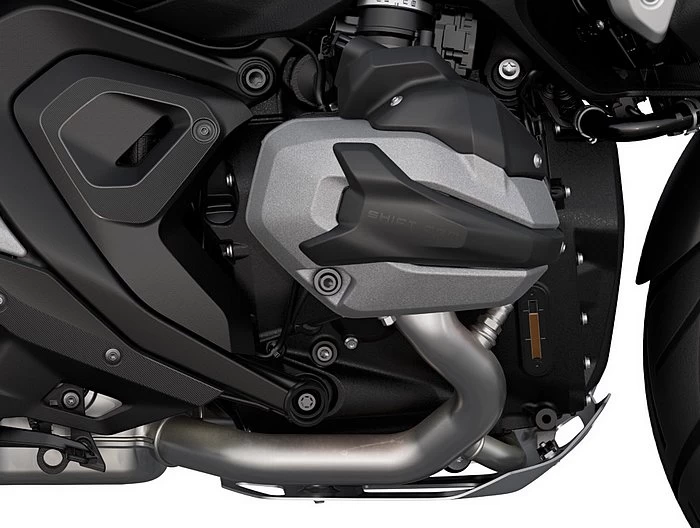
Forty-three years after its birth, the bike whose initials stand for Gelände/Straße reinvents itself once again. From 797 cm3 at birth, the flat-twin it has never abandoned has now grown to exactly 1300 cm3 (106.5 x 73 mm), becoming even more super-square. By increasing the diameter of its pistons, but reducing their stroke, the flat promises even sharper and faster revs. This allows the intake valve diameters to increase, from 40 to 44 mm at the inlet and from 34 to 35.6 mm at the exhaust, further optimizing flow. In terms of performance, the flat-twin engine gains 9 hp to reach 145 hp at 7,750 rpm (unchanged revs). Maximum torque is up by 6 Nm (0.6 mkg) to a promising 149 Nm (15.18 mkg) at 6,500 rpm, 250 rpm later.
While on a sports bike, the race for maximum power is obvious, on a big trail bike of this calibre, it seems somewhat out of place. And yet, how can you imagine a manufacturer today announcing a drop in performance on its big new model? It's not easy... With its new R 1300 GS, BMW can now boast the most powerful production boxer engine ever! This new flat-twin, with its new camshaft layout, adds a detonation sensor to the famous ShiftCam variable valve timing to optimize power control.
Featuring a new camshaft layout, this new flat-twin adds a detonation sensor to the famous ShiftCam variable valve timing system to optimize injection control and deliver even greater riding pleasure. Despite its larger displacement, the new flat-twin is more compact. Its gearbox is also located under the engine.
![BMW R 1300 GS]()
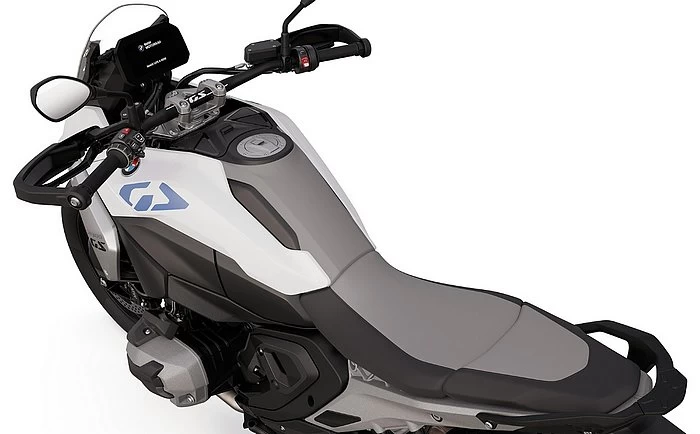
On the chassis side, the revolution is even more visible. While the main frame remains in steel, but with reworked and increased rigidity, the tubular steel trellis rear end, which played a major part in the very raw aesthetic signature of the R 1200 and R 1250 GS, gives way to a die-cast aluminum rear end. Combined with a flatter fuel tank, the overall lines of the R1300GS are a radical departure from those of its predecessor, becoming slimmer, longer and more modern. Perhaps too much, at first glance, for some who are very attached to what the big GS is and represents. Already, comments are pouring in from specialists, professionals, enthusiasts and non-enthusiasts alike, who, as ever, are giving free rein to their good intentions: from "it looks like a BMW G 310 GS" to "finally an RGS I like", from "more elegant" to "the headlight spoils everything", the 1300 leaves no one indifferent.
More in line with the latest aesthetic canons, with its all-new Matrix X-shaped optical signature, the GS creates a sensation: it's love at first sight, or hate at first sight. Whatever the case, as with many iconic motorcycles when they evolve, there's first of all a necessary adaptation period. The first negative opinions can be tempered by looking at it. Then there's the image phase, when you finally see it for real. Perceptions can often change, with volume, size, finish and perceived quality tipping the balance in one direction or another. Then comes the most important part of all: the test drive. A pumpkin that's fun to drive can very quickly turn into a coach. Once you've shared a stretch of road together, felt your soul on the handlebars, experienced the sensations, whether strong or gentle, your outlook inevitably changes. Don't we look at our bikes differently when we look at them with coffee in hand after a great ride? There's no doubt that the R 1300 GS won't miss this opportunity, as the list of dynamic improvements is still long.

The R 1300 GS marks a radical change in design from the R 1250 GS
Lighter: - 12 kg!
Starting with the fact that, in addition to a 9hp increase in power, it loses 12kg on the scales, with an unladen kerb weight of 237kg. For the first time since 2004, the GS loses weight, dropping one kilogram below the 238 kg of the 2013 model. It is now the lightest model in its segment. With less weight and more power, it's even more dynamic overall! Agility and liveliness when changing direction and angle should benefit from this slimming down, compensating for the longer wheelbase (from 1,514 to 1,518 mm) and more open front axle geometry (from 100.6 mm of headroom and 25.7° of column angle to 112 mm and 26.2°), the latter designed to increase overall stability.
The highly personal front and rear wheel steering systems have also been optimized. Now called EVO Telever and EVO Paralever, they offer, according to the press kit, "enhanced steering precision and stability". Available as an option, the R 1250 GS's Dynamic ESA Next Generation electronic suspension adjustment system is now called DSA, for Dynamic Suspension Adjustment, the difference being that the system, which acts on the front and rear hydraulic adjustments, no longer intervenes only on rear shock preload, but also on front shock preload. All this "depending on the steering mode selected, the driving conditions and the type of manoeuvre performed".
More equipment: some standard, many options...
The R 1300 GS also offers a host of technological refinements as standard, including four riding modes: Road, Rain, Eco and Enduro. It also features Engine Brake Torque Management (EBTM), Dynamic Brake Assist (DBA), Hill-Start Assist (HSA), Dynamic Traction Control (DTC) and ABS Pro Full Integral. A new Matrix LED headlamp and front turn signals integrated into the hand guards (watch out for the price of the drop!) are also standard. On the practical side, the R 1300 GS comes standard with a USB socket and 12V charging system on the handlebars, a familiar 6.5" TFT display, keyless ignition, a useful RDC system that continuously monitors tire pressure, BMW's emergency call system and heated grips.

Of course, the R 1300 GS doesn't break with tradition, as the list of options, accessories, equipment and packages of all kinds is long... and expensive. Of particular note is the bike's adaptive height adjustment, which allows the seat height to be reduced from 850 to 820 mm at standstill and when riding slowly. A Sport mode of suspension adjustment also makes its appearance. The optional Headlight Pro system illuminates the inside of the bend according to the bike's position. In terms of driving assistance, there's ACC (Active Cruise Control) with integrated braking function (is this really necessary on a motorcycle?); SWW (Lane Change Warning); FCW (Front Collision Warning). In terms of comfort, even the coldest riders will appreciate the heated rider and passenger seats. And so many other refinements available à la carte (blue!).
By card: blue, gold or Amex?
The new R 1300 GS is available in three distinct styles: the sporty GS Trophy, the sober Triple Black, both of which come with spoked wheels, and the chic Option 719 Tramuntana with gold-spoke wheels and various milled aluminum elements.
For the time being, the Adventure version remains in the catalog in its R 1250 GSA configuration. But the R 1300 GS Adventure will eventually replace it. Note that the new fuel tank on the R 1300 GS loses one liter of capacity (from 20 to 19 l), but retains its 4-liter reserve. Finally, travelers will have noticed that the original bubble has been transformed into a windscreen. Adjustable, of course, but it will be necessary to validate in action the new aerodynamic protection of this terminal devourer that is the GS.
Now starting at €20,690, or €800 more, the bill can quickly skyrocket as you dip into the options list. Just for fun, a full-option Triple Black model is listed at €32,265 on the official configurator available on the manufacturer's website. As with its predecessors, which have marked a real step forward in terms of dynamics... and pricing, the only limit to the R1300GS, in all areas, is you!

The highlights of the new BMW R 1300 GS at a glance:
The BMW R 1300 GS is already available to order, starting at 20,690 euros (outch...). The first customer deliveries will take place in early November 2023.
- Completely reworked boxer engine and BMW ShiftCam technology to adjust control times and intake valve lift.
- Gearbox located under the engine for greater compactness.
- BMW's most powerful boxer engine ever.
- Responsiveness across the entire engine speed range, exemplary fuel economy, low emissions, smooth running and top-level refinement.
- Power and torque: 145 hp (107 kW) at 7,750 rpm and 149 Nm at 6,500 rpm.
- Detonation sensors for optimal injection control and enhanced driving pleasure.
- Completely redesigned suspension with steel main frame and die-cast aluminum rear loop. Improved steering precision and stability thanks to the new EVO Telelever with flexible element and the reworked EVO Paralever rear wheel guidance system.
- 12 kg weight reduction compared to previous model.
- BMW Motorrad Full Integral ABS Pro as standard.
- Four driving modes as standard.
- Engine Brake Torque Regulation (EBTR), Dynamic Brake Assist (DBA) and Hill-Start Assist (HSC) as standard.
- Pro control modes with additional control modes available as options.
- DTC dynamic traction control as standard.
- Optional Electronic Dynamic Suspension Adjustment (DSA), with dynamic adjustment of damping, spring rate and load compensation.
- Adaptive height adjustment and sport suspension available as options.
- New Matrix LED headlamp as standard.
- Headlight Pro with optional adaptive cornering light.
- Hand guards with integrated indicators as standard.
- Lithium-ion battery with "Battery Guard" as standard (service available via the BMW Motorrad app).
- Dynamic Cruise Control (DCC) with braking function as standard.
- Pilot assistant with active cruise control (ACC),
- Optional Front Collision Warning (FCW) and Lane Change Warning (SWW) for safer driving.
- Smartphone charging compartment behind the handlebars with USB and 12V sockets as standard.
- Heated saddles for rider and passenger available as an option.
- Optional handlebar extensions up to 30 mm.
- Wide choice of optional seat heights.
- Connectivity: multifunction instrument cluster with 6.5" TFT color display offering a host of standard functions.
- RDC, Keyless Ride, heated grips as standard.
- Intelligent emergency call available as standard.
- Available in Triple Black, GS Trophy and Option 719 Tramuntana.
- Extensive range of optional equipment, genuine BMW Motorrad accessories and rider equipment.
Michaël Levivier -Manufacturer photos
by Greg

 Share
Share
Key facts BMW R 1300 GS (2024) : What you need to know before you buy
Prices
| Basic version | |
|---|---|
 France France |
20,690€
|
 Italy Italy |
21,300€
|
 United States United States |
$18,895
|
 Spain Spain |
21,750€
|


Performance
- Max speed : 235 km/h (146 mph) on the odometer
- 0-100 km/h acceleration : 3.39 s
- Average fuel consumption : 4.80 liters/100km (0.49 mpg)
-
Estimated range
: 396 km (246 miles)
Calculated range until tank is empty, not verified.

Specifications BMW R 1300 GS 2024
- Chassis
- Frame : Profile steel structure
- Fuel capacity : 19 liters (5.02 US gallons)
- Seat height : 850 mm (33.46 in)
- Length : 2,212 mm (87.09 in)
- Width : 1,000 mm (39.37 in)
- Min height : 1,430 mm (56.30 in)
- Wheelbase : 1,518 mm (59.76 in)
- Weight when fully loaded : 237 kg (522 lb)
- Front axle
- Telelever EVO fork Ø 37 mm, Wheel travel : 190 mm (7.48 in)
- Braking 2 discs Ø 310 mm (12.2 in), radial mounting, 4-piston caliper
- Front tire : 120 / 70 - 19 → Order this type of tire
- Pressure : 2.5 bar
- Transmission
- 6 stage gearbox , manual - optional shifter
- Secondary cardan shaft
- Rear axle
- EVO Paralever monoshock and monoboom, Wheel travel : 200 mm (7.87 in)
- Braking 1 disc Ø 285 mm (11.22 in), 2-piston caliper
- Rear tire : 170 / 60 - 17 → Order this type of tire
- Pressure : 2.9 bar
- Motor
- two-cylinder flat , 4 strokes
- Injection Ø 52 mm
- Cooling system : liquid
- 2 ACT, variable
- 4 valves per cylinder
- 1,300 cc
- 145 ch (143 hp) to 7,750 rpm
- 15.20 mkg to 6,500 rpm
- Power-to-weight ratio : approximately 1.54 kg/ch
- Weight / torque ratio : approximately 14.52 kg/mkg
- Compression : 13.3 : 1
- CO² emissions: 110 g/km
- Standard equipment
- Brake assist : ABS cornering désactivable
- Number of riding modes : 4
- TFT Full-Colour screen size: 16.51 cm (6.5 inches)
- Center stand
- Gear indicator
- Cruise control
- Bluetooth
- USB plug
- Hill Hold Control
- Keyless ignition
- Traction control
- Heated grips
- Radar system
- Anti-slip clutch
- Engine-brake control
- Tire pressure monitoring system
- Practical information





Maintenance
Due to defects in the injection molding process or mechanical damage to the sheath, moisture can penetrate the starting relay. This can lead to corrosion of the components/contacts inside the starting relay, causing functional failure. This corrosion can also lead to electrical leakage, causing components to overheat, creating a fire hazard.
Mounted Vario brand side panniers may not be properly secured and locked, and may fall onto the road while driving, creating a risk of injury.
Production dates: 2023-2024
Moisture can penetrate the right-hand combination switch and cause ignition failures such as stalling or failure of the delayed lighting functions. This increases the risk of accidents and injury.
Information source du rappelModels
2026


2025


2024


Used


Compare the R 1300 GS to its competitors
Price
Acceleration
Fuel consumption
Range
Torque
Power
Power-to-Weight ratio
Torque-to-Weight ratio
Speed
CO² emissions
FAQ Your frequently asked questions about the R 1300 GS 2024
- What is the power of the R 1300 GS 2024?
-
The R 1300 GS 2024 develops a power of 145 ch (143 hp)
- What is the torque of the R 1300 GS 2024?
-
The maximum torque of the R 1300 GS 2024 is 15.20 mkg to 6,500 rpm.
- What is the maximum speed of the R 1300 GS 2024?
-
The R 1300 GS 2024 is capable of reaching a top speed of 235 km/h (146 mph) on the odometer on the track.
- What is the weight of the R 1300 GS 2024?
-
The R 1300 GS 2024 has a a weight when fully loaded of 237 kg (522 lb).
- What is the fuel consumption of the R 1300 GS 2024?
-
Average fuel consumption is estimated at 4.80 l/100km (0.49 mpg) according to the WMTC cycle.
- QWhat is the seat height of the R 1300 GS 2024?
-
To ensure good accessibility, the R 1300 GS 2024 offers a minimum seat height of 850 mm (33.46 in).
- What is the price of the R 1300 GS 2024?
-
The price of the R 1300 GS 2024 is $18,895 in the United States. It is displayed at 20,690€ in France, at 21,300€ in Italy and at 21,750€ in Spain.
- What colors are available for the R 1300 GS 2024?
-
For the 2024 model year, the R 1300 GS is available in several colors: white, black, blue and green.
News
-
New motorcycle products for 2026

-
Bridgestone announces the RS12, its new road-race weapon.
-
Yamaha Race Like A Girl: Natalia Rivera in episode 5.
-
Bridgestone presents the Battlax V03, its new slick tire.
-
With Sartoria Meccanica, MV-Agusta aims to go beyond premium.
-
Upgrading the entire Bonneville family for 2026.
-
Metzeler unveils three new tires at EICMA.
-
World Superbike celebrates 70 years of Yamaha.
-
Exceptional: some thirty new Triumphs in 2026.
-
40.000 bikers for the Royal-Enfield "One Ride" 2025.



Bikers' reviews Leave a review - 27 reviews
But this will be my last BMW Moto ordered with all options in April 2024 delivered in early July 2024, but without the cases without the top case despite the options of supports included in various pack whose prices are to match BMW has been unable to deliver like many customers in the same case. Despite several emails and mail, nothing has been done ....!
Intolerable, disappointing, not worthy of a Premium brand that abuses its image My disappointment is without name Lamentable Rating : 4/5 Respond to Phil74
The look of the bike is more modern and tapered, so much so that it looks like a 700. It's easier to handle, both because of the bike's light weight and because it's lowered below 20km/h. The engine is smoother and has plenty of torque.
The engine is smoother and more torquey.
The windscreen doesn't cover enough (I'm 1.85m tall), whereas on the others I used givi.
Saddle a little too hard. Interesting gadget: blind spot warning. Rating : 3/5 Respond to Jim
And for the passenger? Rating : 4/5 Respond to Sxmx
Feedback on the handlebars improved (almost nil before) Extraordinary handling, it seems to have lost much more than 12kg, the masses are very very well distributed. Fabulous torques, power on hand, those that I missed on the old versions, without transforming the GS into a roadster. Improved wind protection, and comfort as good as ever, for two as well (tested with my partner) A Swiss Army knife motorcycle in my opinion, for the road and offroad.
What can I say, I'm back at BMW and I've signed up for a triple black. Budget all options and accessories 29k€ . A motorcycle worthy of the GS lineage, and which evolves with the times .
Absolutely worth a try. Rating : 5/5 Respond to Krys
And last but not least: the price!!!! Where are we going? For 8,000 euros more, you still get a Tesla. Okay, it's not the same thing, but it stings. But who's going to invest that kind of money? BMW is becoming more and more selective about its clientele, and a backlash would be nice to bring them back down to earth.. Rating : 1/5 Respond to Drrrd
I regret its look which has become more standardized, with a serious doubt if the comfort of the passenger is still respected. I'm a 1200gs processor, I was waiting for the 1300 to come out before replacing it, I admit I'm not really thrilled with the 1300, but I'm waiting to try it, maybe I'll change my mind! Charly Rating : 2/5 Respond to charly