
Motorcycle specifications BMWK 100 1983 BM's first 4
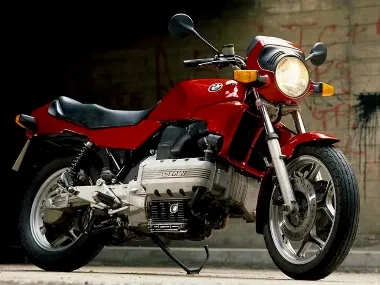

presentation of the K 100 1983
BMW has built the legend of the flat-twin. Although the single-cylinder is a recurrent theme in the brand's history, it is the architecture of its flat-twin that remains its indelible trademark.
Yet innovation regularly shakes up this kind of saga. In the history of motorcycling, certain machines mark a breakthrough. The BMW K 100 falls into this category. For the public accustomed to the Flat, the arrival of this bike was a surprise, a daring gamble that divided purists but paved the way for the modern BM era. Nicknamed the "Flying Brick" because of the shape of its engine, it embodied a technical and philosophical revolution that helped renew interest in the brand.
The genesis of a daring gamble
In the early 1980s, BMW was faced with a dilemma. Its R-series, with its air-cooled, twin-cylinder boxer engine, was beginning to look dated in the face of more sophisticated, high-performance Japanese competition. To remain relevant, the Bavarian brand needed to innovate. Rather than fine-tune its existing engines, it took a radical decision: to design an entirely new motorcycle, with a novel engine architecture.
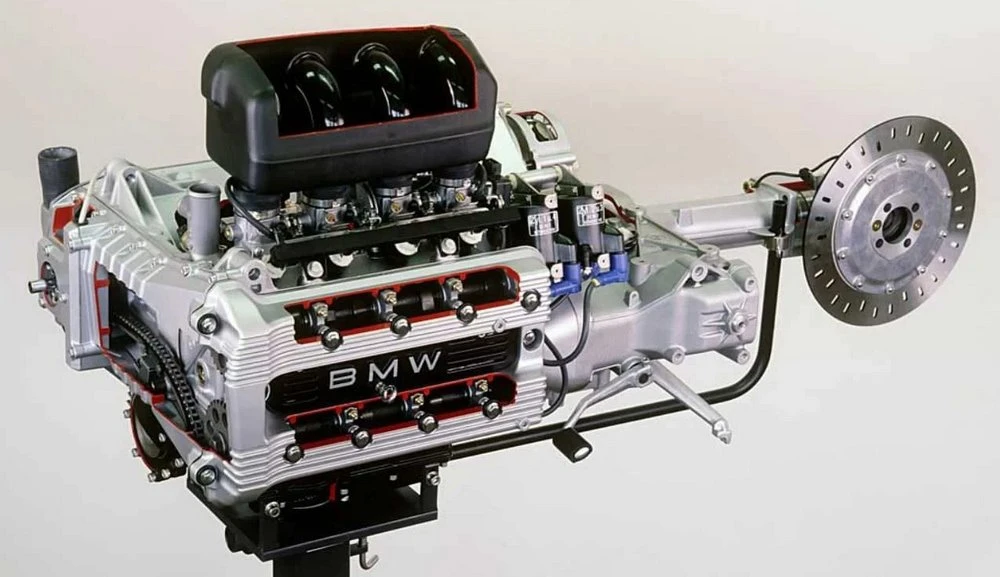
The result was the K 100, a motorcycle powered by a longitudinal in-line 4-cylinder engine, mounted flat in the frame. Transmission was by shaft rather than chain, a BMW specificity retained. This engine block, with its forward-facing cylinders, resembled a brick laid on its side, earning it its nickname.
Avant-garde engineering
The 987 cm3 water-cooled 4-cylinder engine was the first of its kind for BMW. It featured Bosch L-Jetronic electronic fuel injection, a rare technology on a production motorcycle at the time. With 90 hp at 8,000 rpm and torque of 8.7 m.kg at 6,000 rpm, it offered smoother power delivery and a very different torque distribution from the boxer engines of the day.
Its compact design, with the main driveshaft integrated into the engine block, ensured remarkable robustness, making the K 100 a motorcycle capable of covering hundreds of thousands of kilometers without trouble.
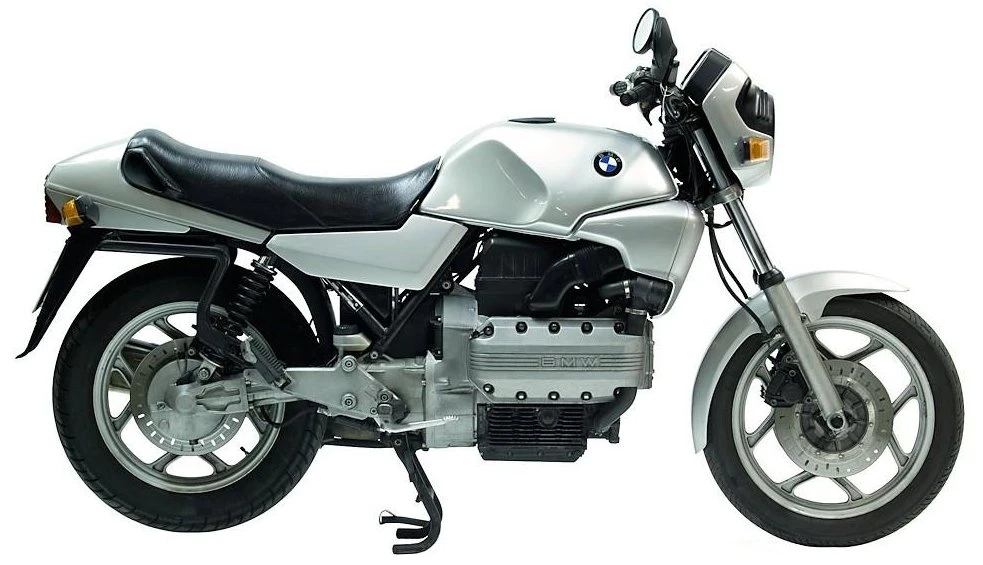
Despite weighing 239 kg (dry), the K 100 was renowned for its excellent balance and handling. Its low center of gravity, thanks to the flat-mounted engine, gave it reassuring stability, even at high speeds.
The Monolever rear suspension, a BMW innovation, was one of the bike's strong points. This single-arm swingarm connected directly to the engine and universal joint transmission eliminated the notorious "universal joint torque" of earlier R models, which tended to lift the bike under acceleration. The system ensured a smoother ride and better roadholding.
A trio of revivals
The K 100 was available in several versions to meet different needs. The basic K 100, a streamlined roadster; the K 100 RS (for Reise-Sport), which added an aerodynamic fairing and half handlebars for a sportier ride; and the K 100 RT (Reise-Touring), which offered a full fairing, an adjustable windscreen and a more upright riding position.
The bike was one of the first to offer ABS as an option, a major safety innovation long before it became the norm. Fuel injection was not widely used, and the position of the engine made a lasting impression.
The "Brick" had to convince
Despite its many qualities, the K 100 was not without its faults, often pointed out by critics and owners alike. While the engine was smooth at high revs, it suffered from noticeable vibrations at low revs, a phenomenon that was only partially resolved on later models.
Despite its low center of gravity, the K 100 was a heavy bike. Its heavy weight could make it difficult to maneuver from a standstill or at very low speeds.
For brand purists, the K 100 lacked the soul and mechanical character of the old boxers. The sound of the engine, though powerful, was more classic, more "Japanese", and less distinctive than that of the flat-twin engines.
Other problems, often minor but recurrent, were reported by owners: the fragility of the fuel pump immersed in the tank, or difficult starting in cold weather on certain models. However, these shortcomings did not detract from the car's reputation for reliability.
A new path
The BMW K 100 paved the way for a whole line of K models, from the surprising K1 to the LT, which muscled up the road-going category. Much later, the 4-cylinder became the S in the Bavarian catalog, while the ^fixed K gained nobility by becoming synonymous with the 6-cylinder. But that's another story.
M.Bi. - Manufacturer's photos
by Greg

 Share
Share
Key facts BMW K 100 (1983) : What you need to know before you buy
Prices
| Basic version | |
|---|---|
 France France |
7,317€
|
Model sold in 1983
Performance
- Max speed : 215 km/h (133.60 mph)
- 0-100 km/h acceleration : 3.90 s
- Average fuel consumption : 6 liters/100km (0.39 mpg)
-
Estimated range
: 367 km (228 miles)
Calculated range until tank is empty, not verified.
Specifications BMW K 100 1983
- Chassis
- Two-seater saddle
- Frame : Tubular steel structure
- Fuel capacity : 22 liters (5.81 US gallons)
- Seat height : 810 mm (31.89 in)
- Length : 2,220 mm (87.40 in)
- Width : 960 mm (37.80 in)
- Min height : 1,155 mm (45.47 in)
-
Min. ground clearance : 175 mm (6.89 in)
- Wheelbase : 1,516 mm (59.69 in)
- Dry weight : 239 kg (527 lb)
- Front axle
- Telehydraulic fork Ø 41 mm, Wheel travel : 185 mm (7.28 in)
- Braking 2 Brembo discs Ø 285 mm (11.22 in), 2-piston caliper
- Front tire (Tubeless) : 100 / 90 - 18 → Order this type of tire
- Pressure : 2.55 bar
- Transmission
- 5 stage gearbox , manual
- Secondary cardan shaft
- Rear axle
- Monobras Monolever, Wheel travel : 130 mm (5.12 in)
- drum brakes Ø 200 mm (7.87 in)
- Rear tire (Tubeless) : 130 / 90 - 17 → Order this type of tire
- Pressure : 2.8 bar
- Motor
- 4 cylinders online, cross-functional , 4 strokes
- injection
- Cooling system : liquid
- 2 ACT
- 2 valves per cylinder
- 987 cc
- 90 ch (88.80 hp) to 8,000 rpm
- 9.80 mkg to 3,000 rpm
- Power-to-weight ratio : 2.69 kg/ch
- Weight / torque ratio : 24.39 kg/mkg
- Compression : 10.2 : 1
- Starting system : electric
- Practical information
- Made in 12,871 copies
- Country of manufacture : Germany




Models
1983
Used
Compare the K 100 to its competitors
FAQ Your frequently asked questions about the K 100 1983
- What is the power of the K 100 1983?
-
The K 100 1983 develops a power of 90 ch (88.80 hp)
- What is the torque of the K 100 1983?
-
The maximum torque of the K 100 1983 is 9.80 mkg to 3,000 rpm.
- What is the maximum speed of the K 100 1983?
-
The K 100 1983 is capable of reaching a top speed of 215 km/h (133.60 mph) on the track.
- What is the weight of the K 100 1983?
-
The K 100 1983 has a a dry weight of 239 kg (527 lb).
- What is the fuel consumption of the K 100 1983?
-
Average fuel consumption is estimated at 6 l/100km (0.39 mpg) according to the WMTC cycle.
- QWhat is the seat height of the K 100 1983?
-
To ensure good accessibility, the K 100 1983 offers a minimum seat height of 810 mm (31.89 in).
- What is the price of the K 100 1983?
-
The price of the K 100 1983 is 7,317€ in France
News
-
New motorcycle products for 2026

-
Bridgestone announces the RS12, its new road-race weapon.
-
Yamaha Race Like A Girl: Natalia Rivera in episode 5.
-
Bridgestone presents the Battlax V03, its new slick tire.
-
With Sartoria Meccanica, MV-Agusta aims to go beyond premium.
-
Upgrading the entire Bonneville family for 2026.
-
Metzeler unveils three new tires at EICMA.
-
World Superbike celebrates 70 years of Yamaha.
-
Exceptional: some thirty new Triumphs in 2026.
-
40.000 bikers for the Royal-Enfield "One Ride" 2025.



Bikers' reviews Leave a review