
Motorcycle specifications BMWR32 1923 It's all there


presentation of the R32 1923
Although BMW has become one of the best-known brands in the motorcycle world (and beyond), its history did not predestine it to become a player in the two-wheeled field. The famous flat-twin owes its fame above all to a reversal of fortune. The world had gone to the dogs, and the BMW Motorrad epic was born.
It was at the end of the First World War. The ban on building aircraft engines imposed on Germany by the Treaty of Versailles in 1919 brought an abrupt end to BMW's string of successes as a manufacturer of aircraft engines. First, engineers built the Bavarian M 4 A 12 engine, derived from the IIIa aircraft engine, as a stationary engine or power unit for boats, tractors and trucks. At the same time, the company was looking for new fields of activity, and turned to two-wheelers. Post-war reconstruction meant that mobility needs were increasingly being met by motorcycles.
Engineers developed a small, twin-cylinder engine with a displacement of 500 cm3. The new M 12 B 15's aluminum pistons and cylinder block weighed just 31 kilos. At first, BMW sold this engine to two-wheeler manufacturers. Then, in 1922, BMW decided to turn to this prosperous market as a motorcycle manufacturer.
the R 32, the world's first motorcycle with a flat engine and drive shaft.
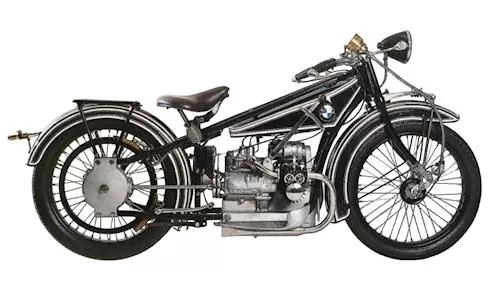
starting with the existing engine, BMW co-founder Max Friz planned to mount the cylinders transversely to the direction of travel. The crankshaft was positioned longitudinally. The gearbox with shafts also arranged longitudinally was controlled by a friction clutch, the two housings being screwed together. A cardan shaft connected the gearbox to the rear wheel. Each of these basic features was already available on the market. But Max Friz was the first to combine them in the innovative construction of the BMW R 32.

On September 28, 1923, at the German Motor Show in the exhibition halls of Berlin's Kaiserdamm, BMW officially presented its first motorcycle, along with its range of engines. It was a bold move. The Munich-based manufacturer was facing competition from over 130 motorcycle manufacturers in its own country. At the same time, the machine powered by an 8.5 hp engine cost 2,200 Reichsmark without options, making it one of the most expensive. Yet its commercial success proved that BMW had bet on the right concept. BMW's motorcycle was distinguished from its competitors not only by the flattened unit formed by the engine and gearbox, but also by its frame with two closed loops of parallel steel tubing
steel tubing. The low-slung, flat boxer engine considerably improved the position of the center of gravity and, by the same token, driving characteristics. The front-wheel fork allowed little travel, but the use of leaf springs provided a certain self-damping effect. The deep black enamel varnish and expensive white line decoration set standards in terms of finish quality.
the first motorcycle engine with light-alloy pistons.
but the mechanics of this motorcycle set even higher standards. The first BMW motorcyclists could take pride in the fact that they benefited from the aircraft engine manufacturer's experience. This was reflected in the choice of materials, such as the use of light alloy for pistons, as well as in a level of operating safety and reliability that was still hard to find in the motorcycle-building sector.
no vulnerable chain transmission between engine and gearbox, no chains or belts to the rear wheelno vulnerable chain transmission between engine and gearbox, no chains or belts to the rear wheel, and valve stems and springs encapsulated at the top of the cylinders, impervious to dust and oil. Together with the closed lubrication circuit, this meant that the bike stayed clean and maintenance operations were considerably simplified.

In those days, the best advertisement for a new motorcycle, and for a new brand in particular, was success in sporting competitions. Thus, on February 2, 1924, the young engineer Rudolf Schleicher took the start of the Mittenwalder Steig mountain race and won it with the fastest time of the day on his BMW. In doing so, he became the first motorsports winner in the history of the Bayerischen Motoren Werke. But Schleicher was not just a fast motorcyclist. He was also an ingenious builder.
On May 18, 1924, three test riders from the BMW works took part in the Solitude Race in Stuttgart with a cylinder head of his own design,
which was, for the first time in motorcycle construction, cast in light alloy, and overhead valves (ohv) encapsulated under a covering hood. They won in three categories. This new design was carried over to the new sport model in 1924,
the R 37 which, with its 16 hp, was almost twice as powerful as the R 32 of the time.
The rest is history, and a succession of evolutions. While the brand has diversified in terms of engine types and machine categories, the foundations laid by the R32 are still present in today's R models.
Image credits: BMW - D.R
by Greg

 Share
Share
Key facts BMW R32 (1923) : What you need to know before you buy

Performance
- Max speed : approximately 95 km/h (59 mph)
- Average fuel consumption : 3 liters/100km (0.78 mpg)
-
Estimated range
: 467 km (290 miles)
Calculated range until tank is empty, not verified.
Specifications BMW R32 1923
- Chassis
- Frame : two closed loops of parallel steel tubing
- Fuel capacity : 14 liters (3.70 US gallons)
- Seat height : 720 mm (28.35 in)
- Length : 2,100 mm (82.68 in)
- Width : 800 mm (31.50 in)
- Min height : 950 mm (37.40 in)
- Wheelbase : 1,380 mm (54.33 in)
- Weight when fully loaded : 122 kg (269 lb)
- Front axle
- Fork + leaf spring
- drum brakes Ø 150 mm (5.91 in)
- Transmission
- 3 stage gearbox
- Secondary cardan shaft
- Rear axle
- rigide
- Motor
- two-cylinder flat , 4 strokes
- Carburettor Ø 22 mm
- Cooling system : by air
- 2 valves per cylinder
- 494 cc
- 9 ch (8.90 hp) to 3,200 rpm
- Power-to-weight ratio : approximately 12.3 kg/ch
- Compression : 5 : 1
- Practical information





Models
1926
1925

1924

1923

Used
Compare the R32 to its competitors
FAQ Your frequently asked questions about the R32 1923
- What is the power of the R32 1923?
-
The R32 1923 develops a power of 9 ch (8.90 hp)
- What is the maximum speed of the R32 1923?
-
The R32 1923 is capable of reaching a top speed of approximately 95 km/h (59 mph) on the track.
- What is the weight of the R32 1923?
-
The R32 1923 has a a weight when fully loaded of 122 kg (269 lb).
- What is the fuel consumption of the R32 1923?
-
Average fuel consumption is estimated at 3 l/100km (0.78 mpg) according to the WMTC cycle.
- QWhat is the seat height of the R32 1923?
-
To ensure good accessibility, the R32 1923 offers a minimum seat height of 720 mm (28.35 in).
News
-
New motorcycle products for 2026

-
Bridgestone announces the RS12, its new road-race weapon.
-
Yamaha Race Like A Girl: Natalia Rivera in episode 5.
-
Bridgestone presents the Battlax V03, its new slick tire.
-
With Sartoria Meccanica, MV-Agusta aims to go beyond premium.
-
Upgrading the entire Bonneville family for 2026.
-
Metzeler unveils three new tires at EICMA.
-
World Superbike celebrates 70 years of Yamaha.
-
Exceptional: some thirty new Triumphs in 2026.
-
40.000 bikers for the Royal-Enfield "One Ride" 2025.


Bikers' reviews Leave a review