
Motorcycle specifications BSA750 Rocket III 1968


presentation of the 750 Rocket III 1968
Why keep it simple when you can keep it complicated? This question must have been at the top of every page of the specifications when the BSA Rocket III was designed. This "3-cylinder rocket" is the result of a project initially developed by 2 Triumph engineers (Bert Hopwood and Doug Hele). Presented in the early '60s to the management of BSA, owner of the Triumph brand, the Trident project was initially rejected. Hopwood and Hele, passionate engineers, far from giving up, continued their development without factory support.
back in BSA's good graces a few years later, the idea of a large-displacement motorcycle was revived on behalf of BSA and jointly with Triumph. The 2 engineers' Trident served as the basis for the 2 models. However, at a time when the group's financial situation was already weak, BSA's management took the preposterous decision to develop 2 technically similar but distinct motorcycles.
thus, while the engine base is a 3-cylinder, 4-stroke 741cc, with 3 Amal carburetors and a 5-speed gearbox, the BSA will have a bank of cylinders inclined 15° forward compared with that of the Trident. Technically, this decision implies entirely different lower-engine castings, without altering the engine's performance (58 hp at 7,250 rpm). The same goes for the chassis: while the constraints are more or less the same, the BSA will have a double cradle steel frame, while the Triumph will have a single cradle. In the eyes of the decision-makers, differentiation of the models required systematic cost overruns.
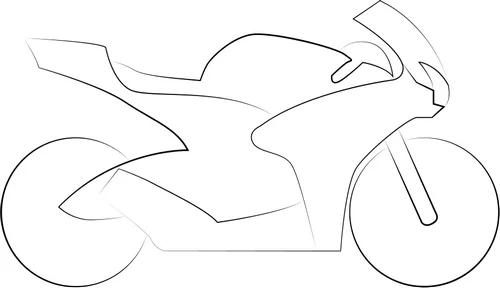
released in 1968 at the same time as its sister Triumph Trident T150, the BSA Rocket III was one of the most powerful and fastest street bikes ever built (before the arrival of the Honda CB750 Four the following year).
aesthetically, the BSA had modern lines for its time. The fuel tank (slightly rounder than its sister model) is adorned with chrome strips and plastic protectors. The laterals are wraparound, and the specific mufflers are immediately identifiable with their triple tailpipes (miraculously common to the BSA and early Triumph Trident). The Rocket3 will be offered in a single color: Red. A version was developed specifically for the USA in 1971, but it kept this color.
apart from the engine, the rest of the bike is very classic: telescopic front forks, twin rear forks and drum brakes for all. The bike is a success: fast, well finished, with an attractive displacement and engine architecture. It would certainly have been a success had it not been for the arrival of the more powerful, more reliable Honda 4-leg, equipped with a disc brake, in the year following its launch. The Rocket 3 didn't have time to be fitted with a disc brake (the Triumph Trident did in 1972). Put into liquidation in 1971, the BSA group was bought out by Norton-Villers. The new Norton-Villers-Triumph entity sold BSAs until stocks ran out (around 1972), when the brand was mothballed.
Tanthallas - Photos: Manufacturer

Thanks to the BSA Club of NSW Australia for permission to use their documentation. Please visit http://www.acay.com.au/~shanep/pages/catalogs.html
Thanks to Winni Scheibe for permission to use the photos
by Greg

 Share
Share
Key facts BSA 750 Rocket III (1968) : What you need to know before you buy
Highlights
- Mythe
- Esprit British
Weak points
- Fiabilité
Model sold in 1968
Performance
- Max speed : approximately 188 km/h (116.80 mph)
- 0-100 km/h acceleration : 5.50 s
Specifications BSA 750 Rocket III 1968
- Chassis
- Frame : Double tubular steel cradle
- Fuel capacity : 19 liters (5.02 US gallons)
- Seat height : 794 mm (31.26 in)
- Wheelbase : 1,430 mm (56.30 in)
- Dry weight : 206 kg (454 lb)
- Weight when fully loaded : 226 kg (498 lb)
- Front axle
- Telehydraulic fork Ø 35 mm
- drum brakes Ø 200 mm (7.87 in) (double came)
- Front tire : 4 / 10 - 19 → Order this type of tire
- Transmission
- 4 stage gearbox
- Secondary by chain
- Rear axle
- 2 lateral shock absorbers
- drum brakes Ø 200 mm (7.87 in) (simple came)
- Rear tire : 4 / 10 - 19 → Order this type of tire
- Motor
- 3 cylinders online , 4 strokes
- 3 carburetors Ø 26 mm
- Cooling system : by air
- 2 valves per cylinder
- 741 cc
- 58 ch (57.20 hp) to 7,250 rpm
- 6.30 mkg to 6,900 rpm
- Power-to-weight ratio : 3.6 kg/ch
- Weight / torque ratio : 32.7 kg/mkg
- Compression : 9.5:1
- Practical information





Models
1968
Used

Compare the 750 Rocket III to its competitors
Acceleration
Fuel consumption
Range
Torque
Power
Power-to-Weight ratio
Torque-to-Weight ratio
Speed
FAQ Your frequently asked questions about the 750 Rocket III 1968
- What is the power of the 750 Rocket III 1968?
-
The 750 Rocket III 1968 develops a power of 58 ch (57.20 hp)
- What is the torque of the 750 Rocket III 1968?
-
The maximum torque of the 750 Rocket III 1968 is 6.30 mkg to 6,900 rpm.
- What is the maximum speed of the 750 Rocket III 1968?
-
The 750 Rocket III 1968 is capable of reaching a top speed of approximately 188 km/h (116.80 mph) on the track.
- What is the weight of the 750 Rocket III 1968?
-
The 750 Rocket III 1968 has a a dry weight of 206 kg (454 lb), a weight when fully loaded of 226 kg (498 lb).
- QWhat is the seat height of the 750 Rocket III 1968?
-
To ensure good accessibility, the 750 Rocket III 1968 offers a minimum seat height of 794 mm (31.26 in).
News
-
New motorcycle products for 2026

-
Bridgestone announces the RS12, its new road-race weapon.
-
Yamaha Race Like A Girl: Natalia Rivera in episode 5.
-
Bridgestone presents the Battlax V03, its new slick tire.
-
With Sartoria Meccanica, MV-Agusta aims to go beyond premium.
-
Upgrading the entire Bonneville family for 2026.
-
Metzeler unveils three new tires at EICMA.
-
World Superbike celebrates 70 years of Yamaha.
-
Exceptional: some thirty new Triumphs in 2026.
-
40.000 bikers for the Royal-Enfield "One Ride" 2025.



Bikers' reviews Leave a review