
Motorcycle specifications HondaCB 750 Four 1969 She changed the world


presentation of the CB 750 Four 1969
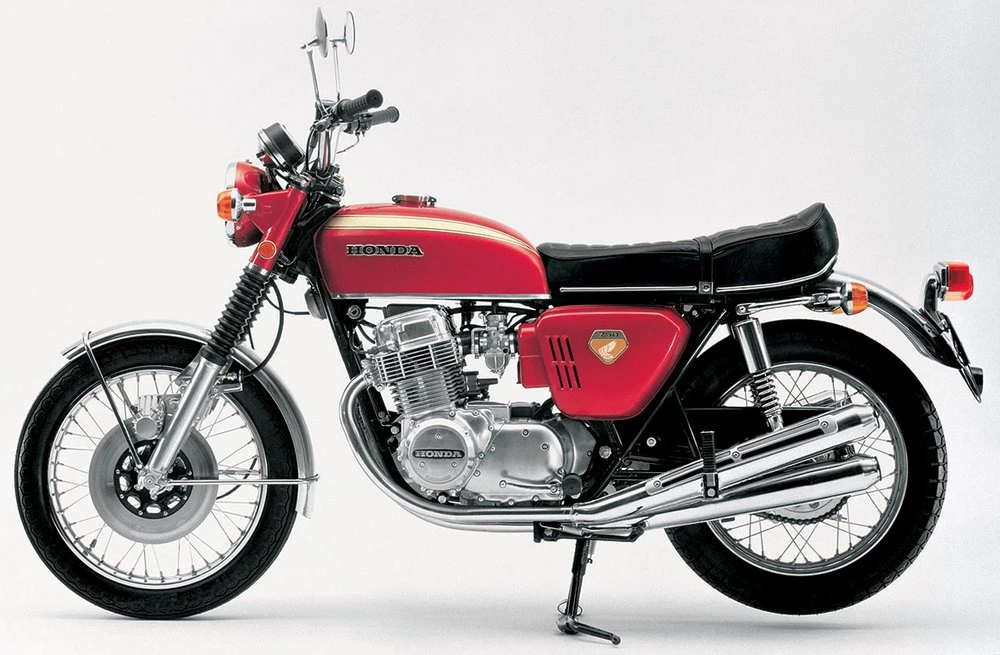
When Honda introduced the CB 750 Four in 1969, the motorcycle world was turned upside down. Until then, large-displacement motorcycles had been the preserve of British and American brands. But with an in-line four-cylinder engine, front disc brake and electric starter, Honda struck a blow. The motorcycle industry entered a new era.
A global shock
At Honda's offices in Tokyo, the engineers had one question on their minds: what to do after leaving the racetrack? Two years earlier, Soichiro Honda had taken the bold decision to retire from the World Speedway Championship. Far from being an abandonment, this withdrawal was in fact a refocusing. The dream was no longer to win on the track, but on the street, on the international market.
Demand is coming from the United States. American dealers are clamoring for a powerful, reliable, modern motorcycle - capable of competing with British twin-cylinders and big American V-twins.
Innovation was needed. Development began in secret under the name "CBX", and the objectives were clear: to exceed the performance of Western models, while guaranteeing ease of use and minimal maintenance. In October 1968, at the Tokyo Motor Show, the prototype caught the eye. In January 1969, in Las Vegas, the CB 750 was unveiled to American dealers. It was a shock: the machine was revolutionary, and its price of $1,495 defied all competition.
Technology and innovation
The CB 750 impressed right from the start. It combines features previously reserved for racing bikes or prototypes:
- Engine: 4-cylinder in-line transverse, 736 cm3, single overhead camshaft (SOHC)
- Power: 67 hp at 8,000 rpm
- Torque: 60 Nm at 7,000 rpm
- 4 Keihin 28-mm carburetors
- Air-cooled
- 5-speed gearbox, chain drive
- Front hydraulic disc brake, rear drum brake
- Dry weight: 218 kg
- Top speed: approx. 200 km/h
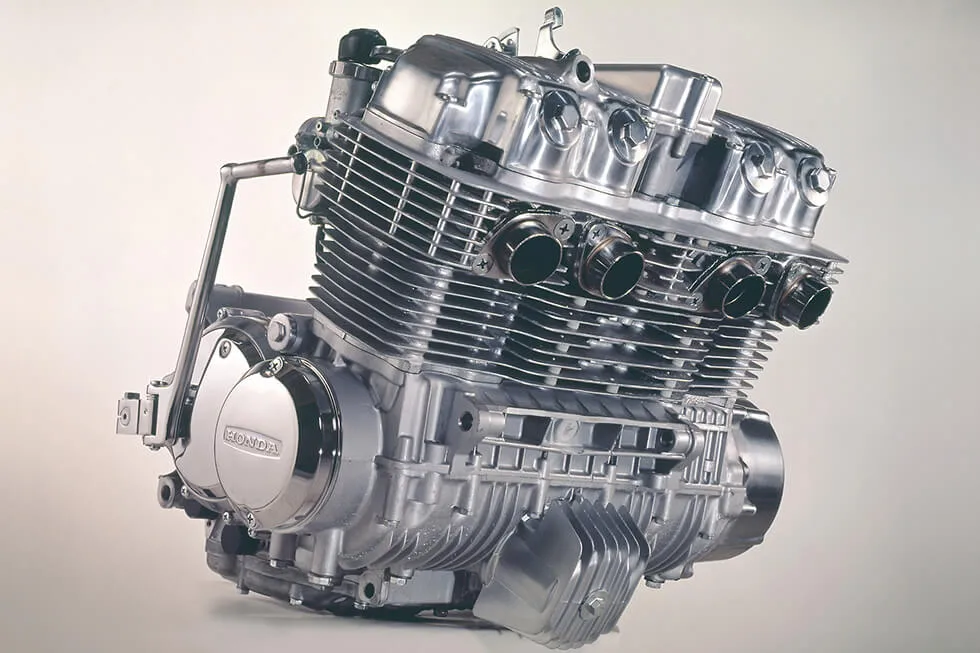
But beyond the numbers, it's the sensations that really stand out. The bike is smooth, quiet and stable at high speeds. It doesn't vibrate or leak. It starts at a moment's notice thanks to its electric starter - a rarity at the time. Above all, the CB 750 is built to last. Honda places great emphasis on mechanical reliability, inherited from its Grand Prix know-how. It can run for a long time without overheating, even under intensive use. This attention to durability appeals to a public weary of the vagaries of European powerplants.
A surprising start to production
In its first few weeks of production, Honda uses an unconventional method to speed up time-to-market: sand-casting for the crankcases. This technique makes it possible to produce parts quickly, without waiting for final industrial molds to be made. As a result, some 7,400 original units were produced using this process. Their appearance was slightly grainy, with a rough finish. Over time, these early models became highly sought-after collector's items.
An icon that changed the rules
The CB 750 Four isn't just a successful motorcycle. It redefined what motorcyclists expect from a machine. Reliable, fast, modern, comfortable, it embodies a paradigm shift. No more technical compromises. Make way for accessible performance. The press was ecstatic. Cycle World speaks of "the most sophisticated production bike ever conceived". Triumph, Norton and BSA couldn't keep up. Their twin-cylinders suddenly seemed dated, noisy and demanding. The Japanese wave is on the march, and the CB 750 is its first roll.
Not beyond reproach
Despite its pioneering status, the CB750 was not without its critics. First of all, its weight: at over 230 kg fully loaded, it demanded a certain rigor at low speeds and when maneuvering at a standstill. The front disc brake, though innovative, lacked bite in certain conditions, particularly in the rain.
Another weak point was the gearbox, judged a little slow and clunky when shifting gears, particularly between first and second. Early models also suffered from a tendency to overheat in intensive urban use, with air cooling reaching its limits in traffic jams.
Finally, the original saddle, while comfortable for medium-distance rides, could become tiring over long distances, especially when riding a duo. Despite these imperfections, the CB 750 Four remains a remarkably well-balanced machine for its time, and its shortcomings have in no way diminished its lasting influence.
A small family for a huge success
Produced until 1978, the CB 750 gave birth to several variants:
- CB750K: standard version, with annual styling upgrades
- CB750F "Super Sport": sportier, with 4-in-1 exhaust system
- CB750A "Hondamatic": semi-automatic gearbox, daring but marginal
- CB750P: police version, used in Japan, the USA and Europe
In all, over 553,000 units are sold. It inaugurates the "Superbike" category and becomes the archetypal "Universal Japanese Motorcycle" (UJM).
With the CB750 Four, Honda didn't just produce an excellent motorcycle. It imposed a new vision of the modern motorcycle. A vision of accessible technology, mastered performance and uncompromising reliability. It paved the way for the next four decades of Japanese domination of the two-wheeled world.
M.Bi - Manufacturer's photos
by Greg

 Share
Share
Key facts Honda CB 750 Four (1969) : What you need to know before you buy
Model sold in 1969
Performance
- Max speed : approximately 200 km/h (124.30 mph)
- Average fuel consumption : 6.90 liters/100km (0.34 mpg)
-
Estimated range
: 261 km (162 miles)
Calculated range until tank is empty, not verified.
Specifications Honda CB 750 Four 1969
- Chassis
- Two-seater saddle
- Frame : Double steel cradle
- Fuel capacity : 18 liters (4.76 US gallons)
- Oil capacity : 3.30 liters (0.87 US gallons)
- Seat height : 800 mm (31.50 in)
- Length : 2,160 mm (85.04 in)
- Width : 885 mm (34.84 in)
- Min height : 1,220 mm (48.03 in)
-
Min. ground clearance : 160 mm (6.30 in)
- Wheelbase : 1,450 mm (57.09 in)
- Dry weight : 218 kg (481 lb)
- Curb mass : 226 kg (498 lb)
- Weight when fully loaded : 240 kg (529 lb)
- Front axle
- Telescopic fork Ø 35 mm, Wheel travel : 143 mm (5.63 in)
- Braking 1 Tokico disc Ø 296 mm (11.65 in), single-piston caliper
- Pressure : 2 bar
- Transmission
- 5 stage gearbox , manual
- Secondary by chain
- Rear axle
- 2 lateral shock absorbers, Wheel travel : 85 mm (3.35 in)
- Preload adjustment
- drum brakes Ø 180 mm (7.09 in)
- Pressure : 2.2 bar
- Motor
- 4 cylinders online , 4 strokes
- 4 keihin Ø 28 mm carburetors
- Cooling system : by air
- 1 ACT
- 2 valves per cylinder
- 736.40 cc
- 67 ch (66.10 hp) to 8,000 rpm
- 6.10 mkg (60 Nm) to 7,500 rpm
- Power-to-weight ratio : 3.3 kg/ch
- Weight / torque ratio : 35.74 kg/mkg
- Compression : 9 : 1
- Starting system : electric and kick
- Practical information
- Made in 553,400 copies
- Country of manufacture : Japan





Models
1969
Used

Compare the CB 750 Four to its competitors
Price
Fuel consumption
Range
Torque
Power
Power-to-Weight ratio
Torque-to-Weight ratio
Speed
FAQ Your frequently asked questions about the CB 750 Four 1969
- What is the power of the CB 750 Four 1969?
-
The CB 750 Four 1969 develops a power of 67 ch (66.10 hp)
- What is the torque of the CB 750 Four 1969?
-
The maximum torque of the CB 750 Four 1969 is 6.10 mkg (60 Nm) to 7,500 rpm.
- What is the maximum speed of the CB 750 Four 1969?
-
The CB 750 Four 1969 is capable of reaching a top speed of approximately 200 km/h (124.30 mph) on the track.
- What is the weight of the CB 750 Four 1969?
-
The CB 750 Four 1969 has a a dry weight of 218 kg (481 lb), a operating weight of 226 kg (498 lb), a weight when fully loaded of 240 kg (529 lb).
- What is the fuel consumption of the CB 750 Four 1969?
-
Average fuel consumption is estimated at 6.90 l/100km (0.34 mpg) according to the WMTC cycle.
- QWhat is the seat height of the CB 750 Four 1969?
-
To ensure good accessibility, the CB 750 Four 1969 offers a minimum seat height of 800 mm (31.50 in).
News
-
New motorcycle products for 2026

-
Bridgestone announces the RS12, its new road-race weapon.
-
Yamaha Race Like A Girl: Natalia Rivera in episode 5.
-
Bridgestone presents the Battlax V03, its new slick tire.
-
With Sartoria Meccanica, MV-Agusta aims to go beyond premium.
-
Upgrading the entire Bonneville family for 2026.
-
Metzeler unveils three new tires at EICMA.
-
World Superbike celebrates 70 years of Yamaha.
-
Exceptional: some thirty new Triumphs in 2026.
-
40.000 bikers for the Royal-Enfield "One Ride" 2025.


Bikers' reviews Leave a review - 1 review