
Motorcycle specifications Honda1000 RCB 1976 A pillar of Endurance


presentation of the 1000 RCB 1976
In the pantheon of racing machines, some shine for their performance, others for their looks, and a few for their ability to make history. The Honda RCB 1000 falls into the latter category. Although less well known to the general public than its modern counterparts, this racing bike is a legend to purists, a machine that rewrote the rules of endurance racing and laid the foundations for today's Superbikes.
To understand the greatness of the RCB 1000, we need to look back to the late 1970s. Motorcycle endurance, with legendary events such as the 24 Hours of Le Mans and the Bol d'Or, was at its peak. It's a playground where reliability, power and rider tenacity are put to the ultimate test. European manufacturers dominate the scene, and it's in this climate of intense competition that Honda decides to strike a blow.
The genesis of a secret project and revolutionary engineering
The RCB 1000 project was born in the greatest secrecy within Honda's racing department. The objective was simple, but audacious: to build a motorcycle capable of dominating endurance racing. To achieve this, Honda engineers opted for a radical approach, starting from scratch rather than modifying a production model.
The RCB bears no resemblance to the Honda models of the time. It's designed for racing, with an ultra-light chrome-molybdenum tubular chassis. But its true genius lies in its technical components, ahead of their time.
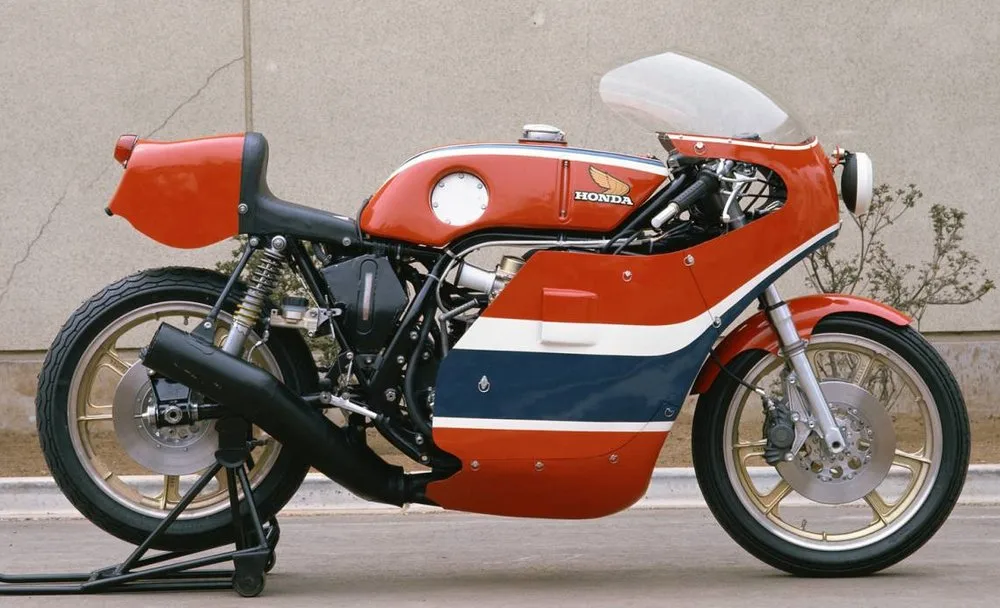
The engine: constantly evolving engineering at the service of domination
Contrary to what you might think, the first version of the RCB 1000, which raced in 1976, was not a 1000 cm3 engine. It was a 915.2 cm³ in-line 4-cylinder, derived from the CB 750 engine and extensively reworked for racing, with a power output of 115 bhp at 9,500 rpm.
In 1977, the bike was fine-tuned. Honda engineers corrected early faults and improved reliability. Engine power was increased to 125 hp at 9,500 rpm. It was the engine of this version that would prove invincible, dominating the circuits and crushing the competition.
The RCB's engine was a marvel of technology for its time. It features a double overhead camshaft (DOHC) and four valves per cylinder, a rarity on endurance bikes. For the crankshaft, Honda opted for plain bearings instead of ball bearings, an innovation that reduced weight and friction.
Fuel is supplied by four Keihin CR racing carburetors, renowned for their rapid response. The exhaust system, a massive "4-in-1", is specifically designed to optimize performance. But the air-cooled engine generated considerable heat, which could be a trial for riders during long endurance races.
State-of-the-art chassis: exceptional suspension and rims
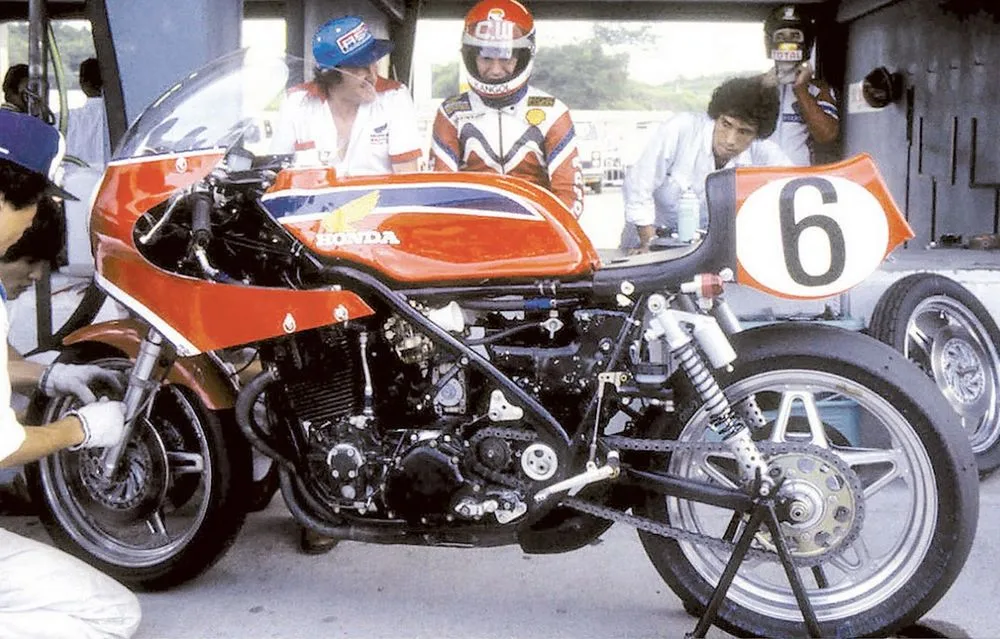
The RCB's efficiency was not limited to its engine. Its chassis was just as revolutionary, with bold technical choices that contributed to its superiority on the track.
Front suspension was provided by a 41 mm telescopic fork, with internals designed to withstand the extreme stresses of racing. The fork's design aimed for a perfect balance between stiffness for performance and shock absorption for durability.
At the rear, the RCB used a double shock absorber suspension system. While early models used standard units, Honda soon equipped its machines with the best shock absorbers available on the market. These dampers were a combination of coil springs and hydraulic damping, allowing precise adjustment to suit different track conditions and the demands of a 24-hour race.
One of the RCB 1000's most emblematic innovations is the use of Comstar wheels. Honda developed these wheels for its endurance bikes, combining the lightness of a spoked rim with the rigidity of a cast rim. These wheels were built with stainless steel spokes, riveted to spun aluminum rims. This design reduced the weight of unsprung masses, improving the bike's handling and acceleration.
Brakes were provided by double discs at the front and a single disc at the rear. To improve efficiency and speed during pit stops, Honda quickly replaced the original components with Brembo brakes, renowned for their stopping power and ability to resist overheating over long periods.
The legacy of a legend: the transition to the RS 1000
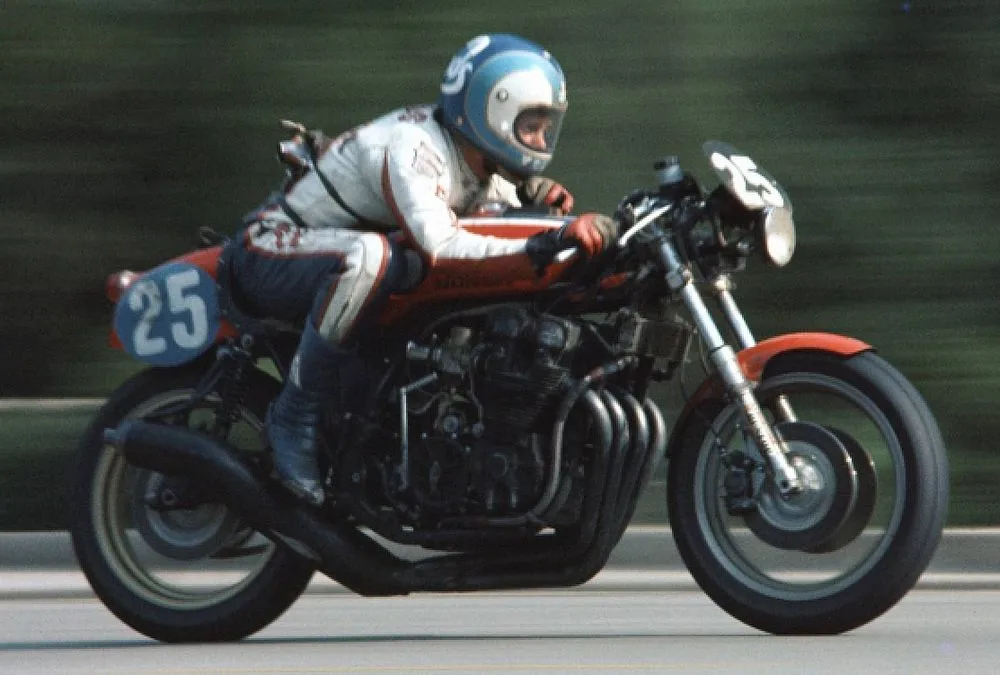
The evolution of the RCB didn't stop in 1977. Honda continued to refine and improve its engine year after year. In 1979, the pinnacle was reached, with power increased to over 130 hp. It was also at this time that Honda began to introduce the RS 1000, a transitional machine that would gradually replace the RCB.
The RS 1000 marks a technological and commercial turning point. It is based on the production CB 900 F Bol d'Or. It was designed to be more accessible to private teams, producing 131.6 hp at 10,000 rpm.
The RCB's heritage is immense. The technologies developed for this racing bike, from its 4-valve DOHC engine to its rims and braking components, directly influenced the design of Honda's road models, such as the CB 900 F Bol d'Or and CB 1100 R. The RCB's racing success paved the way for the Japanese superbikes that were to dominate the world scene in the 1980s and 1990s.
M.Bi. - Manufacturer photos
by Greg

 Share
Share
Key facts Honda 1000 RCB (1976) : What you need to know before you buy
Specifications Honda 1000 RCB 1976
- Chassis
- Vehicle not capable of carrying passengers
- Frame : Double cradle steel frame
- Dry weight : 187 kg (412 lb)
- Front axle
- Telehydraulic fork
- Braking
- Transmission
- 5 stage gearbox , manual
- Secondary by chain
- Rear axle
- 2 lateral shock absorbers
- Braking 1 disc
- Motor
- 4 cylinders online , 4 strokes
- 4 keihin Ø 32 mm carburetors
- Cooling system : combined air / oil
- 2 ACT
- 4 valves per cylinder
- 915.20 cc
- 115 ch (113.40 hp) to 9,500 rpm
- 10.10 mkg (99 Nm) to 8,500 rpm
- Power-to-weight ratio : 1.65 kg/ch
- Weight / torque ratio : 18.51 kg/mkg
- Compression : 11 : 1
- Practical information
- Country of manufacture : Japan





Models
1976
Used
Compare the 1000 RCB to its competitors
FAQ Your frequently asked questions about the 1000 RCB 1976
- What is the power of the 1000 RCB 1976?
-
The 1000 RCB 1976 develops a power of 115 ch (113.40 hp)
- What is the torque of the 1000 RCB 1976?
-
The maximum torque of the 1000 RCB 1976 is 10.10 mkg (99 Nm) to 8,500 rpm.
- What is the maximum speed of the 1000 RCB 1976?
-
The 1000 RCB 1976 is capable of reaching a top speed of over 270 km/h (167.80 mph) on the track.
- What is the weight of the 1000 RCB 1976?
-
The 1000 RCB 1976 has a a dry weight of 187 kg (412 lb).
- Is the 1000 RCB 1976 approved for transporting a passenger?
-
No, this vehicle is only suitable for 1 people; it is a single-seater.
News
-
New motorcycle products for 2026

-
Bridgestone announces the RS12, its new road-race weapon.
-
Yamaha Race Like A Girl: Natalia Rivera in episode 5.
-
Bridgestone presents the Battlax V03, its new slick tire.
-
With Sartoria Meccanica, MV-Agusta aims to go beyond premium.
-
Upgrading the entire Bonneville family for 2026.
-
Metzeler unveils three new tires at EICMA.
-
World Superbike celebrates 70 years of Yamaha.
-
Exceptional: some thirty new Triumphs in 2026.
-
40.000 bikers for the Royal-Enfield "One Ride" 2025.




Bikers' reviews Leave a review