
Motorcycle specifications HondaCRF 450 L 2019 A little trail from a big cross


presentation of the CRF 450 L 2019
There was a time when the CRF range consisted of just two models, the 250 and the 450, but in recent years the range has become more emancipated. The new arrival is the 450 L. A machine that comes down from cross-country with the added potential of versatility. A genuine trail bike needs to have many qualities in common: off-road, it has to be light, have a high-performance suspension system, and be agile enough to make things easier when the going gets tough. As for the engine, it must deliver a good level of power and torque right from the low revs, and above all be perfectly exploitable to enable the rider to take advantage of all the grip available at the rear wheel, whatever the terrain.
All these qualities that make a trail so much fun off-road are also very useful in town. Thin and agile, a trail bike can weave in and out of traffic, swallowing up bumps and potholes, thanks to its liveliness and acceleration from the lowest revs.
A competition machine can be an excellent basis for a versatile trail bike. However, there are many parameters to take into account. The very high levels of performance demanded by racing often mean maintenance intervals that are incompatible with everyday use, where you simply need to press a button and go. What's more, a racing machine often lacks the accessories required for road use, such as lights, indicators or the main switch...
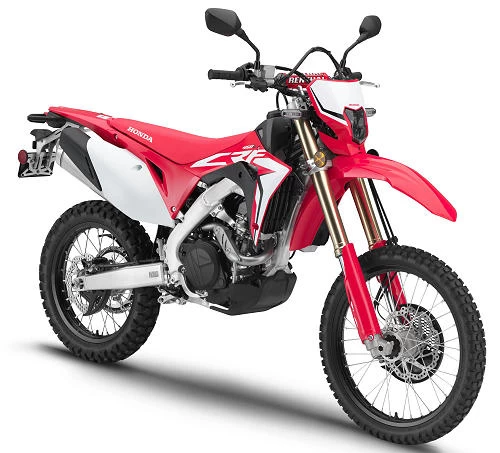
Perfectly aware of this situation, and with the aim of creating a trail bike whose performance is as close as possible to that of a racing machine, while offering "civilized" behavior and service intervals, Honda engineers chose the basis of the famous CRF 450 R to develop their all-new trail bike.
This machine is intended to be a CRF in its own right, but with all the modifications necessary to make it legally roadworthy and highly efficient for all-round use. As such, the CRF 450 L presents itself as a homogeneous machine, as comfortable on the trails as it is on the road.
the Honda CRF 450 L at a glance:
The transition from a "racing" environment to that of "road" use was perfectly integrated into the development of the CRF 450 L. For example, homologation requires the engine to meet Euro4 standards, while from the point of view of reliability and ease of use, power characteristics and engine behavior must be defined with great care.
However, the CRF 450 R is still here, just a little more refined in terms of engine and chassis technology, as well as the exhaust system. Fuel injection and ignition mappings are now managed by a Lambda sensor, the volumetric ratio has been reduced, and crankshaft mass has been increased to optimize handling. The gearbox now features 6 speeds (for long road trips), while a torque damper has been added to the 18-inch rear wheel.
The plastics in the bodywork are taken directly from the CRF 450 R, and all lighting is LED, with the front headlamp proving particularly effective.
The titanium fuel tank is larger - to the benefit of range - while all the components that make the CRF450L road-ready (speedometer, horn, etc.) are original equipment.
the Honda CRF 450 L in detail :
engine
While the CRF450R chassis proved easy to adapt to the CRF 450 L's trail vocation, the 449 cm3 single-cylinder engine required more consideration on the part of Honda's engine designers. The requirements were varied: the need to meet Euro4 standards in terms of gas emissions and noise, but also the need to be usable by a wide cross-section of riders in different conditions of use, both on-road and off-road.
Although the general architecture of the Unicam 4-valve single-cylinder remains largely unchanged, many details have been modified to enhance its versatility. For example, the crankshaft mass has been increased, resulting in a 13% increase in inertia for improved responsiveness and torque feel. Timing has also been revised to better distribute power and torque; the gearbox now has 6 ratios instead of 5 to better adapt to the demands of the road, while the outer casings have been fitted with additional trim to filter out mechanical noise.
With the same objective in mind, the alternator has been replaced by a component capable of supplying the electrical energy required by the LED lighting, as well as keeping the battery charged when the machine is idling. The battery itself is a high-capacity model.
Bore and stroke dimensions remain identical to those of the CRF450R (96 x 62.1 mm), with a volumetric ratio of 12:1 (vs. 13.5:1).
The piston has the classic 3 rings (vs. 2 on the "R"), the redesigned airbox feeds a PGM-FI fuel injection system now managed via a lambda sensor, while exhaust is via a single silencer replacing the split system found on the CRF 450 R. An AI air injection system and catalytic converter keep emissions under control.
The 4-valve Unicam cylinder head continues to feature latch-operated intake valves. Intake valve lift (ø 38 mm) is 7.7 mm, while exhaust lift is 6.7 mm. The return springs have an oval cross-section, while the valves have an angle of 9° at the intake and 10.5° at the exhaust.
The clutch features 7 lined discs, plus an additional 2 mm-thick disc for effective heat dissipation, while the springs ensure a consistent feel. The final drive ratio is set at 13 x 51, with a 520-pitch O-ring chain.
The CRF 450 L boasts a power output of 18.4 kW and maximum torque of 32 Nm. Reliability and service intervals are important factors for the everyday user, and particular attention has been paid to these. It's on these points that the CRF 450 L's design and build quality make the difference, with no less than 32,000 km guaranteed between major overhauls, and oil and air filter changes every 1,000 km.
cycle
Thoroughly revised in 2016, the CRF 450 R's chassis proved an ideal basis for the development of the CRF450L, with limited changes to meet the constraints of homologation and multipurpose use.
First of all, the aluminum double-beam frame has been significantly enlarged at the swingarm mounting plates to accommodate the larger engine crankcases resulting from the adoption of the 6-speed gearbox. The steering column area has also been modified to accommodate a steering lock, while at the rear the aluminum swingarm has been filled with urethane foam to limit noise. The rear loop is identical, with slightly modified mounting points to accommodate the rear light and right-side exhaust.
Caster angle and drag are set at 28.5°/122 mm, while the wheelbase is 1,500 mm, 18 mm longer than the CRF450R for greater stability.
The 2 R and L versions share the same 22 mm fork offset. Kerb weight is 130.8 kg and seat height 940 mm.
Front suspension is a Showa inverted fork with ø 49 mm compression-adjustable springs. At the rear, a fully adjustable monoshock operates via a Pro-Link variable duplication system. In terms of braking, the front benefits from a ø 260 mm "lace" disc associated with a dual-piston caliper that offers both power and feel. A ø 240 mm disc and single-piston caliper complete the set-up at the rear.
Where the CRF 450 R uses a 19" rear wheel, the CRF450L is equipped with an 18" model with torque damper, so that enduro-type casings can be used. The front wheel is a 21-inch diameter model with a black anodized rim, as is the rear. Tire sizes are 80/100-21 at the front and 120/80-18 at the rear.
The CRF 450 L's styling is totally inspired by that of the CRF450R, from which it takes its rear mudguard, side covers and sabot. The radiator openings house a larger element equipped with an electric fan.
All lighting is provided by LEDs, while the speedometer, horn, brake switches and mirrors all meet the requirements for road homologation.
Still on the subject of practicality, while the fuel tank of the CRF450R was content with 6.3 l, that of the CRF 450 L, again in titanium, gains a further 1.3 l for a total of 7.6 l.
News and media credits: Honda
by Greg

 Share
Share
Key facts Honda CRF 450 L (2019) : What you need to know before you buy
 France
Specifications Honda CRF 450 L 2019
- Chassis
- Frame : Double beam and single split cradle in aluminum
- Fuel capacity : 7.60 liters (2.01 US gallons)
- Seat height : 940 mm (37.01 in)
- Length : 2,280 mm (89.76 in)
- Width : 825 mm (32.48 in)
- Min height : 1,260 mm (49.61 in)
- Wheelbase : 1,500 mm (59.06 in)
- Weight when fully loaded : 130.80 kg (288 lb)
- Front axle
- Telehydraulic inverted forks Ø 49 mm
- Braking 1 disc Ø 260 mm (10.24 in), 2-piston caliper
- Front tire : 80 / 100 - 21 → Order this type of tire
- Transmission
- 6 stage gearbox , manual
- Secondary by chain
- Rear axle
- Mono-damper
- Braking 1 disc Ø 240 mm (9.45 in), single-piston caliper
- Rear tire : 120 / 80 - 18 → Order this type of tire
- Motor
- single-cylinder , 4 strokes
- Injection
- Cooling system : liquid
- 1 ACT
- 4 valves
- 449.70 cc
- 25 ch (24.70 hp)
- 3.40 mkg
- Power-to-weight ratio : approximately 4.98 kg/ch
- Weight / torque ratio : approximately 36.19 kg/mkg
- Compression : 12 : 1
- Practical information





Models
2019
Used
Compare the CRF 450 L to its competitors
FAQ Your frequently asked questions about the CRF 450 L 2019
- What is the power of the CRF 450 L 2019?
-
The CRF 450 L 2019 develops a power of 25 ch (24.70 hp)
- What is the torque of the CRF 450 L 2019?
-
The maximum torque of the CRF 450 L 2019 is 3.40 mkg.
- What is the weight of the CRF 450 L 2019?
-
The CRF 450 L 2019 has a a weight when fully loaded of 130.80 kg (288 lb).
- QWhat is the seat height of the CRF 450 L 2019?
-
To ensure good accessibility, the CRF 450 L 2019 offers a minimum seat height of 940 mm (37.01 in).
- What is the price of the CRF 450 L 2019?
-
The price of the CRF 450 L 2019 is 10,699€ in France
News
-
New motorcycle products for 2026

-
Bridgestone announces the RS12, its new road-race weapon.
-
Yamaha Race Like A Girl: Natalia Rivera in episode 5.
-
Bridgestone presents the Battlax V03, its new slick tire.
-
With Sartoria Meccanica, MV-Agusta aims to go beyond premium.
-
Upgrading the entire Bonneville family for 2026.
-
Metzeler unveils three new tires at EICMA.
-
World Superbike celebrates 70 years of Yamaha.
-
Exceptional: some thirty new Triumphs in 2026.
-
40.000 bikers for the Royal-Enfield "One Ride" 2025.


Bikers' reviews Leave a review - 19 reviews
40 HP 130 KG 5800 euros brand new TIREZ LE RIDEAU
It's a complete flop Rating : 1/5 Respond to mandariniers
Motorcycle certainly too expensive at the start and to finish "trailiser" (tank, seat, radiator protections, passage in vortex for more than 48cv (bullshit of law in 25cv! etc.)
When it's done... apart from a similarly worked excf, nothing compares... Rating : 5/5 Participate in the conversation
What a pity, this model could have come close, but 25 hp is far too little, even for leisure use. As for the price, well, that's just shameful!
In fact, this bike is no longer even listed on Honda's official website
Rating : 2/5 Respond to engherand
-thirty or so hp, whereas other brands can produce more than 40/50 hp without straining themselves, with reliability to boot...
I was looking forward to it, but I'll be going elsewhere......Honda has killed the 2t in cross-country and that's not enough for them, they're going to succeed in killing the real trails Rating : 1/5 Respond to ericgsr
Rating : 5/5 Respond to didier
When developing a new motorcycle, they should have totally innovated. Start with the Honda CRF 450 RX, and add a modernized, fuel-injected XR 400 engine and 6-speed gearbox.
And a larger fuel tank as standard, just to get out of the garden. The Japanese are more than capable of producing this kind of Trail/Enduro.
Will they ever make the effort to meet customer expectations?
The FIRST 10 MESSAGES all seem to point in the same direction. Namely, a motorcycle with :
- a reliable, low-maintenance engine
- Greater autonomy
- And a lower price Rating : 1/5 Respond to Jp
An enduro, just approved to pass the standards.
Apart from the small CRF250Ls, Honda has completely deserted the Trail scene for over a decade. Only the XR 650 is still sold, but outside Europe, and it's rather dated.
Yet there's a market to be had for the Japanese medium-displacement Trail.
Alas, they couldn't care less about our opinions: the European market is a niche, and only 5-figure sales prices can make it attractive.
(CRF1000L)
Rating : 1/5 Participate in the conversation
honda's is a dud in my opinion, 25 ridiculous hp, a titanium tank of no interest, and a price 4000 euros higher than the 250 crf l !!! Rating : 1/5 Respond to husky
Thank you for the description of the latest Honda and I'm looking forward to discovering it at the end of the year.
However, I'm a bit puzzled by the technical specifications:
7.6-liter fuel tank: What about range? In my opinion, less than 200 kms, to be seen with the reserve, but it's enough to tighten the buttocks in off-road touring. The manufacturers of adaptable tanks will be rubbing their hands.
25 HP: Unless I'm mistaken, this is the power of the 250 CRFL. My only question is, why so little with a 450? Personally, I'd prefer a 35/40 HP engine with an annual overhaul or every 20,000 km. Don't tell us that it's to justify a service every 32,000 kms, I have a 1000 CRF and the service budget is very acceptable (1 year or 20,000 kms).
Changing the air and oil filters every 1000 kms: no comment there.
And all this for 9000 euros, the same price as a 690 KTM or Husky 701, which offer greater autonomy and, above all, far more power, with proven reliability.
Well, I'll wait and see and, above all, I'll try it out, but if what you say is true, the replacement for the 400 or 600 XR may be a long time coming.
See you soon on the roads and tracks. Rating : 1/5 Respond to michgaut
But 25 hp for a 2018 450 and barely 8 l of fuel tank, like the 250 and less than the 250 Rally?!?!!
It's like reading a provocation; keeping the secret on 40-45hp, or even 48?, A2 license required (in 2018, easy for the best engine manufacturer on the globe...) and what a "bécane\" d\''apprentissage TT/route. I'd add a 12-13L fuel tank; then I'd go for 8 to 9000â'¬. Or you could opt for a more comfortable seat, bigger tank, luggage rack, etc., for the stiff ones. Rating : 3/5 Respond to jiji
I've just been to my Honda dealer: he doesn't believe in 24 hp.
But he'll check it out anyway.
On the other hand, are you sure about changing the filters every 1000 km? Rating : 3/5 Respond to JMP
We would have preferred 240 cm3 for 45 HP.
By reducing it to 12 HP, we could even do without a lifetime overhaul...
A shame. Rating : 4/5 Respond to JUDEC
Even though the 450 is 15 kg lighter, the technical specifications are very similar, and certainly don't justify the price difference between the models. Rating : 3/5 Respond to eagle4