
Motorcycle specifications KawasakiB8 125 1962 Kawasaki accelerates its destiny


presentation of the B8 125 1962
In the shadow of the Japanese mountains, where the ancestral energy of the samurai permeates the air, the history of Kawasaki began its epic journey. It was a time of forge and fire, but instead of gleaming blades, it was the mighty pistons that would write the destiny of this iconic brand.
The company didn't turn its attention to motorcycles until 1949. Mr Shozo Kawasaki had initially been involved in the production of military machines, and it was not until the end of the war that he turned his attention to more peaceful activities. Motorcycle production began... more than seven decades after the founding of Kawasaki Tsukiji Shipyard. In the early 1950s, Kawasaki first launched the KE-1 engine, a single-cylinder 150 cm³ 4-stroke made in its Kobe aircraft factory. The same goes for the KB-5, a 125 cm3 2-stroke engine launched in 1955, which (along with its other versions) would equip several models from Meihatsu, a brand soon to be acquired by Kawasaki.
The first real "Kawasaki" motorcycles (with a flag crest on the tank - the ancestor of today's RiverMark) didn't appear until 1960 with the Meihatsu B7, a 125 cm3 single which met with some success, even though it was in fact a copy of a German DKW RT125.
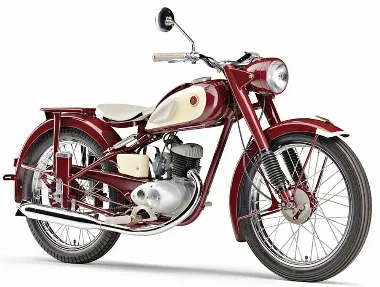
The bright dawn of the 1960s saw the emergence of a visionary engineer by the name of Shinsuke Tamura, whose mind was bubbling with revolutionary ideas. Driven by a passion for innovation, he set about creating a machine that would transcend the ordinary, giving birth to Kawasaki's first mass-produced motorcycle: the B8 125 cm3! Featuring a 2-stroke single-cylinder engine, with a maximum power output of 8 hp at 8,000 rpm in 1962.
Tamura, like a modern alchemist, fused raw power with mechanical elegance. Inspired by Meihatsu's B7, which already used a Kawasaki engine, chassis and suspension, he sculpted each part with meticulous precision. It quickly became popular with the Japanese workers for whom it was primarily intended.
The B8 put the competition to the sword, thanks in part to its 4-speed transmission, but also to its suspension. Sparkling with its reflections, the bike also made a name for itself with its high-capacity fuel tank, its duo capabilities, the practical optional package carrier... and its rapid success in competition. The "B8-Motocross" version took the top 6 places in the national MX championship in '63. The ancestor of the KX was born.
A very practical improvement in its career: an integral crankcase to protect the chain. A plus in terms of economy and cleanliness, as well as protecting the chrome from grease stains. Ainis' metallic dress glistened under the spotlights, capturing stunned glances as it roared through the darkness of night. Every curve was a functional work of art.
The B8 125 became a rolling legend, pushing back the limits of speed and elegance. Bikers' dreams intertwined with the roar of its engine, creating a symphony of freedom and power.
And so, this first true Kawasaki became the phoenix of the asphalt, reborn with every stroke of the starter motor as an affirmation of power and ingenuity.
Its story is that of a daring chapter in the book of two-wheelers, where Kawasaki made its way with panache across the motorcycling landscape, leaving behind the unalterable echo of its adventure. And today, its legacy lives on, reminding road lovers that sometimes, the extraordinary lies at the end of the handlebar.
E. Jolidebu - Manufacturer's photos
by Greg

 Share
Share
Key facts Kawasaki B8 125 (1962) : What you need to know before you buy
 France
Specifications Kawasaki B8 125 1962
- Chassis
- Frame : simple steel cradle
- Fuel capacity : 10 liters (2.64 US gallons)
- Seat height : 790 mm (31.10 in)
- Length : 1,900 mm (74.80 in)
- Width : 680 mm (26.77 in)
- Min height : 980 mm (38.58 in)
- Wheelbase : 1,265 mm (49.80 in)
- Dry weight : 116 kg (256 lb)
- Weight when fully loaded : 125 kg (276 lb)
- Front axle
- Telescopic fork Ø nc
- drum brakes
- Front tire : 100 / 90 → Order this type of tire
- Transmission
- 4 stage gearbox , manual
- Secondary by chain
- Rear axle
- 2 lateral shock absorbers
- drum brakes
- Rear tire : 130 / 80 → Order this type of tire
- Motor
- single-cylinder , 2 strokes
- 1 carburettor Ø 20 mm
- Cooling system : by air
- 125 cc
- 8 ch (7.90 hp) to 8,000 rpm
- 6.40 mkg to 4,800 rpm
- Power-to-weight ratio : 14.68 kg/ch
- Weight / torque ratio : 18.13 kg/mkg
- Compression : 6,3 : 1
- Standard equipment
- Spoke wheels
- Practical information





Models
1962
Used
Compare the B8 125 to its competitors
Torque
Power
Power-to-Weight ratio
Torque-to-Weight ratio
Speed
FAQ Your frequently asked questions about the B8 125 1962
- What is the power of the B8 125 1962?
-
The B8 125 1962 develops a power of 8 ch (7.90 hp)
- What is the torque of the B8 125 1962?
-
The maximum torque of the B8 125 1962 is 6.40 mkg to 4,800 rpm.
- What is the maximum speed of the B8 125 1962?
-
The B8 125 1962 is capable of reaching a top speed of approximately 100 km/h (62.10 mph) on the track.
- What is the weight of the B8 125 1962?
-
The B8 125 1962 has a a dry weight of 116 kg (256 lb), a weight when fully loaded of 125 kg (276 lb).
- QWhat is the seat height of the B8 125 1962?
-
To ensure good accessibility, the B8 125 1962 offers a minimum seat height of 790 mm (31.10 in).
- What is the price of the B8 125 1962?
-
The price of the B8 125 1962 is 150€ in France
News
-
New motorcycle products for 2026

-
Bridgestone announces the RS12, its new road-race weapon.
-
Yamaha Race Like A Girl: Natalia Rivera in episode 5.
-
Bridgestone presents the Battlax V03, its new slick tire.
-
With Sartoria Meccanica, MV-Agusta aims to go beyond premium.
-
Upgrading the entire Bonneville family for 2026.
-
Metzeler unveils three new tires at EICMA.
-
World Superbike celebrates 70 years of Yamaha.
-
Exceptional: some thirty new Triumphs in 2026.
-
40.000 bikers for the Royal-Enfield "One Ride" 2025.


Bikers' reviews Leave a review