
Nicknamed the "Michelangelo of the motorcycle", Massimo Tamburini is not just a designer, he's one of the greatest creators in the history of the motorcycle. His machines are not mere vehicles; they are rolling works of art, symbols of performance, technology and pure beauty. From the founding of Bimota to his masterpieces at Ducati and MV Agusta, his legacy is immense and continues to inspire enthusiasts the world over.
The beginnings of Bimota: the alliance of three geniuses
Tamburini's story began with an all-consuming passion for mechanics and racing. In 1973, he founded Bimota in Rimini, Italy, with two friends and partners: Valerio Bianchi and Giuseppe Morri. The name Bimota is an acronym of their surnames: Bianchi, Morriand Tamburini.
At the time, Japanese engines were very powerful, but their chassis left much to be desired. Tamburini, with his engineering vision, came up with the idea of designing revolutionary frames and combining them with these powerful engine blocks. The aim was to create motorcycles combining maneuverability, lightness and extreme performance.
Among Bimota's first notable creations are some landmark models:
-
HB1 (1973): The very first model, a Bimota chassis wrapping a Honda CB750 engine.
-
SB1 (1975): A racing model with a Suzuki engine, demonstrating the brand's sporting ambitions.
-
HD2 and HD3: Chassis for the Honda CB400F and Honda CB750 Four, always in the same vein of improved performance.
-
KB1 (1978): The first mass-produced model, powered by the Kawasaki Z1 engine. It marked Bimota's entry into the high-performance road bike market.
-
SB2 (1977): Another iconic model with a Suzuki GS750 engine, introducing new technical solutions such as swingarm adjustment.
-
Yamaha YB3: The 250cc racing model of 1980, which demonstrated Bimota's dominance in competition.
-
Kawasaki KB2: A compact, powerful model with the Kawasaki Z500 engine.
-
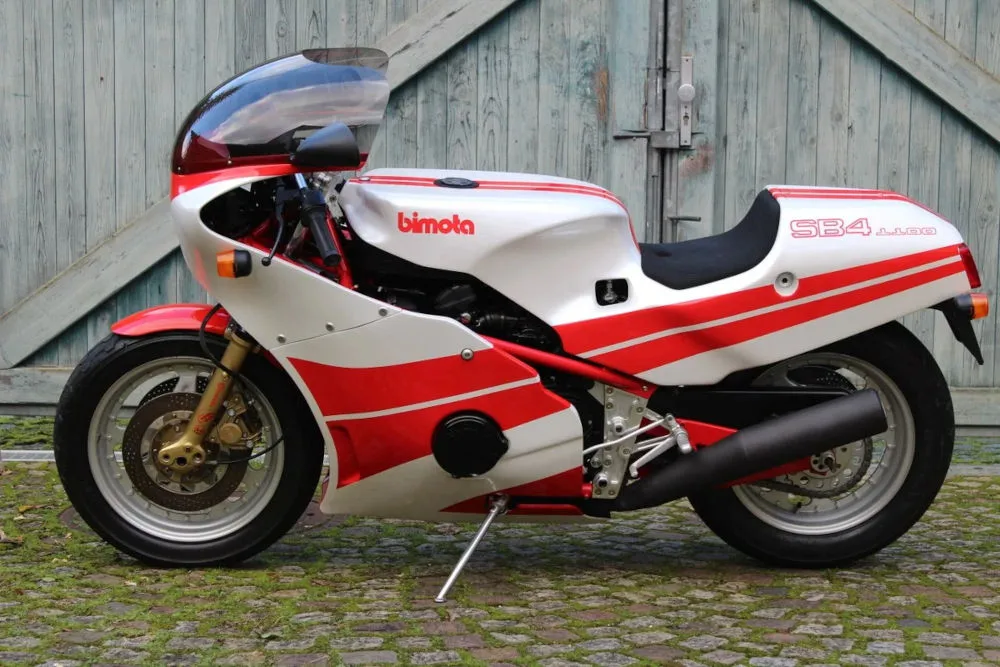
SB4: The first Bimota with a full fairing, featuring the engine from the Suzuki GSX1100.
-
DB1 (1985): A motorcycle that caused a sensation with its wrap-around fairing and Ducati engine. It was one of the first motorcycles to conceal its entire mechanical system, a bold design choice for its time.
After leaving Bimota in the mid-80s, Tamburini joined Cagiva (later MV Agusta Group) and relaunched the Ducati brand. It was here that he created motorcycles that have become living legends.
Ducati masterpiece: the 916
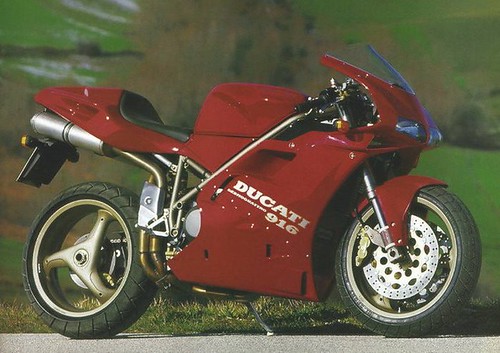
In October 1993, Massimo Tamburini unveiled the Ducati 916 at the Milan Motorcycle Show. It was a revelation, a motorcycle that would change the face of the industry. With its single-sided swingarm, under-seat exhausts and twin headlights, the 916 is a dynamic sculpture. It's not just beautiful, it's incredibly efficient on the track, propelling Ducati to multiple world Superbike titles. The 916, and its 996 and 998 evolutions, is considered one of the most beautiful motorcycle designs of all time.
MV Agusta: the F4 and the Brutale
After his success at Ducati, Tamburini dedicated himself to the rebirth of the prestigious MV Agusta brand. His mission was to restore the brand to its former glory by creating a motorcycle that would combine luxury, performance and exceptional design.
In 1999, he presented the MV Agusta F4 Serie Oro. Like the 916 before it, the F4 is a work of art, with its four organ-shaped tailpipes and sleek lines. It is considered by many to be the pinnacle of Tamburini's design and a cult motorcycle that redefined the superbike segment.

After the F4, he created another model that would become a standard: the MV Agusta Brutale. Launched in 2001, this naked bike takes the DNA of the F4 by removing the fairing, revealing a muscular engine and a beautifully sculpted trellis frame. The Brutale Serie Oro, the first production version, was launched in 2002.

The legacy of a visionary
Massimo Tamburini passed away in 2014, but his influence remains omnipresent. His son, Andrea Tamburini, carried on his legacy by creating the Tamburini Corse brand. The brand has continued to produce exceptional machines, such as the T12 Massimo in 2016, an ultimate racing motorcycle, and the F43 Centenario in 2023, a sublime tribute to F4 design.
From the Bimota HB1 to the Tamburini Corse F43 Centenario, every bike he has designed or inspired by his work is a milestone in history, a symbol of his genius. That's why Massimo Tamburini will forever remain the architect of every motorcyclist's dreams.

 Share
Share
 helmet
 Gloves
 jacket
 braking
 Chain kit
 Oils
Oils Find an intercom
 Parts
Parts Luggage
 Tires
Tires


Bikers' reviews