
Motorcycle specifications Suzuki750 GSX-R 1986 The most famous sportswoman


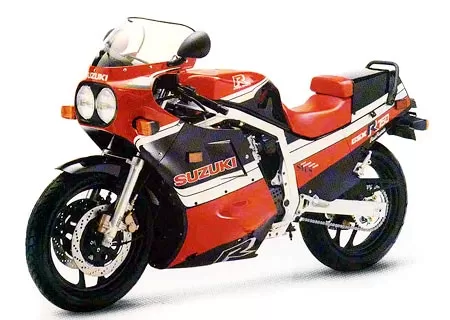
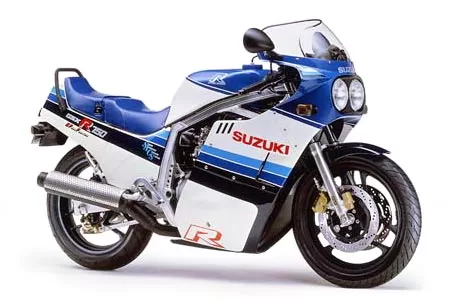
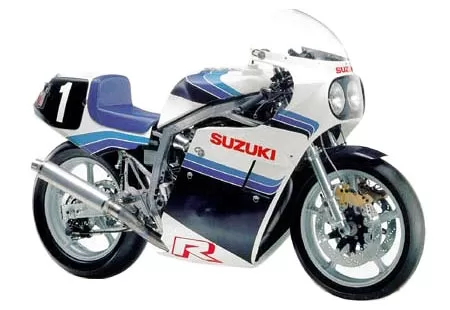
presentation of the 750 GSX-R 1986
What can be said to introduce the GSX-R 750 that hasn't already been said elsewhere, so much so that this bike has become a benchmark. The GSX-R 750 is a revolution in itself; a quantum leap in the arms race; a pure pistarde that some genius (or lucky person) would have equipped for the road.
The GSX-R 750 has been the benchmark, the immortal myth for decades. None of its supersport rivals from the early days have survived it; Gone are the VF-F, RC 30, RC 45, FZ, FZR, YZF 750, GPZ-R, ZXR, ZX7-R... Suzuki's 750 supersport bike has exhausted its competitors to the point where they've left the segment in favor of the 600 and 1000cc models.
admittedly, the introduction is excessive and not very objective: the disappearance of the 750cc is surely due much more to changes in the rules of endurance competitions than to the superiority of the GSX-R. However, it has to be said that the Hamamatsu-based company has made its mark on the 750cc supersports segment. So much so, in fact, that the brand could not bring itself to abandon this displacement and for a third of a century offered a GSX-R 750 in its catalog, more than 30 years after its first presentation in September 1984 at the Cologne Motor Show (IFMA). This resilience underlines the importance of this model in Suzuki's history.
after all, many Suzuki models have inherited genes from this bike: sportbikes (the GSX-R family), road bikes (the GSX-F family, the GSX-G), roadsters (the GSX-S families and the GSF Bandit, which got the supersport engine and, for the first 600 Bandit, a frame reminiscent of the shape of the first GSX-R frames).
a model of this calibre deserved a few pages in the "vintage motorcycles" section.

The engineers seem to have taken only one constraint into account: efficiency. And everything in the machine's design seems to be based on this idea.
the engine is innovative, but not revolutionary. Suzuki has simply taken the best of today's mastered technologies and adapted them in its own way. The 4-cylinder short-stroke engine (70 mm x 48.7 mm) is fitted with a twin-cam cylinder head driving 16 valves.
Some competitors (Honda with its VF-F, Kawasaki with the GPZ and Yamaha with its FZ, which will arrive shortly after the GSX-R) have opted for liquid cooling, much more efficient than the traditional fins of air-cooled engines. However, this technology has the disadvantage of being heavier than air cooling. Liquid and bulky radiators weigh heavily on the scales.
On the other hand, this new block, whose power must reach 100 hp (this point is part of the specifications imposed on the engineers), cannot be satisfied with simple air cooling. Suzuki therefore opted for an original solution called the Suzuki Advance Cooled System, from which the SACS engine name derives. This system uses engine oil as the cooling fluid. The engine retains its cooling fins and adds a smaller radiator than those used for water cooling. This saves weight on both the fluid and the radiator. The quantity of engine oil is greater than on a conventional engine, but this is all the better for mechanical reliability (the longevity of this type of engine is proof of this).
The SACS solution is undoubtedly one of the most rational solutions for this type of motorcycle, providing greater efficiency while remaining simple in design.
and if Suzuki has succeeded in saving a certain number of kilos with its engine, the chassis is not to be outdone. The aim here is to offer a bike that weighs 20% less than the competition. Suzuki took 220kg as the reference weight (a realistic basis for the time), and imposed a weight of 176kg on his design engineers.
To keep the weight down, the frame and swingarm are made of aluminum. This is a common feature in competition, but one rarely found on production bikes. At just 8kg, the frame is extremely lightweight.
With its short wheelbase (1,425 mm), narrow tires (110/80-18 front and 140/70-18 rear) and low weight, the GSX-R is extremely maneuverable and spirited. The frame's perfectible rigidity and the sometimes excessive reactivity of this first generation led the brand to modify the swingarm in 1986 (lengthening it by 30 mm) to provide a little more stability. In 1987, it also gained a number of improvements taken from the 1986 GSX-R 750R model (a kind of competitor's bike halfway between the road and track versions).
incidentally, the GSX-R brakes hard, very hard. Suzuki uses what it calls a "decapiston" system, with a double 300 mm front disc fitted with 2 4-piston calipers and a single 280 mm disc with 2-piston caliper; enough to tear up strips of asphalt when it comes to stopping the 176 kg machine.

the sensations are breathtaking, and the new bike accelerates, brakes and twirls like no serious motorcycle ever has.rie before it, even if you need a certain amount of experience to master its sometimes brutal reactions. The GSX-R 750 is by no means a utility bike that can be ridden gently.
when the GSX-R was launched in France, the importer provided dealerships with a brochure bearing the headline: "Born to be a legend": "Born to be a legend". And while this slogan may not have been self-evident at the time, it summed up the impressions of both the bikers who came to see it in the dealership window, and those who were lucky enough to ride it.
Tanthallas - Manufacturer's photos

by Greg

 Share
Share
Key facts Suzuki 750 GSX-R (1986) : What you need to know before you buy
Highlights
- Performances
- Sensations
Weak points
- Elitist
- Exclusive
- Lack of rigidity
Prices
| Basic version | |
|---|---|
 France France |
6,500€
|


Performance
- Max speed : approximately 240 km/h (149.10 mph)
Specifications Suzuki 750 GSX-R 1986
- Chassis
- Frame : longerons and aluminum
- Fuel capacity : 19 liters (5.02 US gallons)
- Seat height : 755 mm (29.72 in)
- Length : 2,115 mm (83.27 in)
- Width : 745 mm (29.33 in)
- Min height : 1,215 mm (47.83 in)
- Wheelbase : 1,455 mm (57.28 in)
- Dry weight : 176 kg (388 lb)
- Weight when fully loaded : 200 kg (441 lb)
- Front axle
- Telehydraulic fork Ø 41 mm, Wheel travel : 130 mm (5.12 in)
- Braking 2 discs Ø 300 mm (11.81 in), 4-piston caliper
- Front tire : 110 / 80 - 18 → Order this type of tire
- Transmission
- 6 stage gearbox
- Secondary by chain
- Rear axle
- Mono-damper, Wheel travel : 127 mm (5 in)
- Braking 1 disc Ø 280 mm (11.02 in), single-piston caliper
- Rear tire : 140 / 70 - 18 → Order this type of tire
- Motor
- 4 cylinders online , 4 strokes
- 4 carburetors Ø 29 mm
- Cooling system : combined air / oil
- 2 ACT
- 4 valves per cylinder
- 749 cc
- 100 ch (98.60 hp) to 10,500 rpm
- 7.20 mkg to 8,000 rpm
- Power-to-weight ratio : 1.78 kg/ch
- Weight / torque ratio : 24.44 kg/mkg
- Compression : 9.8 : 1
- Practical information





Models
1987
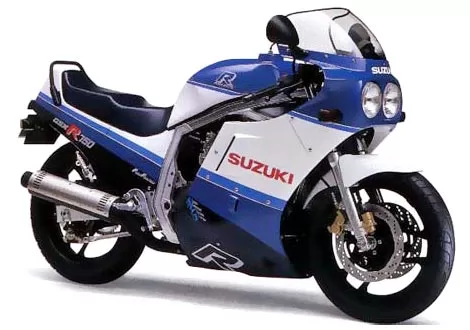
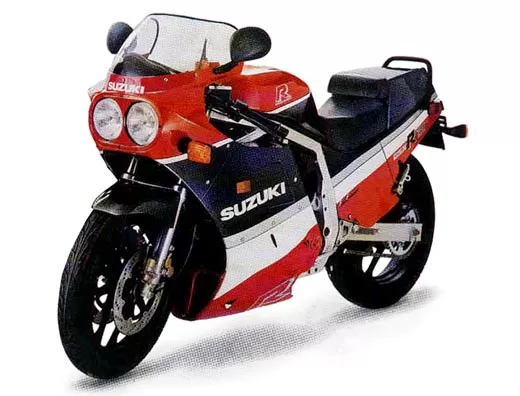
1986
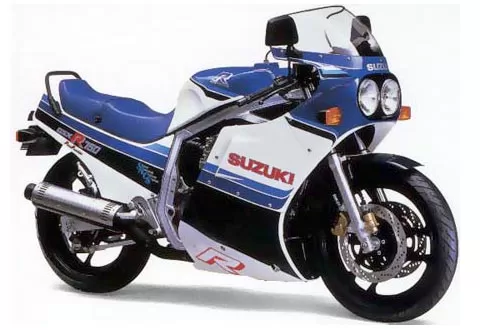
1985
Used


Compare the 750 GSX-R to its competitors
Fuel consumption
Range
Torque
Power
Power-to-Weight ratio
Torque-to-Weight ratio
Speed
FAQ Your frequently asked questions about the 750 GSX-R 1986
- What is the power of the 750 GSX-R 1986?
-
The 750 GSX-R 1986 develops a power of 100 ch (98.60 hp)
- What is the torque of the 750 GSX-R 1986?
-
The maximum torque of the 750 GSX-R 1986 is 7.20 mkg to 8,000 rpm.
- What is the maximum speed of the 750 GSX-R 1986?
-
The 750 GSX-R 1986 is capable of reaching a top speed of approximately 240 km/h (149.10 mph) on the track.
- What is the weight of the 750 GSX-R 1986?
-
The 750 GSX-R 1986 has a a dry weight of 176 kg (388 lb), a weight when fully loaded of 200 kg (441 lb).
- QWhat is the seat height of the 750 GSX-R 1986?
-
To ensure good accessibility, the 750 GSX-R 1986 offers a minimum seat height of 755 mm (29.72 in).
- What is the price of the 750 GSX-R 1986?
-
The price of the 750 GSX-R 1986 is 6,500€ in France
News
-
New motorcycle products for 2026

-
Bridgestone announces the RS12, its new road-race weapon.
-
Yamaha Race Like A Girl: Natalia Rivera in episode 5.
-
Bridgestone presents the Battlax V03, its new slick tire.
-
With Sartoria Meccanica, MV-Agusta aims to go beyond premium.
-
Upgrading the entire Bonneville family for 2026.
-
Metzeler unveils three new tires at EICMA.
-
World Superbike celebrates 70 years of Yamaha.
-
Exceptional: some thirty new Triumphs in 2026.
-
40.000 bikers for the Royal-Enfield "One Ride" 2025.


Bikers' reviews Leave a review - 1 review