
Motorcycle specifications YamahaR7 700 2026 Tense outside...


presentation of the R7 700 2026
Introduced in 2021, the R7 has quickly become Yamaha's school of sport. With its R1 face, distinctive riding position and a more spirited chassis than the MT-07 (from which it derives), it has attracted a clientele eager for trajectories, without the thrill of a hectic cavalry. With 73 horsepower, the engine lacks the adrenalin of a 600 R6.
Recent improvements to the CP2 range allow this gentle pistarde to step up a gear. For greater efficiency? Above all, more control.
The new R7 revitalizes its styling cautiously, but enough to give it a little more distinction. With its double-pupil eyes and, above all, the better-integrated central headlight (we won't miss the monocle in the center of the air intake), it's more assertive, more incisive. This face and the appearance of turn signals in the rearview mirrors are the most distinctive features of this evolution. And yet, the entire exterior has changed, albeit timidly, so that everyone can find their feet. Surfaces lose their curves and detours for straighter, tighter lines - and without unsightly fins that would serve no purpose anyway.
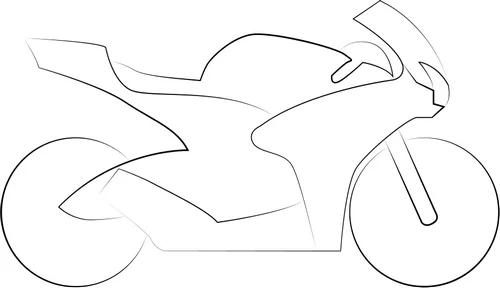
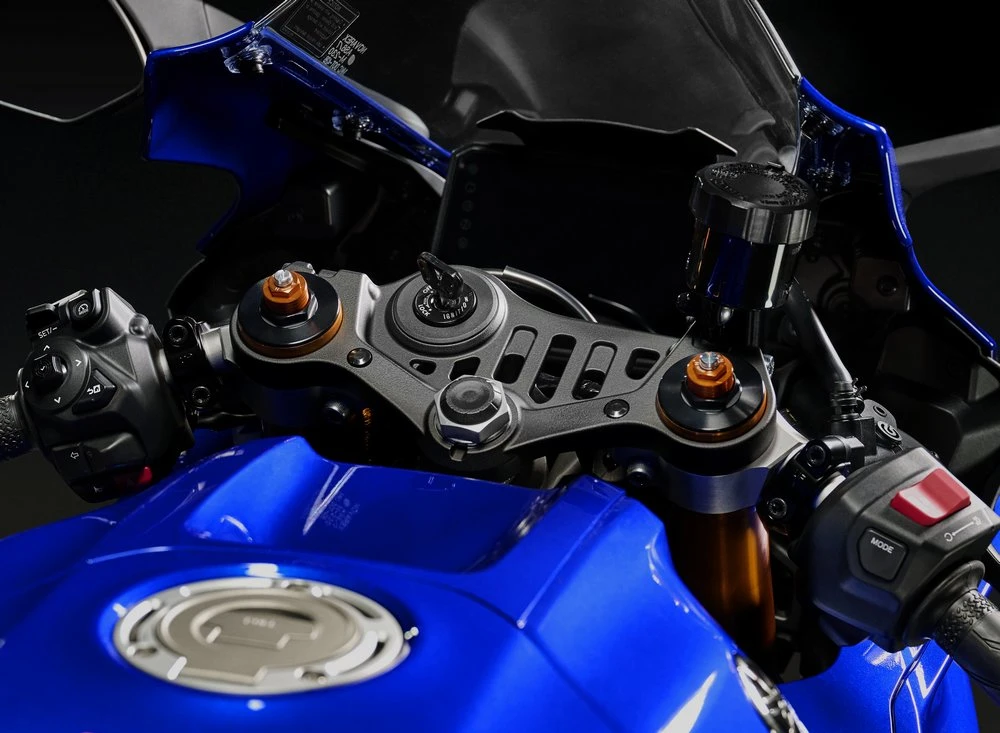
The first version of the R7 (the one with the 700 twin - we're not talking about the 750 Superbike from '99) put the rider in a sporty, sporty position. The new one repositioned its half handlebars to relieve the rider's posture, while remaining engaged. Add to this R1 footrests, a sharpened seat lowered by 5 mm and a modified fuel tank, and you get improved mobility for more responsive riding.
Refocused
And that's what it's all about: riding! Better! The result is a whole series of chassis modifications: a reinforced, stiffer frame with no weight gain, a modified swingarm, a redesigned fork top-member, aluminum piston rods in the fork instead of steel, and more responsive wheels. Yamaha's SpinForged wheels are lighter and reduce inertia. Tires remain faithful to Bridgestone's S series, but are upgraded from S22 to S23. Now it's ready to generate more liveliness and rigor in curves.
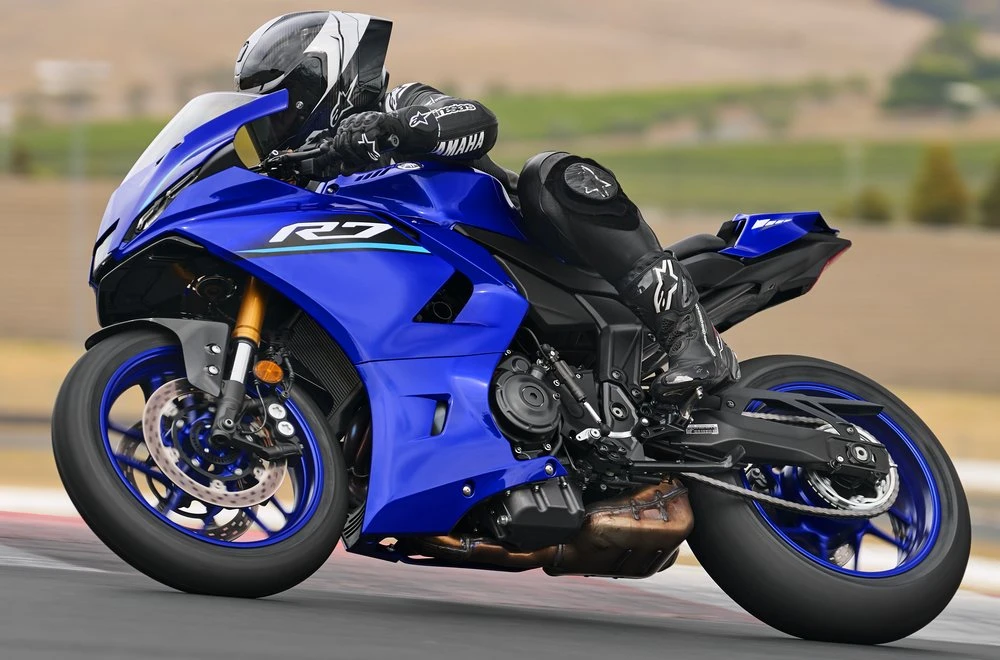
An area where it's imperative to get in and out fast. For even if the twin is invigorating, pleasant and lively, it's still not a very powerful mill for a 189-kilo sports bike. It's impossible to pull out of a corner quickly if you haven't kept your speed up. By upgrading to Euro5+, the twin-cylinder engine has lost neither watts nor power. It has simply left some of its sensations behind. Its behavior will be smoother, with a more even distribution of torque. However, the 73.4 hp and 6.9 mkg package is designed differently... in different ways, plural.
Its voltage rises with electronics
Suddenly, the R7 Phase II is all about electronics. Before, you had nothing. You welded and that was it. Today, electronics on a par with the 900 R9 are thinking in terms of watts output, and even before. The ride-by-wire will start managing the throttle opening level, in correlation with the three power modes. Next, the 6-axis IMU will locate the bike and its movements in space to inform traction control and others. This is just the beginning. We'll now give you an overview of all the riding assistance available on the R7:
- Three preset driving modes (Sport / Street / Rain) + two customizable modes
- 3rd-generation Up&Down shifter (2 settings)
- Traction control (3 levels)
- Sump modes (3 levels)
- SCS glide control (3 levels)
- LIF wheeling control
- EBM engine brake management (2 levels)
- BC curve braking control
- BSR engine torque regulation on deceleration
- LC (Launch Control) stop-start assistance
- ABS deactivation on rear axle
- Cruise control
- Speed limiter
A real overdose, for a motorcycle 1/3 less powerful than an R9. Fortunately, all these aids can be switched off to give the experienced rider back his or her freedom.
In fact, the Y-TRAC REV app is available as an option for recording, analyzing and comparing data (lap times, sector times, angle of inclination, engine speed, gear position, speed, throttle position, level of electronic assistance).
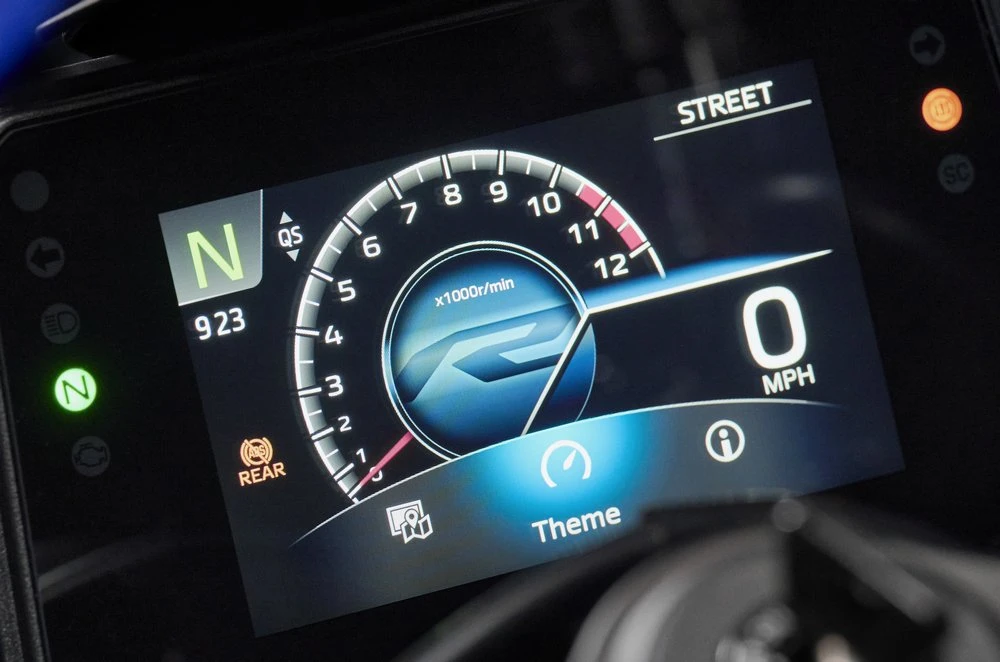
The R7 has also dropped its LCD screen and, like virtually all other Yamaha models, is equipped with a 5-inch TFT color display. A serious visual leap forward, with beautiful graphics distributed according to 4 display themes.
Pairing with your smartphone allows the screen to inform you, in addition to on-board data, of calls, text messages, the weather, GPS navigation (via the Garmin StreetCross app); and to modify the settings of the remote electronic assistances in the YRC menu.
It keeps its preferences
The R7 2026 seems to have shopped around for its electronics among the fierce sports cars in the range. Not so with the brakes - no Brembo here, but she wouldn't have much use for them. The job will be done very convincingly, with 4-piston radial jaws from Advics to bite the 298 mm discs. The rear features a 245 mm disc.
Before adjusting the multiple possibilities of the techno-numerical controls, a chassis adjustment will save a lot of time. The 41 mm inverted fork and shock absorber can be adjusted from anywhere.
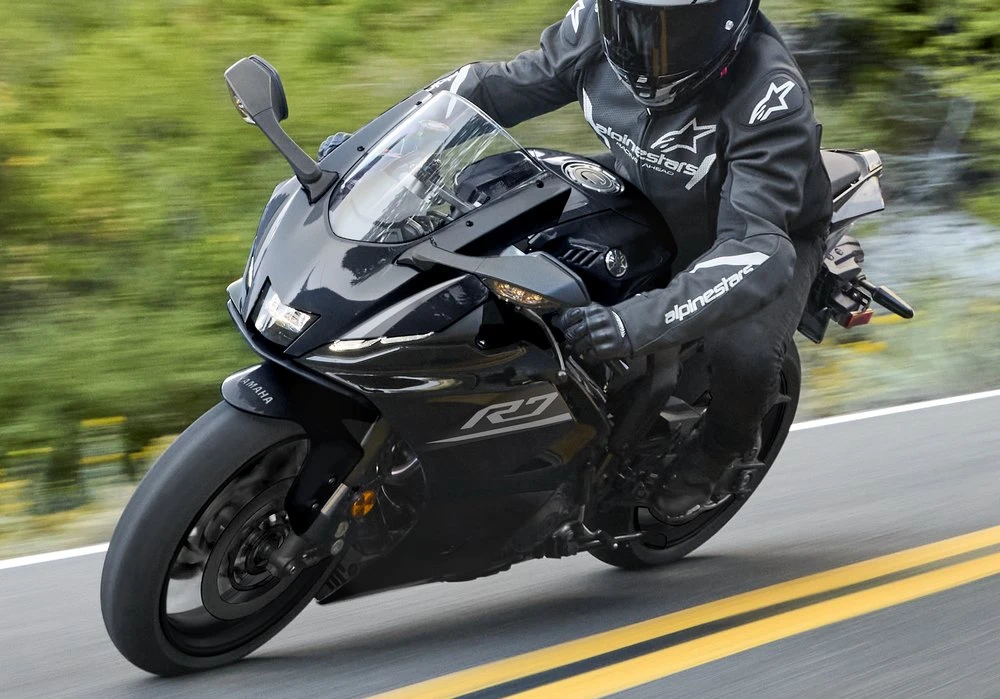
Let's take a few lines to point out that the R7 gets new commodos, turn signals that switch themselves off, and the Emergency Stop Signal (ESS) function - turning on the hazard lights when braking hard or suddenly.
Honed in silicon
The Yamaha R7 has been upgraded.
In terms of modernity and refined dynamics management. Slightly less demanding, more technological, more racy (not racing), this bike wants to race without the fury. When you know how to track, it can provide the means to enjoy yourself.
The entire R family is available in 70th anniversary colors. The R7 too, which makes it look like.... theYZF-R7 mentioned at the beginning. A superb design of which she'll be proud.
M.B. - Manufacturer's photos
by Greg

 Share
Share
Key facts Yamaha R7 700 (2026) : What you need to know before you buy
Prices
| Basic version | |
|---|---|
 France France |
10,500€
(Motoplanete estimate)
|
Model sold in 2026

Performance
- Max speed : approximately 210 km/h (130.50 mph)
- Average fuel consumption : 4.10 liters/100km (0.57 mpg)
-
Estimated range
: 341 km (212 miles)
Calculated range until tank is empty, not verified.
Specifications Yamaha R7 700 2026
- Chassis
- Two-seater saddle
- Frame : steel diamond type
- Fuel capacity : 14 liters (3.70 US gallons)
- Oil capacity : 3 liters (0.79 US gallons)
- Seat height : 830 mm (32.68 in)
- Length : 2,070 mm (81.50 in)
- Width : 725 mm (28.54 in)
- Min height : 1,160 mm (45.67 in)
-
Min. ground clearance : 135 mm (5.31 in)
- Wheelbase : 1,395 mm (54.92 in)
- Weight when fully loaded : 189 kg (417 lb)
- Front axle
- Reverse telehydraulic fork Ø 41 mm, Wheel travel : 120 mm (4.72 in)
- Angle de chasse : 24 °
- Preload, compression and rebound adjustment
- Braking 2 Advics discs Ø 298 mm (11.73 in), radial mounting, 4-piston caliper
- Front tire (Tubeless) : 120 / 70 - 17 → Order this type of tire
- Handlebars handlebars
- Transmission
- 6 stage gearbox , manual - shifter as standard
- Secondary by chain
- Rear axle
- Monoshock, Wheel travel : 121 mm (4.76 in)
- Preload and rebound adjustment
- Braking 1 Advics disc Ø 245 mm (9.65 in), single-piston caliper
- Rear tire (Tubeless) : 180 / 55 - 17 → Order this type of tire
- Motor
- two-cylinder online, parallel , 4 strokes, set at 270°
- Injection Ø nc
- Cooling system : liquid
- 2 ACT
- 4 valves per cylinder
- 689 cc
- 73.40 ch (72.40 hp) to 8,750 rpm
- 6.90 mkg (68 Nm) to 6,500 rpm
- Power-to-weight ratio : approximately 2.44 kg/ch
- Weight / torque ratio : approximately 25.57 kg/mkg
- Compression : 11.5 : 1
- Starting system : electric
- Anti-pollution standard : Euro 5+
- Standard equipment
- Brake assist : ABS cornering
- Number of riding modes : 5
- TFT Full-Colour screen size: 12.70 cm (5 inches)
- Forged rims
- Gear indicator
- Shifter
- Inertial measurement system
- Traction control
- Inertial measurement system
- Anti-wheeling control
- Launch Control
- Aluminium rims
- ABS Cornering
- Bluetooth
- Practical information





Models
2026


Used
Compare the R7 700 to its competitors
FAQ Your frequently asked questions about the R7 700 2026
- What is the power of the R7 700 2026?
-
The R7 700 2026 develops a power of 73.40 ch (72.40 hp)
- What is the torque of the R7 700 2026?
-
The maximum torque of the R7 700 2026 is 6.90 mkg (68 Nm) to 6,500 rpm.
- What is the maximum speed of the R7 700 2026?
-
The R7 700 2026 is capable of reaching a top speed of approximately 210 km/h (130.50 mph) on the track.
- What is the weight of the R7 700 2026?
-
The R7 700 2026 has a a weight when fully loaded of 189 kg (417 lb).
- What is the fuel consumption of the R7 700 2026?
-
Average fuel consumption is estimated at 4.10 l/100km (0.57 mpg) according to the WMTC cycle.
- QWhat is the seat height of the R7 700 2026?
-
To ensure good accessibility, the R7 700 2026 offers a minimum seat height of 830 mm (32.68 in).
- What is the price of the R7 700 2026?
-
The price of the R7 700 2026 is 10,500€ in France
- Is the R7 700 2026 approved for transporting a passenger?
-
Yes, this vehicle is equipped as standard for 2 people.
- What colors are available for the R7 700 2026?
-
For the 2026 model year, the R7 700 is available in several colors: blue, black and red / white.
News
-
New motorcycle products for 2026

-
Bridgestone announces the RS12, its new road-race weapon.
-
Yamaha Race Like A Girl: Natalia Rivera in episode 5.
-
Bridgestone presents the Battlax V03, its new slick tire.
-
With Sartoria Meccanica, MV-Agusta aims to go beyond premium.
-
Upgrading the entire Bonneville family for 2026.
-
Metzeler unveils three new tires at EICMA.
-
World Superbike celebrates 70 years of Yamaha.
-
Exceptional: some thirty new Triumphs in 2026.
-
40.000 bikers for the Royal-Enfield "One Ride" 2025.



Bikers' reviews Leave a review