
Motorcycle specifications Yamaha300 YZF-R3 2017 For slicing without cutting


presentation of the 300 YZF-R3 2017
While the 300 sportsbike category may not arouse much enthusiasm (in our neck of the woods), its presence is confirmed year after year. The creation of a specific World Superbike championship for this category tends to confirm this position. At Yamaha, the R3 is ideally positioned between the youthful YZF-R125 and the demanding R6 / R1. The summer of 2017 will be beneficial, as it will bring the Euro4 pass. New decals, reflectors and engine adjustments are all part of the package. Apart from that, no other changes to report. The YZF-R3's image as a provocative, accessible but not radical sports bike continues, with just the right amount of watts.
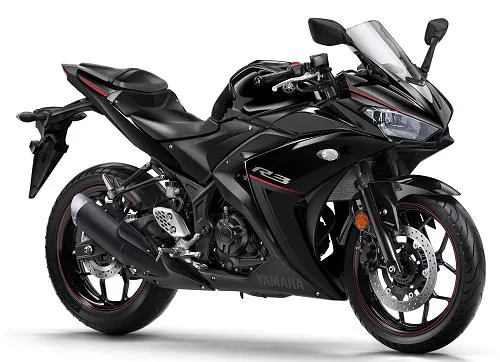
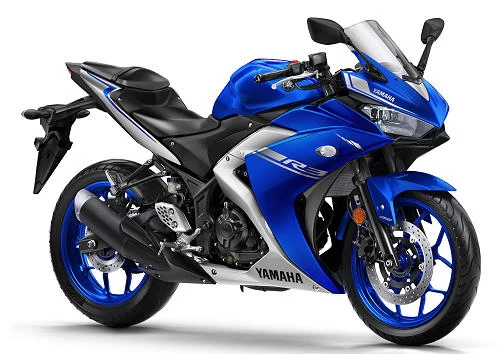
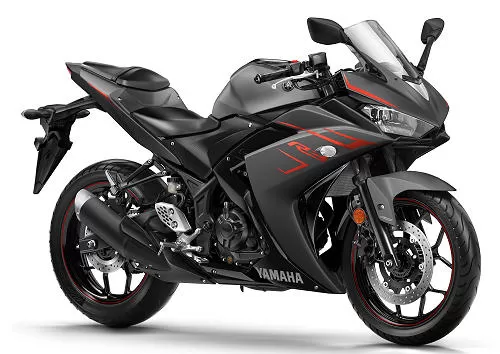
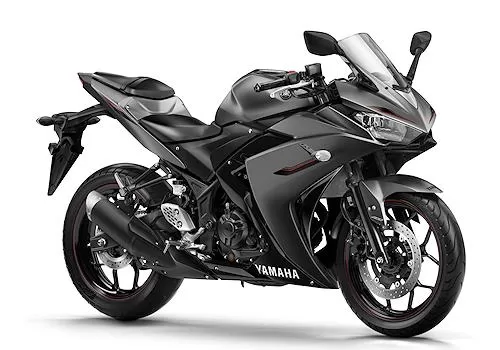
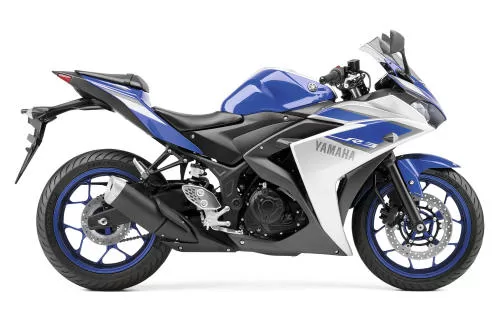
this YZF-R3 does indeed have the genes of the R family. It's inspired, taut, almost nervous, with a rewarding design and a salient personality. You haven't even started it yet, and it smells like a wriggling shark. A sports car isn't just about horsepower and lap times; it's that desire that it provokes. This cheeky little thing really makes you want to take an interest.

R3 for 3 cylinders?!? No, for its level of displacement. Yam gives it a big 300; 321 cm3 to be precise. Very super-square, with dimensions of 68 by 44.1 mm, the new twin-cylinder spits out an impressive 42 hp at 10,750 rpm. Torque-wise, it's not much to shout about, but delivers a decent 3 mkg at 9,000 rpm. In terms of numbers, its wattage enables it to tease the KTM RC 390 (44 hp), provoke the Benelli 302 R (35 hp) and downright smoke the Suzuki GSX 250 R (25 hp).
Medium-sized YZF doesn't mean medium-sized technology. Much of Yam's engineering can be found in this mill: fuel injection, double ACT, multi-valves, forged pistons, case-hardened connecting rods, Diasil cylinder (Yam technology incorporating 20% silicon in aluminum), the presence of just one tappet and one pellet between each cam and valve, balancer and cylinder offset as on the MT-07 and MT-09 engines.
Let's put it more simply: the R3 will give you three times more power than the YZF-R 125, with only 29 kilos more to carry around. Yam claims a wet weight of 169 kilos.
that's almost the same weight as the R6 dry. But the R3 doesn't offer as many chassis refinements as the R6. Well, you don't need a SuperSport-worthy chassis either. A more classic yet tried-and-tested design will do just fine. 35 mm steel tubes are welded together in a traditional diamond pattern. To flatter the owner, some technical comparisons are put forward by Yamaha. Like the choice of a long 573 mm swingarm, allowing the R3's chassis to benefit from the same swingarm to wheelbase ratio as the 2014 R1.
The R3 is suspended by a 41 mm fork, absolved of any adjustment, and a Monocross-style shock absorber mounted directly on the swingarm. As for brakes, they're more road-GT than pure sport. ABS is standard, monitoring one disc per wheel. The front disc measures 298 mm and features a double-piston caliper; the rear is a 220 mm single-piston unit.

The R3's total sportiness should not rhyme with racing. With half-handlebars positioned above the fork crown, a reduced seat height (780 mm) and basic suspension, the mid-size YZF seems to be geared towards leisurely rides and a sporty GT riding position. A full dashboard is also included, with fuel gauge, gear indicator, shiftlight and digital speedometer; a needle will also give you the engine speed.
the Yamaha YZF-R3 occupies a strategic position in the popular 250 / 300 segment in emerging countries, and adds the famous R stamp, synonymous with the racetrack and sporting prestige. Its twin-cylinder engine has what it takes to ensure a minimum of performance, and its silhouette is a success. In France, the interest in this category was matched by its success. Colin Edwards believes in it completely.
******May 2019 update:
On May 9, 2019, Yamaha launched a recall campaign for its YZF-R3 and MT-03 for a problem with a fragile front brake lever.
Nature of the problem:
Under certain circumstances, the front brake lever can break during use due to porosity formed by unsaturated material during the low-temperature, non-pressure molding process. Further investigation revealed that these suspect levers should have been identified during the testing process and scrapped, but accidentally found their way onto the production line due to an incorrect cycle.
Under normal use, the brake lever cannot break.
To remedy this, Yamaha is launching a recall campaign to check the production markings on the front brake lever and replace it if necessary.
A total of 115 machines are affected for the French market.
Machines concerned :
- MT-03 (B9A7) with serial numbers between RH125 0010041 and RH125 0010640.
- YZF-R3 (B7P1) with serial numbers between RH12D 0002001 and RH12D 0002315.
Yamaha specifies that customers owning these machines have been notified by registered mail and should make an appointment as soon as possible with their Yamaha dealer to have this intervention carried out free of charge.
*****December 2018 update:
Yamaha has recalled its YZF-R3 and MT-03 for two defects: one on the radiator hose side, the other at the selector level.
Here are the details of these two recalls:
1 / Radiator hose failure
Due to incorrect material properties resulting from an improper curing process (vulcanization), a crack may appear on a radiator hose, and in extreme cases, coolant may leak. Yamaha is therefore initiating a recall campaign to replace the radiator hose(s).
Customers owning these machines have been notified by registered mail and must make an appointment as soon as possible with their Yamaha dealer to have this intervention carried out free of charge.
Machines concerned:
- YZF-R3 model 2017 (BR51) with serial numbers between RH121 0001001 and RH121 0003280.
- YZF-R3 models 2015-2016 (B023 / B02B) with serial numbers between RH071 0001001 and RH071 0006680.
- MT03 model 2018 (B9A1) with serial numbers between RH125 0001001 and RH125 0005280.
- MT03 model 2016 (B082) with serial numbers between RH07K 0001001 and RH07K 0006640.
A total of 1101 machines for the French market.
2/ Defective selector torsion spring
The torsion spring is not sufficiently strong due to insufficient shot peening. As a result, it can be difficult to change gear ratios on some machines. In extreme cases, the torsion spring may break, making it impossible to change gear ratios. Yamaha is therefore launching a recall campaign to replace the torsion spring.
Customers owning these machines have been notified by registered mail and must make an appointment as soon as possible with their Yamaha dealer to have this intervention carried out free of charge.
Machines concerned:
- YZF-R3 2015-2016 (B023 / B02B) with serial numbers between RH071 0001001 and RH071 0006000.
- MT03 model 2016 (B082) with serial numbers between RH07K 0001001 and RH07K 0004520.
A total of 731 machines for the French market.
M.B - Photos and video
by Greg

 Share
Share
Key facts Yamaha 300 YZF-R3 (2017) : What you need to know before you buy
Highlights
- Sporty figure
- New twin-cylinder
Weak points
- Low success rate for this type of engine
Prices
| Basic version | |
|---|---|
 France France |
5,799€
|


Performance
- Max speed : approximately 160 km/h (99.40 mph)
Specifications Yamaha 300 YZF-R3 2017
- Chassis
- Frame : in diamond steel
- Fuel capacity : 14 liters (3.70 US gallons)
- Seat height : 780 mm (30.71 in)
- Length : 2,090 mm (82.28 in)
- Width : 720 mm (28.35 in)
- Min height : 1,135 mm (44.69 in)
- Wheelbase : 1,380 mm (54.33 in)
- Weight when fully loaded : 169 kg (373 lb)
- Front axle
- Telehydraulic fork Ø 41 mm, Wheel travel : 130 mm (5.12 in)
- Braking 1 disc Ø 298 mm (11.73 in), 2-piston caliper
- Front tire : 110 / 70 - 17 → Order this type of tire
- Pressure : 2 bar
- Transmission
- 6 stage gearbox
- Secondary by chain
- Rear axle
- Mono-damper, Wheel travel : 125 mm (4.92 in)
- Braking 1 disc Ø 220 mm (8.66 in), single-piston caliper
- Rear tire : 140 / 70 - 17 → Order this type of tire
- Pressure : 2.5 bar
- Motor
- two-cylinder online , 4 strokes
- Injection
- Cooling system : liquid
- 2 ACT
- 4 valves per cylinder
- 321 cc
- 42 ch (41.40 hp) to 10,750 rpm
- 3 mkg to 9,000 rpm
- Power-to-weight ratio : approximately 3.78 kg/ch
- Weight / torque ratio : approximately 52.14 kg/mkg
- Compression : 11.2 : 1
- Standard equipment
- Brake assist : ABS as standard
- Practical information




Maintenance
Models
2018

2017
2016

2015

Used


Compare the 300 YZF-R3 to its competitors
Torque
Power
Power-to-Weight ratio
Torque-to-Weight ratio
Speed
FAQ Your frequently asked questions about the 300 YZF-R3 2017
- What is the power of the 300 YZF-R3 2017?
-
The 300 YZF-R3 2017 develops a power of 42 ch (41.40 hp)
- What is the torque of the 300 YZF-R3 2017?
-
The maximum torque of the 300 YZF-R3 2017 is 3 mkg to 9,000 rpm.
- What is the maximum speed of the 300 YZF-R3 2017?
-
The 300 YZF-R3 2017 is capable of reaching a top speed of approximately 160 km/h (99.40 mph) on the track.
- What is the weight of the 300 YZF-R3 2017?
-
The 300 YZF-R3 2017 has a a weight when fully loaded of 169 kg (373 lb).
- QWhat is the seat height of the 300 YZF-R3 2017?
-
To ensure good accessibility, the 300 YZF-R3 2017 offers a minimum seat height of 780 mm (30.71 in).
- What is the price of the 300 YZF-R3 2017?
-
The price of the 300 YZF-R3 2017 is 5,799€ in France
News
-
New motorcycle products for 2026

-
Bridgestone announces the RS12, its new road-race weapon.
-
Yamaha Race Like A Girl: Natalia Rivera in episode 5.
-
Bridgestone presents the Battlax V03, its new slick tire.
-
With Sartoria Meccanica, MV-Agusta aims to go beyond premium.
-
Upgrading the entire Bonneville family for 2026.
-
Metzeler unveils three new tires at EICMA.
-
World Superbike celebrates 70 years of Yamaha.
-
Exceptional: some thirty new Triumphs in 2026.
-
40.000 bikers for the Royal-Enfield "One Ride" 2025.



Bikers' reviews Leave a review - 7 reviews
Rating : 4/5 Respond to JP
The differences between the R25 and the R3 are mainly technical: 3 kilos and 6 horsepower more, a little more torque, and of course a different displacement.
Otherwise, the silhouette and design are the same, except for a slightly different deco. Rating : 5/5 Participate in the conversation