
Motorcycle specifications YamahaFZ 600 1987


presentation of the FZ 600 1987
Some models are long overdue. Recent examples include the Yamaha 1700 Vmax and the Suzuki 1300 B-KING. But there was a time when the Japanese industry was so dynamic that it could afford to release a new model almost at the snap of a finger; a new model whose sole purpose would be to keep customers waiting for the real thing. The Yamaha FZ 600 is a case in point.
in the mid-1980s, the manufacturer with the tuning forks offered enthusiasts of medium-displacement sports bikes a fairly classic model in the shape of the FJ 600. Its worthy successor (the FZR 600) was already more or less announced, but the competition was becoming increasingly aggressive, with water-cooled 4-cylinder models far more powerful than the FJ 600.
kawasaki was quickest off the mark with the GPX 600 and GPZ 600 R in 1985. Honda's 600cc CBR range was launched in 1987, inspired by the "Aero" styling of the CBR 1000 F. Suzuki, for its part, decided to stand out from the crowd by introducing a highly prestigious 2-stroke model, the RG 500 Gamma (to mention only the Japanese models), to compete with these 4-stroke 600cc cylinders. The FZ 600, launched in France in 1986, was the transition between the FJ and the FZR, marketed in 1989.
naturally, the manufacturer had to make some technical concessions and adopt certain elements from existing models. The engine, for example, is an evolution of the FJ's old air-cooled, 8-valve, in-line 4-cylinder engine (also found in the XJ and YX). With less than 70 bhp (66 or 67 bhp depending on the source), this powertrain doesn't measure up to the competition, but it's no mean feat; Kawasaki and Honda have water-cooled 600cc 16-valve engines in their range, developing around 85 bhp. But Yamaha goes on to prove that a motorcycle is more than just an engine.
in fact, thanks to a well-designed chassis, the FZ 600 retains all its interest in sporty riding, provided that the rider has the right attitude.if the playground is not limited to the long straights where its turbulent rivals can make the most of their superior power, then the FZ 600 is a great choice for sporty riding.
the frame is a perimeter made of square-section steel tubing. Fairly classic in the sportbike category, this type of frame has been used for many other models (Kawasaki Gpz, Honda VFF...). It offers a good compromise between weight and rigidity, without the cost of aluminum. Equipped with good-quality suspension (conventional fork and Monocross monoshock) and a 16" front wheel, the FZ surprises with its excellent roadholding and manoeuvrability, making light of any difficulties, whereas a GPZ 600R with its brutal power demands a little caution.
weighing in at just over 200 kg with full tanks, the 267 mm dual disc and 2-piston opposed calipers ensure powerful, long-lasting braking. The single 245 mm disc with opposed double-piston calipers acts as a good retarder, and can be a great help to the arsouilleurs.
aesthetically, the plumage of the FZ 600 is well worth the ramage.... or even more. On this point, all testers at the time are unanimous. This Yamaha looks good.
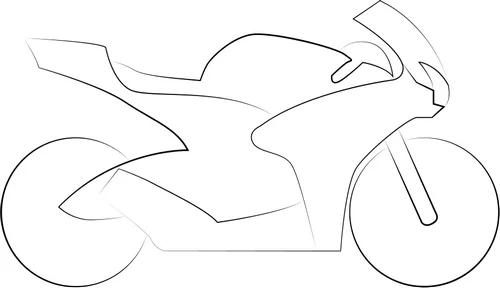
The bodywork gives the FZ a much sportier look than the Gpz or the CBR, whose look is a little more civilized. The full fairing starts with a round double headlamp to great effect, and the rear shell seems to have been cut to size. As for the seat, while its extreme thinness brings it closer to competition bikes, comfort suffers.
All in all, Yamaha has succeeded in making an excellent sports bike while retaining its air-cooled engine. And if the engine is a little stingy in terms of feel, this is more than made up for by the precision and sportiness of the chassis.
the icing on the cake is that Yamaha has had the good idea of offering this machine at a very aggressive price. At under 35,000 francs in 1987, the FZ 600 was far more affordable than its direct competitors (CBR 600 at 41,700 francs, GPZ 600 at 40,800 francs). Enough to make you think twice before buying.
its short run on the market didn't make it a bestseller, nor an essential model in motorcycle history. But it did keep the market waiting until the arrival of a first-rate replacement: the FZR 600 (marketed in 1989).
M.B - Manufacturer's photos

by Greg

 Share
Share
Key facts Yamaha FZ 600 (1987) : What you need to know before you buy
Highlights
- Partie-cycle
- Look
- Price
Weak points
- Engine
- Comfort
Prices
| Basic version | |
|---|---|
 France France |
5,335€
|


Performance
- Max speed : 200 km/h (124.30 mph)
- Average fuel consumption : 7.10 liters/100km (0.33 mpg)
-
Estimated range
: 232 km (144 miles)
Calculated range until tank is empty, not verified.
Specifications Yamaha FZ 600 1987
- Chassis
- Frame : steel tube perimeter
- Fuel capacity : 16.50 liters (4.36 US gallons)
- Seat height : 785 mm (30.91 in)
- Length : 2,025 mm (79.72 in)
- Width : 690 mm (27.17 in)
- Min height : 1,145 mm (45.08 in)
- Wheelbase : 1,385 mm (54.53 in)
- Dry weight : 186 kg (410 lb)
- Weight when fully loaded : 202 kg (445 lb)
- Front axle
- Telehydraulic fork Ø 36 mm, Wheel travel : 110 mm (4.33 in)
- Braking 2 discs Ø 267 mm (10.51 in), 2-piston caliper
- Front tire : 100 / 90 - 16 → Order this type of tire
- Transmission
- 6 stage gearbox
- Secondary by chain
- Rear axle
- Mono-damper, Wheel travel : 140 mm (5.51 in)
- Braking 1 disc Ø 245 mm (9.65 in), 2-piston caliper
- Rear tire : 120 / 80 - 18 → Order this type of tire
- Motor
- 4 cylinders online , 4 strokes
- 4 carburetors Ø 30 mm
- Cooling system : liquid
- 2 ACT
- 2 valves per cylinder
- 598 cc
- 67 ch (66.10 hp) to 10,000 rpm
- 5 mkg to 7,000 rpm
- Power-to-weight ratio : 2.81 kg/ch
- Weight / torque ratio : 37.2 kg/mkg
- Compression : 10 : 1
- Practical information





Used

Compare the FZ 600 to its competitors
Fuel consumption
Range
Torque
Power
Power-to-Weight ratio
Torque-to-Weight ratio
Speed
FAQ Your frequently asked questions about the FZ 600 1987
- What is the power of the FZ 600 1987?
-
The FZ 600 1987 develops a power of 67 ch (66.10 hp)
- What is the torque of the FZ 600 1987?
-
The maximum torque of the FZ 600 1987 is 5 mkg to 7,000 rpm.
- What is the maximum speed of the FZ 600 1987?
-
The FZ 600 1987 is capable of reaching a top speed of 200 km/h (124.30 mph) on the track.
- What is the weight of the FZ 600 1987?
-
The FZ 600 1987 has a a dry weight of 186 kg (410 lb), a weight when fully loaded of 202 kg (445 lb).
- What is the fuel consumption of the FZ 600 1987?
-
Average fuel consumption is estimated at 7.10 l/100km (0.33 mpg) according to the WMTC cycle.
- QWhat is the seat height of the FZ 600 1987?
-
To ensure good accessibility, the FZ 600 1987 offers a minimum seat height of 785 mm (30.91 in).
- What is the price of the FZ 600 1987?
-
The price of the FZ 600 1987 is 5,335€ in France
News
-
New motorcycle products for 2026

-
Bridgestone announces the RS12, its new road-race weapon.
-
Yamaha Race Like A Girl: Natalia Rivera in episode 5.
-
Bridgestone presents the Battlax V03, its new slick tire.
-
With Sartoria Meccanica, MV-Agusta aims to go beyond premium.
-
Upgrading the entire Bonneville family for 2026.
-
Metzeler unveils three new tires at EICMA.
-
World Superbike celebrates 70 years of Yamaha.
-
Exceptional: some thirty new Triumphs in 2026.
-
40.000 bikers for the Royal-Enfield "One Ride" 2025.



Bikers' reviews Leave a review - 2 reviews
It's a real little sports bike with a very good chassis, very lively on corner changes, thanks to its light weight, narrow tires and 16-inch front wheel. The bike is based on a 400 fzr body and chassis, and a 600 xj type 51 j engine. It's a bit of a do-it-yourself affair, but well thought-out, and the brakes are very similar to those of the 350 rdlc, although effective
In terms of feel and behavior, this bike isn't at all at ease on degraded pavements like small country roads, it's very dry and very stiff, whether it's the rear shock absorber or the fork, although for the latter you can add air (1 bar max, I think) to make it a little more comfortable, the riding position is largely acceptable for a sports bike, and the footrests are well positioned, neither too high nor too far back. The same goes for the half handlebars, which are slightly above the fork tubes.
As for the engine, it's not crazy at just under 70 hp, but it's delivered in such a way that, combined with the chassis, it makes for a machine with a typical sporty character, with very short, close ratios and an engine that only delivers its power when revved up. It's hard to stay calm on board and not get caught up in the game, it's a bit of a crime buster, which is also what makes it so endearing
Reliability-wise, there's nothing wrong with the engine, but you have to keep an eye on the swingarm bushes, which have neither bearings nor grease nipples. These are rings that wear out just like the bushes, and if they're not dismantled and greased from time to time, the plastics are very fragile, they have become brittle over time, the fuel tank is subject to corrosion, the starter relay can sometimes give up the ghost, watch out for the voltage regulator connector, which can melt if the contacts oxidize.
A very important detail is that parts are very hard to find, and sometimes impossible to find. Don't hesitate to look abroad for certain parts, and be patient. Rating : 5/5 Respond to Jérôme