
Motorcycle specifications YamahaRD 400 1976 A Yamaha demonstration


presentation of the RD 400 1976
Following on from the YR-5 350cc (1970) and the RD 350 (1973), the RD 400 arrived in 1975 to take on the fierce competition from Japanese midsizers. Faced with the new Honda CB 400, Kawa Z 400 and KH 400 and Suzuki GT 380, Yamaha could no longer be content with its 350cc. But unlike its eternal rival Honda and its 4-stroke competition bikes, Yamaha has developed its racing program entirely around the 2-stroke engine, and the RD range has become the manufacturer's technological showcase on the road.
However, rather than limiting itself to a simple re-boring to gain the extra 51cc, Yamaha chose to overhaul its holey twin-cylinder from top to bottom: cylinder head, crankshaft, airbox, silentbloc-mounted engine, 6-speed gearbox... Everything goes. The new two-cylinder gains power, trunk space and liveliness. What's more, the Japanese manufacturer has innovated by developing an oil pump that adapts the oil/petrol mixture (2T obliges) according to the type of driving. This means that when the engine is heavily used, the mixture is richer in oil, so as not to compromise reliability.
The new twin-cylinder engine develops 40 horsepower. While the increase in power may seem modest compared to the 350cc's 36 hp, the 400cc is much more expressive. Like the 2-strokes of the time, the RD expresses itself over a relatively narrow rev range (4,000 to 7,000 rpm). Maintained within this range, the engine gives of its best, and more than holds its own against its competitors (the Honda CB 400 F develops 37hp and the Kawa Z 400 36hp). What's more, its designers have kept the weight of the RD to a minimum: at 175 kg fully loaded, it weighs 15 to 20 kg less than other Japanese models.
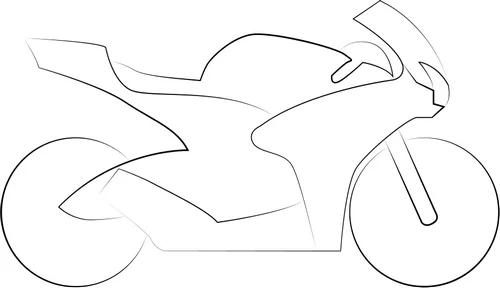

The chassis remains classic: double cradle frame, telescopic front fork (35mm diameter and 140mm travel), twin rear suspension (80mm travel). The bike brakes very well for its time, thanks to 267mm front and rear disc brakes with single-piston calipers. In the saddle, the RD is lively. Its 18-inch aluminum-alloy wheels are narrow and accept modest tire sizes (AV 3.25-18 & AR 3.50-18). While these sizes may come as a surprise to today's bikers (especially the rear tire), they are quite classic for the 70s. These narrow tires were ideal for agility and top speed, without compromising traction (given the 400cc's reasonable power output).
The RD sported a sporty aesthetic, with a long tank and small side cases in the style of competition bikes. The seat, an extension of the tank, lengthens the line to inspire good stability. All in all, this motorcycle respects the sporting canons of the time, although it is somewhat removed from the classicism of its direct rivals.
The Yamaha is not, however, an exclusive sports bike. The seat is comfortable, and the relaxed riding position (a far cry from modern sports bikes) makes it ideal for long rides, if not long trips.
The RD 400 enjoyed a good commercial career, thanks to its qualities and, above all, to its particularly well-targeted price compared to the Honda models. By this time, the two manufacturers were already ahead of the other Japanese brands in terms of production volume, but also on the racetrack. As on the track, Yamaha had decided to take on Honda's 4-strokes with the technology it mastered best: 2-stroke.
Tanthallas - Photos : Manufacturer

by Greg

 Share
Share
Key facts Yamaha RD 400 (1976) : What you need to know before you buy
Highlights
- Power
- Poids
- Price
Weak points
- Consumption
- Protection
Prices
| Basic version | |
|---|---|
 France France |
1,400€
(Motoplanete estimate)
|

Performance
- Max speed : approximately 175 km/h (108.70 mph)
Specifications Yamaha RD 400 1976
- Chassis
- Frame : Double tubular steel cradle
- Fuel capacity : 16.50 liters (4.36 US gallons)
- Seat height : 800 mm (31.50 in)
- Length : 2,015 mm (79.33 in)
- Width : 830 mm (32.68 in)
- Min height : 1,085 mm (42.72 in)
- Wheelbase : 1,350 mm (53.15 in)
- Dry weight : 157 kg (346 lb)
- Weight when fully loaded : 175 kg (386 lb)
- Front axle
- Telescopic fork Ø 35 mm, Wheel travel : 120 mm (4.72 in)
- Braking 1 disc Ø 267 mm (10.51 in), single-piston caliper
- Front tire : 3 / 25 - 18 → Order this type of tire
- Transmission
- 6 stage gearbox , manual
- Secondary by chain
- Rear axle
- 2 lateral shock absorbers, Wheel travel : 80 mm (3.15 in)
- Braking 1 disc Ø 267 mm (10.51 in), single-piston caliper
- Rear tire : 3 / 50 - 18 → Order this type of tire
- Motor
- two-cylinder online , 2 strokes
- 2 carburetors Ø 28 mm
- Cooling system : by air
- 398 cc
- 40 ch (39.40 hp) to 7,000 rpm
- 4.20 mkg to 6,500 rpm
- Power-to-weight ratio : 3.98 kg/ch
- Weight / torque ratio : 37.38 kg/mkg
- Compression : 6.2 : 1
- Practical information





Used


Compare the RD 400 to its competitors
Torque
Power
Power-to-Weight ratio
Torque-to-Weight ratio
Speed
FAQ Your frequently asked questions about the RD 400 1976
- What is the power of the RD 400 1976?
-
The RD 400 1976 develops a power of 40 ch (39.40 hp)
- What is the torque of the RD 400 1976?
-
The maximum torque of the RD 400 1976 is 4.20 mkg to 6,500 rpm.
- What is the maximum speed of the RD 400 1976?
-
The RD 400 1976 is capable of reaching a top speed of approximately 175 km/h (108.70 mph) on the track.
- What is the weight of the RD 400 1976?
-
The RD 400 1976 has a a dry weight of 157 kg (346 lb), a weight when fully loaded of 175 kg (386 lb).
- QWhat is the seat height of the RD 400 1976?
-
To ensure good accessibility, the RD 400 1976 offers a minimum seat height of 800 mm (31.50 in).
- What is the price of the RD 400 1976?
-
The price of the RD 400 1976 is 1,400€ in France
News
-
New motorcycle products for 2026

-
Bridgestone announces the RS12, its new road-race weapon.
-
Yamaha Race Like A Girl: Natalia Rivera in episode 5.
-
Bridgestone presents the Battlax V03, its new slick tire.
-
With Sartoria Meccanica, MV-Agusta aims to go beyond premium.
-
Upgrading the entire Bonneville family for 2026.
-
Metzeler unveils three new tires at EICMA.
-
World Superbike celebrates 70 years of Yamaha.
-
Exceptional: some thirty new Triumphs in 2026.
-
40.000 bikers for the Royal-Enfield "One Ride" 2025.



Bikers' reviews Leave a review - 1 review