
Motorcycle specifications Bimota750 HB1 1973 The first Bimota


presentation of the 750 HB1 1973
In the early 1970s, the motorcycle world was in the midst of a revolution. Japan, with the Honda CB 750 Four, introduced the concept of the "superbike" to the general public: a powerful, reliable and affordable 4-cylinder engine. However, its power was contained within a chassis that struggled to keep pace. This gap between engine and chassis gave rise to one of the world's most exclusive and respected brands: Bimota. And its very first creation, the HB1, is the cornerstone of this legend.
Before Bimota: a brilliant engine, a fallible frame
The Honda CB 750 was a mechanical star for its time. Its engine was a jewel of technology. Unfortunately, its double-cradle steel frame, though sufficient for standard use, quickly showed its limits in sporty riding. Lack of rigidity, high weight and a less-than-aggressive geometry made it blurred and inaccurate at high speeds.
It was a frustration personally felt by a certain Massimo Tamburini, one of the three founders of Bimota (along with Valerio Bianchiand Giuseppe Morri). A motorcycle enthusiast and racer in his spare time, Tamburini was convinced that he could design a part-cycle capable not only of mastering the potato of the Japanese engine, but of transcending it.
After : The art of the chassis
The HB1, whose name simply stands for Honda Bimota 1, was his answer. Rather than modify the existing frame, Tamburini started from scratch.
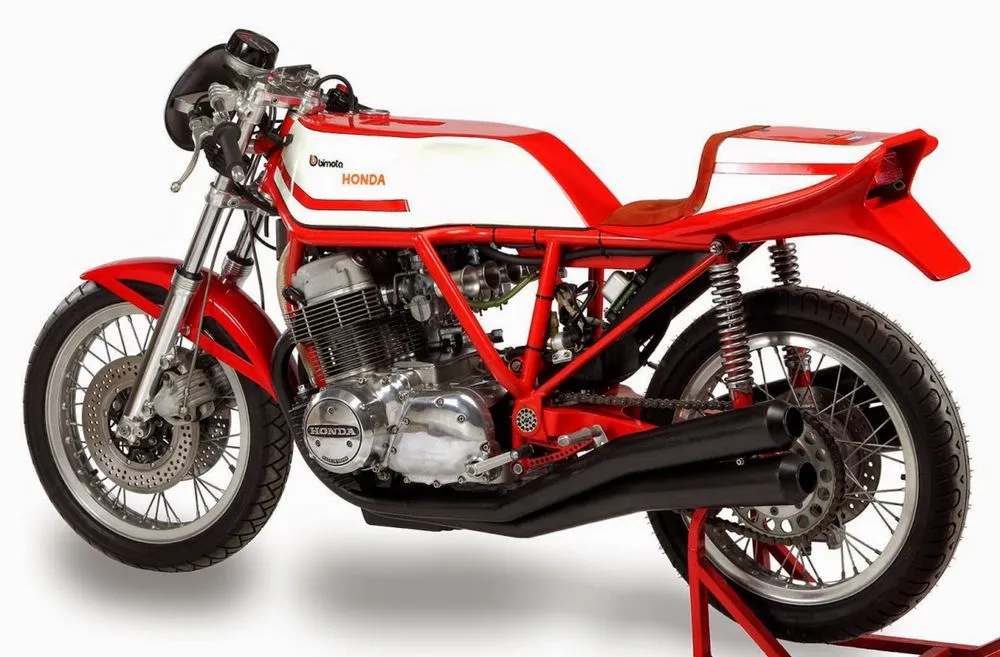
The technical strength of the HB1 was its tubular trellis frame, made from chrome-molybdenum (CrMo) steel. This design offered far greater torsional rigidity than the original frame, while being spectacularly lighter. The Bimota frame alone weighed around 9 kg, almost half the weight of its Honda counterpart.
This obsession with lightness and rigidity was the common thread running through the entire project. The swingarm was also a custom-built, stiffer part. Other components, such as the sculpted fuel tank and single-seater seat shell, were made of fiberglass. The design was clean, functional and undeniably Italian, inspired directly by Grand Prix machines.
Before being a motorcycle, a conversion kit
Originally, the Bimota HB1 was not sold as a complete motorcycle. It was a high-end conversion kit for CB 750 owners. The customer supplied his "donor" motorcycle, and the Bimota kit included:
- Chrome-moly frame
- Swingarm
- Fiberglass tank
- Single-seat saddle and shell
- Recessed controls
- Wrist handlebars
The owner had to transplant his Honda's engine, fork, wheels, brakes and electrical system. The end result was a transformed machine. Tens of kilos lighter, lower, with an optimized center of gravity and more aggressive steering geometry, the HB1 could be ridden like a real road bike. It offered precision and cornering stability that the standard CB 750 could only dream of.
Rare from the start
Only 10 HB1 kits and one complete prototype were produced between 1972 and 1973. This extremely limited production makes it one of the rarest and most sought-after Bimotas in the world today.
But its importance far exceeds its rarity. The HB1 established the philosophy that would define Bimota for decades to come: take the best production engines available (mainly Japanese at first) and build them a showcase of Italian engineering and design. It was striking proof that the genius of a motorcycle lies not only in its engine, but in the perfect harmony of all its components.
M.Bi. - Photos D.R.
by Greg

 Share
Share
Key facts Bimota 750 HB1 (1973) : What you need to know before you buy
Specifications Bimota 750 HB1 1973
- Chassis
- Vehicle not capable of carrying passengers
- Frame : Double cradle steel frame
- Fuel capacity : 15 liters (3.96 US gallons)
- Seat height : 762 mm (30 in)
- Wheelbase : 1,448 mm (57.01 in)
- Dry weight : 200 kg (441 lb)
- Front axle
- telehydraulic fork Ø 35 mm
- Braking 2 discs Ø 295 mm (11.61 in), single-piston caliper
- Front tire : 110 / 80 - 18 → Order this type of tire
- Handlebars handlebars
- Transmission
- 5 stage gearbox , manual
- Secondary by chain
- Rear axle
- 2 lateral shock absorbers
- Preload adjustment
- Braking 1 disc, single-piston caliper
- Rear tire : 130 / 80 - 18 → Order this type of tire
- Motor
- 4 cylinders online , 4 strokes
- 4 keihin Ø 28 mm carburetors
- Cooling system : by air
- 1 ACT
- 2 valves per cylinder
- 736.40 cc
- 67 ch (66.10 hp) to 8,000 rpm
- 6.10 mkg to 7,500 rpm
- Power-to-weight ratio : 3.03 kg/ch
- Weight / torque ratio : 32.79 kg/mkg
- Compression : 9.2 : 1
- Practical information
- Made in 11 copies
- Country of manufacture : Italy





Models
1973
Used
Compare the 750 HB1 to its competitors
FAQ Your frequently asked questions about the 750 HB1 1973
- What is the power of the 750 HB1 1973?
-
The 750 HB1 1973 develops a power of 67 ch (66.10 hp)
- What is the torque of the 750 HB1 1973?
-
The maximum torque of the 750 HB1 1973 is 6.10 mkg to 7,500 rpm.
- What is the maximum speed of the 750 HB1 1973?
-
The 750 HB1 1973 is capable of reaching a top speed of over 200 km/h (124.30 mph) on the track.
- What is the weight of the 750 HB1 1973?
-
The 750 HB1 1973 has a a dry weight of 200 kg (441 lb).
- QWhat is the seat height of the 750 HB1 1973?
-
To ensure good accessibility, the 750 HB1 1973 offers a minimum seat height of 762 mm (30 in).
- Is the 750 HB1 1973 approved for transporting a passenger?
-
No, this vehicle is only suitable for 1 people; it is a single-seater.
News
-
New motorcycle products for 2026

-
Bridgestone announces the RS12, its new road-race weapon.
-
Yamaha Race Like A Girl: Natalia Rivera in episode 5.
-
Bridgestone presents the Battlax V03, its new slick tire.
-
With Sartoria Meccanica, MV-Agusta aims to go beyond premium.
-
Upgrading the entire Bonneville family for 2026.
-
Metzeler unveils three new tires at EICMA.
-
World Superbike celebrates 70 years of Yamaha.
-
Exceptional: some thirty new Triumphs in 2026.
-
40.000 bikers for the Royal-Enfield "One Ride" 2025.



Bikers' reviews Leave a review