
Motorcycle specifications Ducati750 GT 1971 Le twin !!!
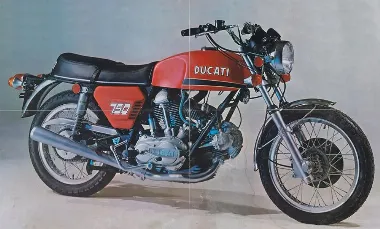

presentation of the 750 GT 1971
In 1971, the motorcycle industry was dominated by iconic British twin-cylinders and the exponential rise of reliable, high-performance Japanese machines. Ducati, a small brand from Bologna best known for its sporty single-cylinder machines, was about to play a decisive card. Far from being a classic commercial project, the Ducati 750 GT is the work of a genius engineer, Fabio Taglioni, who has opted for a radically new engine architecture for the brand: the V-twin.
A story of racing and ingenuity
The history of the 750 GT is inseparable from its creator, chief engineer Fabio Taglioni. In the early 70s, competition was fierce. Japanese manufacturers, like Honda with its CB 750 Four, were imposing their standards of power and reliability. Taglioni, instead of imitating his rivals, relied on an architecture he had perfected in the 60s on racing prototypes: the 90° V-twin engine, which Ducati would call the "L-Twin". The idea behind this engine was to achieve perfect balance, reducing vibrations and optimizing torque.
Legend has it that Ducati management was not entirely convinced by the project. The trigger was the famous victory of the 750 at Imola in 1972, driven by Paul Smart. This resounding success proved the technical superiority of the concept and legitimized production of the road version, the 750 GT, which was already in development.
Design for beauty
The Ducati 750 GT is a little jewel of design and engineering, a sober and functional machine that breaks with the lines of its competitors.
The 90° V-twin 748 cm3 engine is the centerpiece. Featuring two valves per cylinder, a single overhead camshaft (SOHC) per cylinder and bevel gear distribution, it is fed by two 30 mm carburetors. Power output was 60 hp, a solid performance for the time. The single-crank engine, with its 360° crankshaft, gave the motorcycle a distinctive sound and vibration, recognizable among thousands.
The 750 GT was built around a double-cradle steel frame. The trellis frame was not yet in use, but would arrive with the 500 Pantah in 1979.
The silhouette of the 750 GT, often attributed to Taglioni himself, is a model of balance and elegance. Its chrome-plated steel tank, comfortable seat and twin "sausage" silencers give it a timeless silhouette. The absence of anything superfluous highlights the engine, which is itself a piece of design.
Character before perfection
The 750 GT wasn't the fastest or most reliable bike of its time, but it offered a unique riding experience that seduced bikers the world over.
Bikers of the time praised its handling and roadholding. Thanks to its rigid frame and low center of gravity, the 750 GT performed wonderfully on winding roads. The torque of the V-engine was a revelation. It enabled powerful acceleration from low revs, and offered a ride where power was not the only measure of efficiency. The distinctive sound of the V-Twin, with its husky, pulsating tone, became the brand's signature sound.
Exclusivity had a price, other than financial
Despite its qualities, the 750 GT faced criticism, often compared to the clinical perfection of Japanese motorcycles.
Ducati's first twin-cylinder road engine was not without its faults. A few oil leaks and electrical problems accompanied it. Although its architecture was renowned for its balance, the first single-crank 750 GTs transmitted a fair amount of vibration to the rider, particularly at low revs. These vibrations, considered a flaw by some, were seen by enthusiasts as an integral part of the bike's character.
A legend is born
The Ducati 750 GT was only produced for a short time, but its impact was monumental. It laid the foundations for the engineering and design that would define the Italian brand for decades to come. It paved the way for icons like the legendary 750 SuperSport.
M.Bi - Manufacturer photos / DR
by Greg

 Share
Share
Key facts Ducati 750 GT (1971) : What you need to know before you buy
 France
 United States
Specifications Ducati 750 GT 1971
- Chassis
- Two-seater saddle
- Frame : double tubular steel cradle
- Fuel capacity : 17 liters (4.49 US gallons)
- Seat height : 780 mm (30.71 in)
- Length : 2,250 mm (88.58 in)
- Width : 760 mm (29.92 in)
- Min height : 1,070 mm (42.13 in)
- Wheelbase : 1,500 mm (59.06 in)
- Dry weight : 185 kg (408 lb)
- Front axle
- Telescopic fork Ø 38 mm
- Braking 1 disc Ø 280 mm (11.02 in), 2-piston caliper
- Transmission
- 5 stage gearbox , manual
- Secondary by chain
- Rear axle
- 2 lateral shock absorbers
- drum brakes Ø 200 mm (7.87 in)
- Motor
- two-cylinder 90° L-shape , 4 strokes
- 2 carburetors Ø 30 mm
- Cooling system : by air
- by spiral bevel gear, 1 ACT per cylinder
- 2 valves per cylinder
- 748 cc
- 60 ch (59.20 hp) to 8,000 rpm
- 5.70 mkg to 4,000 rpm
- Power-to-weight ratio : 3.13 kg/ch
- Weight / torque ratio : 32.46 kg/mkg
- Compression : 8.5 : 1
- Starting system : kick
- Practical information
- Made in 4,133 copies
- Country of manufacture : Italy





Models
1971
Used
Compare the 750 GT to its competitors
FAQ Your frequently asked questions about the 750 GT 1971
- What is the power of the 750 GT 1971?
-
The 750 GT 1971 develops a power of 60 ch (59.20 hp)
- What is the torque of the 750 GT 1971?
-
The maximum torque of the 750 GT 1971 is 5.70 mkg to 4,000 rpm.
- What is the maximum speed of the 750 GT 1971?
-
The 750 GT 1971 is capable of reaching a top speed of 200 km/h (124.30 mph) on the track.
- What is the weight of the 750 GT 1971?
-
The 750 GT 1971 has a a dry weight of 185 kg (408 lb).
- QWhat is the seat height of the 750 GT 1971?
-
To ensure good accessibility, the 750 GT 1971 offers a minimum seat height of 780 mm (30.71 in).
- What is the price of the 750 GT 1971?
-
The price of the 750 GT 1971 is 1,450€ in France. It is displayed at $1,995 in the United States.
- Is the 750 GT 1971 approved for transporting a passenger?
-
Yes, this vehicle is equipped as standard for 2 people.
News
-
New motorcycle products for 2026

-
Bridgestone announces the RS12, its new road-race weapon.
-
Yamaha Race Like A Girl: Natalia Rivera in episode 5.
-
Bridgestone presents the Battlax V03, its new slick tire.
-
With Sartoria Meccanica, MV-Agusta aims to go beyond premium.
-
Upgrading the entire Bonneville family for 2026.
-
Metzeler unveils three new tires at EICMA.
-
World Superbike celebrates 70 years of Yamaha.
-
Exceptional: some thirty new Triumphs in 2026.
-
40.000 bikers for the Royal-Enfield "One Ride" 2025.



Bikers' reviews Leave a review