
Motorcycle specifications HondaRC 30 - VFR 750 R 1988 Circuit legend


presentation of the RC 30 - VFR 750 R 1988
the year is 1987. Cyril Neveu has just won the Paris-Dakar for the fifth time; the Airbus A320 has just taken off; Ferrari unveils the F 40; a small TV channel is born: M6; the Channel Tunnel is being built; but that's not all... The world is about to be turned upside down again. Just as the recent Suzuki 750 and 1100 GSX-R have significantly accelerated the Earth's rotation speed, a new machine is about to emerge from the paddocks. A girl of the track, whose initials will soon become the abbreviation of a fantasy. 4 signs, which will be symbolic and absolute: RC 30.
it sounds like the code name of a US Air Force fighter(editor's note: the Honda CBR 1100 XX would adopt the name Super Blackbird 10 years later, in reference to the American SR-71 aircraft). A sports bike like no other, a 750 that plays in a different league from the GSX-R, FZ and ZXR. No, not a sports bike - a racing machine, designed for the track and approved for the road. An uncompromising HRC creation, beautiful, sublime, with an eloquent genetic heritage. It's a direct descendant of the RVF endurance factory, itself inspired by the 500 speed bike. Exceptional? No doubt about it. Impossible to doubt when you know that this bike is hand-assembled directly at HRC. And there's no hiding its goal: Superbike. A promising championship that the FIM will launch next year(today, more than 20 years later, the SBK has become one of the most resounding championships in the motorcycle world).
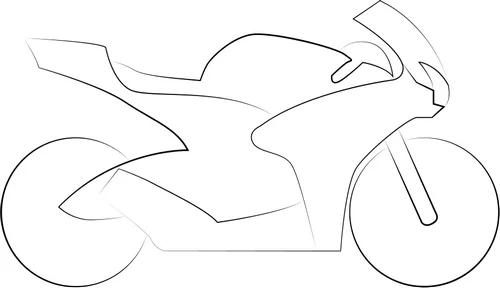
first of all, there's the silhouette. Streamlined, low, taut, uncompromising, like a 500 GP bike. A 7? cut for performance, where every detail proves the RC 30's commitment to competition. Let's take off the fairing and discover what's hidden beneath this FRB (Fiber Reinforced Plastic) assembly, a material that's lighter yet stronger than plastic. It only takes a few moments, as the hand-made fairing is held in place by large staples fastened behind the components. Once naked, we're overcome with admiration and confusion. The race is on, skin-deep.

Indeed, it's enough to make you bristle. But that's the bridle for France. And let's not complain too much: the Japanese version is calmed down to 77 hp. Let's breathe a sigh of relief knowing that the normal version develops 112 bhp, and that the addition of an HRC kit enables it to climb to 122 bhp. And if you feel like it (and your wallet), the TTF1 kit boasts 133 hp. Fortunately, the titanium connecting rods are designed to keep up.
Before installing these kits, let's take a look at the concern for compactness and efficiency shown by HRC's engine designers. Starting with valves fitted with tappets guided in the cylinder head, allowing direct attack by the ACT cams; this results in less friction, a lighter cylinder head, and intake pipes raised by 6°, as well as straighter ducts. A cascade of sprockets drives the valve train with rarely-seen precision, not to mention a very distinctive whistle and the added worry of replacing two chains. The carburetors are 35 mm, specially designed for this VFR-R. And for cooling, 2 remarkable curved radiators evacuate the heat.

As a road machine, the RC 30 weighs 18 kg more than the official RVF - but the V4 weighs exactly the same in both machines: 75 kg.
around this little technological temple, Honda has taken care to build a chassis to match. The frame, for example, is not really a double aluminum perimeter beam like the others - it comes from the same molds as those used on the RVF; but slightly reinforced to withstand the stresses of the road. Anchored to its reeds, we touch the sublime: a magnificent pro-arm monobar, fruit of the love affair between Honda and ELF. Such a piece of equipment on a sporty road bike is a dream come true. On the one hand, there's a superb multi-spoke rim, and on the other, you can discover that all the crown nuts are braked with wire, just like in 
Crazy gear? No, simply the very best for the very best sports bike. A machine that few would have dared dream of ever seeing on the road. But here it is! Honda has done it, and offers what is surely the most emblematic motorcycle of the 80s.
considered one of Honda's most prestigious models, over 4700 RC 30s were built, each with a carbon-encrusted key. The number of victories it has achieved is staggering: the Bol d'Or several times over, the 24 Hours of Le Mans and the 8 Hours of Suzuka, victories and titles in all the world's Superbike championships, and a host of Tourist Trophy successes. But this dream comes at a price: almost 90,000 francs. Oh yes, that's the slap in the face nobody wants to know. But is it really so unreasonable to have Sarron's bike in the garage?
* what did 90,000 francs represent at the time? About 19 months' minimum wage, almost a Renault 5 GT Turbo, 2 GSX-R 750s, over 30,000 baguettes of bread, or 18,600 liters of SP 95
M.B - Manufacturer's photos
This short promotional video from the time clearly shows the passion and craftsmanship that Honda put into its RC 30.
the year is 1987. Cyril Neveu has just won the Paris-Dakar for the fifth time; the Airbus A320 has just taken off; Ferrari unveils the F 40; a small TV channel is born: M6; the Channel Tunnel is being built; but that's not all... The world is about to be turned upside down again. Just as the recent Suzuki 750 and 1100 GSX-R have significantly accelerated the Earth's rotation speed, a new machine is about to emerge from the paddocks. A girl of the track, whose initials will soon become the abbreviation of a fantasy. 4 signs, which will be symbolic and absolute: RC 30.
it sounds like the code name of a US Air Force fighter(editor's note: the Honda CBR 1100 XX would adopt the name Super Blackbird 10 years later, in reference to the American SR-71 aircraft). A sports bike like no other, a 750 that plays in a different league from the GSX-R, FZ and ZXR. No, not a sports bike - a racing machine, designed for the track and approved for the road. An uncompromising HRC creation, beautiful, sublime, with an eloquent genetic heritage. It's a direct descendant of the RVF endurance factory, itself inspired by the 500 speed bike. Exceptional? No doubt about it. Impossible to doubt when you know that this bike is hand-assembled directly at HRC. And there's no hiding its goal: Superbike. A promising championship that the FIM will launch next year(today, more than 20 years later, the SBK has become one of the most resounding championships in the motorcycle world).
first of all, there's the silhouette. Streamlined, low, taut, uncompromising, like a 500 GP bike. A 7? cut for performance, where every detail proves the RC 30's commitment to competition. Let's take off the fairing and discover what's hidden beneath this FRB (Fiber Reinforced Plastic) assembly, a material that's lighter yet stronger than plastic. It only takes a few moments, as the hand-made fairing is held in place by large staples fastened behind the components. Once naked, we're overcome with admiration and confusion. The race is on, skin-deep.
Indeed, it's enough to make you bristle. But that's the bridle for France. And let's not complain too much: the Japanese version is calmed down to 77 hp. Let's breathe a sigh of relief knowing that the normal version develops 112 bhp, and that the addition of an HRC kit enables it to climb to 122 bhp. And if you feel like it (and your wallet), the TTF1 kit boasts 133 hp. Fortunately, the titanium connecting rods are designed to keep up.
Before installing these kits, let's take a look at the concern for compactness and efficiency shown by HRC's engine designers. Starting with valves fitted with tappets guided in the cylinder head, allowing direct attack by the ACT cams, resulting in less friction, a lighter cylinder head, and intake pipes raised by 6°, as well as straighter ducts. A cascade of sprockets drives the valve train to a degree of precision rarely seen, not to mention that distinctive whistle and the added worry of replacing two chains. The carburetors are 35 mm, specially designed for this VFR-R. And for cooling, 2 remarkable curved radiators evacuate the heat.
As a road machine, the RC 30 weighs 18 kg more than the official RVF - but the V4 weighs exactly the same in both machines: 75 kg.
around this little technological temple, Honda has taken care to build a chassis to match. The frame, for example, is not really a double aluminum perimeter beam like the others - it comes from the same molds as those used on the RVF; but slightly reinforced to withstand the stresses of the road. Anchored to its reeds, we touch the sublime: a magnificent pro-arm monobar, fruit of the love affair between Honda and ELF. Such a piece of equipment on a sporty road bike is a dream come true. On the one hand, there's a superb multi-spoke rim, and on the other, you can discover that all the crown nuts are braked with wire, just like in
Crazy gear? No, simply the very best for the very best sports bike. A machine that few would have dared dream of ever seeing on the road. But here it is! Honda has done it, and offers what is surely the most emblematic motorcycle of the 80s.
considered one of Honda's most prestigious models, the RC 30 was built in over 4700 examples, each starting with a carbon-inlaid key. The number of victories it has achieved is staggering: the Bol d'Or several times over, the 24 Hours of Le Mans and the 8 Hours of Suzuka, victories and titles in all the world's Superbike championships, and a host of Tourist Trophy successes. But this dream comes at a price: almost 90,000 francs. Oh yes, that's the slap in the face nobody wants to know. But is it really so unreasonable to have Sarron's bike in the garage?
* what did 90,000 francs represent at the time? About 19 months' minimum wage, almost a Renault 5 GT Turbo, 2 GSX-R 750s, over 30,000 baguettes of bread, or 18,600 liters of SP 95
M.B - Manufacturer's photos
This short promotional video from the time clearly shows the passion and craftsmanship that Honda put into its RC 30.
by Greg

 Share
Share
Key facts Honda RC 30 - VFR 750 R (1988) : What you need to know before you buy
Highlights
- Exceptional motorcycles
- Efficiency
- V4 performance
Weak points
- Tarif... Arggghh !
- On-road comfort
- Bridling
Prices
| Basic version | |
|---|---|
 France France |
13,319€
|
Performance
- Max speed : approximately 255 km/h (158.40 mph)
- Average fuel consumption : 9 liters/100km (0.26 mpg)
-
Estimated range
: 200 km (124 miles)
Calculated range until tank is empty, not verified.
Specifications Honda RC 30 - VFR 750 R 1988
- Chassis
- Frame : diamond type, double aluminium beam
- Fuel capacity : 18 liters (4.76 US gallons)
- Seat height : 785 mm (30.91 in)
- Length : 2,045 mm (80.51 in)
- Width : 700 mm (27.56 in)
- Min height : 1,100 mm (43.31 in)
- Wheelbase : 1,410 mm (55.51 in)
- Dry weight : 185 kg (408 lb)
- Weight when fully loaded : 208 kg (459 lb)
- Front axle
- Telehydraulic fork Ø 43 mm, Wheel travel : 120 mm (4.72 in)
- Braking 2 discs Ø 310 mm (12.2 in), 4-piston caliper
- Front tire : 120 / 70 - 17 → Order this type of tire
- Pressure : 2.5 bar
- Transmission
- 6 stage gearbox , manual
- Secondary by chain
- Rear axle
- Pro-Arm monobracket with shock absorber, Wheel travel : 130 mm (5.12 in)
- Braking 1 disc Ø 220 mm (8.66 in), 2-piston caliper
- Rear tire : 170 / 60 - 18 → Order this type of tire
- Pressure : 2.9 bar
- Motor
- 4 cylinders 90° L-shape , 4 strokes
- 4 carbides Ø 38 mm
- Cooling system : liquid
- by cascade pinions, 2 AC
- 4 valves per cylinder
- 748.14 cc
- 112 ch (110.50 hp) to 11,500 rpm
- 7.38 mkg to 11,000 rpm
- Power-to-weight ratio : 1.67 kg/ch
- Weight / torque ratio : 25.07 kg/mkg
- Compression : 11:1
- Practical information





Used


Compare the RC 30 - VFR 750 R to its competitors
Fuel consumption
Range
Torque
Power
Power-to-Weight ratio
Torque-to-Weight ratio
Speed
FAQ Your frequently asked questions about the RC 30 - VFR 750 R 1988
- What is the power of the RC 30 - VFR 750 R 1988?
-
The RC 30 - VFR 750 R 1988 develops a power of 112 ch (110.50 hp)
- What is the torque of the RC 30 - VFR 750 R 1988?
-
The maximum torque of the RC 30 - VFR 750 R 1988 is 7.38 mkg to 11,000 rpm.
- What is the maximum speed of the RC 30 - VFR 750 R 1988?
-
The RC 30 - VFR 750 R 1988 is capable of reaching a top speed of approximately 255 km/h (158.40 mph) on the track.
- What is the weight of the RC 30 - VFR 750 R 1988?
-
The RC 30 - VFR 750 R 1988 has a a dry weight of 185 kg (408 lb), a weight when fully loaded of 208 kg (459 lb).
- What is the fuel consumption of the RC 30 - VFR 750 R 1988?
-
Average fuel consumption is estimated at 9 l/100km (0.26 mpg) according to the WMTC cycle.
- QWhat is the seat height of the RC 30 - VFR 750 R 1988?
-
To ensure good accessibility, the RC 30 - VFR 750 R 1988 offers a minimum seat height of 785 mm (30.91 in).
- What is the price of the RC 30 - VFR 750 R 1988?
-
The price of the RC 30 - VFR 750 R 1988 is 13,319€ in France
News
-
New motorcycle products for 2026

-
Bridgestone announces the RS12, its new road-race weapon.
-
Yamaha Race Like A Girl: Natalia Rivera in episode 5.
-
Bridgestone presents the Battlax V03, its new slick tire.
-
With Sartoria Meccanica, MV-Agusta aims to go beyond premium.
-
Upgrading the entire Bonneville family for 2026.
-
Metzeler unveils three new tires at EICMA.
-
World Superbike celebrates 70 years of Yamaha.
-
Exceptional: some thirty new Triumphs in 2026.
-
40.000 bikers for the Royal-Enfield "One Ride" 2025.


Bikers' reviews Leave a review - 1 review
Rating : 5/5 Respond to Chicboy