
Motorcycle specifications SuzukiGSX 1100 G 1996
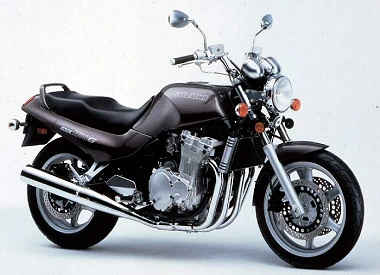

presentation of the GSX 1100 G 1996
From the very first encounter, the GSX 1100 G impresses with its dimensions rather than its plasticity. A massive fuel tank sits atop a massive engine, giving it the look of a comfort-equipped workhorse rather than a thoroughbred bred for racing.
then the gaze settles on the powertrain. this astonishing engine seems to vacillate between air cooling, with its far too small fins, and liquid cooling, with its no less discreet radiator.
connoisseurs will immediately smile at this naive description, knowing that this is the now famous 1127cc air/oil-cooled 4-cylinder of the GSX-R 1100. However, until 1991, when the GSX-G came out, Suzuki had always taken care to hide its SACS (Suzuki Air Cooled System) engine behind fairing sides (GSX-R, GSX-F). And it's almost a pity that Suzuki didn't bring out half-shell GSX-Rs in the style of the Ducati SS, so much so that the engine's aesthetics exude the nastiness or, as the case may be, the beauty of a cathedral.

another original feature is Suzuki's shaft-and-pinion secondary transmission. This is a very pleasant transmission, perfectly adapted to the new engine definition (editor's note: it's surprising that this transmission was never used again). All that remained was for the Japanese manufacturer to graft this powertrain onto a suitable frame.
in this area, it's a safe bet that Suzuki took a close look at the competition, particularly the Yamaha V-Max. Like that big custom/dragster, the GSX-G has to deal with more than respectable acceleration and acceleration. Like an urban dragster, therefore, the GSX-G had to be very stable, so it could be ridden without fear. Suzuki therefore chose a frame with a rather open steering column angle and a long wheelbase (1585 mm for the GSX-G, versus 1465 mm for the GSX-R, which had a rather long wheelbase for a supersport). However, this choice has a few drawbacks. The steering is relatively heavy at low speeds, and the bike doesn't really turn in a handkerchief. But the result is convincing. The suspension work is totally geared to comfort, as is the two-seater seat, and the "G" can be ridden over long distances in complete relaxation, both for the rider's buttocks and those of his passenger. Handling remains decent as soon as the machine is rolling, but it clearly prefers big curves.

nevertheless, it's clear that the GSX-G's road-holding qualities are enormous, despite its lack of protection. These qualities are also highlighted in tests and comparisons in the French specialist press, such as Moto1's FJ 1200 / GSX 1100 G comparison (No. 99, August 1991). All the more so as the "G" engine, reworked to develop its original 100 hp, is much more pleasant than the French version of the GSX 1100 F.
in the years that followed (marketed in France in 1994 and 1995), Suzuki offered versions equipped with a somewhat lightly-integrated fairing, which didn't exactly make a commercial splash. In the end, the presence of the GSX 1100 F somewhat dampened sales of the "G", which today remains a good motorcycle, albeit all too rare.
Tanthallas - Photos : Manufacturer
.jpg)
by Greg

 Share
Share
Key facts Suzuki GSX 1100 G (1996) : What you need to know before you buy
Highlights
- Engine
- Comfort
- Price
Weak points
- Protection
- Poids
Prices
| Basic version | |
|---|---|
 France France |
7,610€
|

Performance
- Max speed : 220 km/h (136.70 mph)
Specifications Suzuki GSX 1100 G 1996
- Chassis
- Frame : Double tubular steel cradle
- Fuel capacity : 21 liters (5.55 US gallons)
- Seat height : 805 mm (31.69 in)
- Length : 2,280 mm (89.76 in)
- Width : 765 mm (30.12 in)
- Min height : 1,115 mm (43.90 in)
- Wheelbase : 1,585 mm (62.40 in)
- Dry weight : 261 kg (575 lb)
- Weight when fully loaded : 279 kg (615 lb)
- Front axle
- Telehydraulic fork Ø 43 mm, Wheel travel : 150 mm (5.91 in)
- Braking 2 discs Ø 310 mm (12.2 in), 4-piston caliper
- Front tire : 110 / 80 - 18 → Order this type of tire
- Transmission
- 5 stage gearbox
- Secondary cardan shaft
- Rear axle
- Mono-damper, Wheel travel : 133 mm (5.24 in)
- Braking 1 disc Ø 295 mm (11.61 in), 2-piston caliper
- Rear tire : 160 / 60 - 17 → Order this type of tire
- Motor
- 4 cylinders online , 4 strokes
- 4 carburetors Ø 36 mm
- Cooling system : combined air / oil
- 2 ACT
- 4 valves per cylinder
- 1,127 cc
- 100 ch (98.60 hp) to 8,000 rpm
- 10 mkg to 7,000 rpm
- Power-to-weight ratio : 2.65 kg/ch
- Weight / torque ratio : 26.1 kg/mkg
- Compression : 10 : 1
- Practical information





Used
Compare the GSX 1100 G to its competitors
FAQ Your frequently asked questions about the GSX 1100 G 1996
- What is the power of the GSX 1100 G 1996?
-
The GSX 1100 G 1996 develops a power of 100 ch (98.60 hp)
- What is the torque of the GSX 1100 G 1996?
-
The maximum torque of the GSX 1100 G 1996 is 10 mkg to 7,000 rpm.
- What is the maximum speed of the GSX 1100 G 1996?
-
The GSX 1100 G 1996 is capable of reaching a top speed of 220 km/h (136.70 mph) on the track.
- What is the weight of the GSX 1100 G 1996?
-
The GSX 1100 G 1996 has a a dry weight of 261 kg (575 lb), a weight when fully loaded of 279 kg (615 lb).
- QWhat is the seat height of the GSX 1100 G 1996?
-
To ensure good accessibility, the GSX 1100 G 1996 offers a minimum seat height of 805 mm (31.69 in).
- What is the price of the GSX 1100 G 1996?
-
The price of the GSX 1100 G 1996 is 7,610€ in France
News
-
New motorcycle products for 2026

-
Bridgestone announces the RS12, its new road-race weapon.
-
Yamaha Race Like A Girl: Natalia Rivera in episode 5.
-
Bridgestone presents the Battlax V03, its new slick tire.
-
With Sartoria Meccanica, MV-Agusta aims to go beyond premium.
-
Upgrading the entire Bonneville family for 2026.
-
Metzeler unveils three new tires at EICMA.
-
World Superbike celebrates 70 years of Yamaha.
-
Exceptional: some thirty new Triumphs in 2026.
-
40.000 bikers for the Royal-Enfield "One Ride" 2025.




Bikers' reviews Leave a review - 6 reviews
Its Achilles' heel: the cardan shaft bellows, which can yawn with age, making it permeable. Rainwater infiltration at the bottom of the cardan shaft protection, electrolyte between the spring and the shaft leading to premature tooth wear. This can easily be remedied by replacing or covering the open part. Rating : 5/5 Respond to henry
Unique value for money. unrivalled for a bike of such quality
(If I had the money, I'd ride an RT1200RT)
Positive points
its sturdiness, its cardan shaft, its power with torque at all levels, its mechanical simplicity, its good old valve clearance nuts!!! (no more 150-euro/cartridge chips), impeccable roadholding (drives in all weathers, including high winds). Its maintenance (I do everything myself). Its reliability, never any breakdowns. The price of parts (idem 1200 bandit) and finally its price and its looks!
Negative points
its weight when stationary (even if it disappears as soon as you ride it), certain steels (rust quite easily around the exhaust outlets), its fuel consumption (7 L, but this is quickly compensated for by the price of the insurance, 10 euros/month), its protection (as far as I'm concerned, the stripped-down roadster look suits me just fine).
Its Achilles heel
the cardan shaft bellows, which can yawn with age, making it permeable. Rainwater infiltration at the bottom of the cardan shaft protection, electrolyte between the spring and the shaft, leading to premature tooth wear. Rating : 5/5 Respond to henry