
Motorcycle specifications YamahaYZF-R1 1000 2019 The size of the M1


presentation of the YZF-R1 1000 2019
The R1 goes from strength to strength, never satisfied with its thirst for performance. Endurance victories only confirm her status as an accomplished racer. And encourages it to evolve, slowly. After its Euro4 update in 2017, the 2018 model has improved the shifter - it now works in both directions, up and down the gears. An essential update, as all the big-bore sports bikes are equipped with them... or will be very soon.
It needs this technology, and more, to compete and even dominate in its class. And it doesn't do so half-heartedly. The new-generation R1 seems halfway between a production bike and a racing prototype. Its eyes have all but disappeared, giving it the look of a track machine. Clearly, it's come out of a laboratory with a racing twist. But... but... where's the sensuality, the escaping effects, the wild damsel allure and the hectic desire to please like an actress in the finest of dresses?! Boldness has bled style dry, and the R1 can only think of one thing: crushing the stopwatch under the blows of the cross-plane.
it bleeds asphalt, but it has to respect certain laws... or standards. Euro4 was one of these, and the R1 had to comply, with the installation of infamous retro-reflectors and a minor engine update to give it a less toxin-laden breath. A sting that the boiler will take without flinching or changing its character. Remember back in 2009, when Yamaha installed this block with its distinctive engine timing? An unfamiliar growl, surprising motricity, the aura of MotoGP... It shook up the category. But for a long time, the Yam stayed in the 180 hp zone, when the competition was adding big ladles. Less powerful and more clumsy, the R1 could no longer keep up with the best (except in Endurance racing). The 2015 version and beyond puts things back in order. Getting back on top of the wattage, putting the quiche through its paces as it did in its heyday, cracking the Fast & Furious mode and knocking out the references - that's its battle, the one it's always loved.
Yesterday, 182 units in the 4-cylinder class. Today, we're changing categories. Not a spoonful, not a ladleful of extra watts; a bowlful! The R1 boasts 200 horsepower! a 10% gain for the engine-makers, that's quite an achievement. At last, there's enough power to keep up with the BMW S 1000 RR, Kawasaki ZX-10R, Ducati Panigale V4 and MV-Agusta F4 1000. Torque drops slightly, to 11.5 mkg. On the other hand, the search for maximum power climbs: it's 1000 rpm more, or 13,500, to get all the sauce.
To find these watts, no Red Bull but elbow grease in the workshops. Under the new cylinder head with its revised ducts, the compression ratio rises to 13:1, the valve angle tightens, and when the mixture explodes, it's on forged aluminum pistons. Then it's off to the titanium fractured-head connecting rods - a first for a production bike. The cavalry then passes through a new crankshaft whose inertia has been reduced by 20%. The irregularly spaced ignition sequence (270° - 180° - 90° - 180°) of the Crossplane engine is retained.

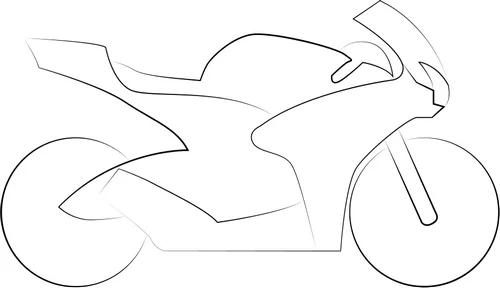
Yamaha also offers its most powerful sports engine a new valve-gear mechanism, with a higher lift than the cam profile. Air intake is now similar to that of MotoGP's M1, with a central duct in place of the nose. It's going to breathe in there, especially as the airbox increases its capacity by 23% to 10.5 liters. Inside, we find the YCC-I variable intake cone system. When out of breath, gases will escape through.... Wait a minute! Where have those pots gone? Since 2004, Yam had placed them delightfully under the posterior. Did the Star Trek-style rear end chase them away? No, it's efficiency that's to blame. Better mass centering, weight savings and renewed aesthetics. The sound promises to be as thrilling as ever. A cross-plane in the towers, I guarantee it'll stir the hair.
watts aren't everything. And when there are more of them than there are kilos, it can quickly blow up in your face. But that was before! We're in the digital age, with sensors that think, and the new R1 is full of electronic packages. The previous model offered traction control and a choice of several mappings. Sufficient for the average sportsman, outdated for the experienced rider and/or technology fan. Miss R1 pulls out all the stops, and there's no need to bluff.
No more keeping up, doing better than the others. The R1 inaugurated (on a production model) a 6-axis inertial sensor called IMU. Three gyroscopic sensors measure pitch, roll and yaw, and three other G sensors provide information on forward/reverse, left/right and up/down movements. With these and measurements every 8 thousandths of a second, the on-board electronics can "see" in 3D and in real time how the machine is behaving. This enables it to fine-tune ignition, fuel injection, throttle opening and steering aids.
Traction control (TCS) takes advantage of the IMU to modulate driveability according to the difference in wheel speed and the angle taken by the bike. It is further aided by slip control (SCS), which limits the lateral movement of the rear tire when a loss of grip is detected.
Since the on-board brain knows where and how the R1 is in space at all times, it can use the data to calm any urge to take off. This is how the LIF Front LIFt control system, more commonly known as the anti-wheeling system, is installed. Front wheels tickling the clouds is always a nice touch, but it can also cost you time on the runway. Add to this a start-assist mode, similar to that used on the Aprilia RSV4 Factory APRC SE. It's called LCS and takes advantage of data from other control programs. Wring out the starting knob with a 200hp 1000 and you'll soon get a big burn or disastrous volume. With the Launch Control System, you open the throttle and the electronics manage: revs are limited to 10,000 rpm, then the LCS calls on the TCS and LIF to guarantee optimum acceleration at start-up.

Well, the R1 seems to have made up for lost time with its silicon chips, and....
And that's not all. The D-Mode, which lets you select several power modes, has been upgraded to 4 maps. Right next door comes YRC, Yamaha Ride Control, offering 4 riding modes. Each has factory-set parameters, but can be adapted by the user, so you can tailor modes to suit your mood and environment.
now, with all this, how are we going to inform the driver of everything that's active? We need a new dashboard, and not a needle next to a watch! Under the bubble, the R1 boasts true racing instrumentation, similar to that of a Ducati 1199 / 1299. A color TFT screen the size of a Galaxy S5 (I'm not advertising, I've got an iPhone) displays a bar graph, accelerometer and brake pressure. A sensor enables the display to adapt to ambient brightness. Finally, the screen offers two display modes: road or track:
- In "Road" mode, the bar-type rev counter uses different colors according to engine speed, enabling the rider to instantly grasp the values. Instantaneous speed, odometer, daily totalizer, real-time fuel consumption, average fuel consumption and amount of fuel consumed are also present in this mode. Icons at the top and bottom of the display also show TCS and SCS activation, and the selected power mode.
- In "Track" mode, the display shows specific information with a high degree of clarity: number of laps, lap time and stopwatch function. The bar graph tachometer display starts at 8,000 rpm and extends to the red zone. The gear indicator is displayed on the right-hand side. To facilitate post-race analysis, each display has a memory function for lap-by-lap analysis.
let's not forget one thing. Despite all this on-board electronics, it's still the chassis that's going to keep up with the 200 horsepower and turn your riding into a time trial. New R1, new chassis, with a new version of the Deltabox aluminum frame, using the engine as a load-bearing element via 4 attachment points. The swingarm is also new, abandoning its bottom reinforcement and featuring a high-strength structure.
And weight had to be saved. How do you get under 200 kilos and still install ABS, sensors and ECUs everywhere, when you were 206 kilos on the scales in 2014? With the right materials! Magnesium, for example, to make the rear frame buckle, and for the wheels - normally, only very sporty special series are equipped with such wheels. The front wheel is 530g heavier, the rear 340g. Yamaha has also saved 1,600g on the fuel tank alone. When you're lighter, you're more agile. A redesign of the geometry also goes in this direction. The 10 mm shorter wheelbase should make it more lively to ride.
New KYB suspensions include an inverted 43 mm fork, with all adjustments located at the top of the tubes. Rear damping is Monocross with pushrods. On the M version, a much racier R1, you have access to Öhlins with electronic settings - another world.
The R1 changes its entire braking system. Gone are the 6-piston calipers; the monoblock radial calipers bite 320 mm discs with 4 pistons. In a major event, the Japanese finally put armored hoses on a sportbike. More consistent braking and a more direct feel, it's much more in the spirit of a hypersport, isn't it? What's more, ABS is standard, backed up by integral braking. An action on the front also activates the rear brake, but not vice versa.

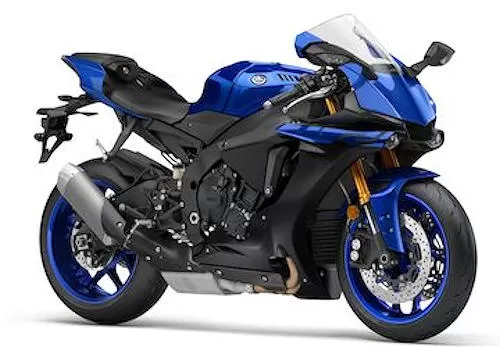
The LED headlamps have a small effect, but they're drowned out by the visual shock of this new R1. With its high horsepower, cross-plane shimming and MotoGP looks, the R1 is no longer the superb sports bike we once knew, but an M1 adapted to the common rider. Yamaha has given it what it takes to return to the forefront of ultra-efficient sports bikes. It shakes, grunts, heats up the clocks and becomes a weapon once again. And if that's not enough for you, a limited-edition R1M version with even more pistarderie (Öhlins and carbon) is available for accomplished track riders.
M.B - Manufacturer's media
by Greg

 Share
Share
Key facts Yamaha YZF-R1 1000 (2019) : What you need to know before you buy
 France

Specifications Yamaha YZF-R1 1000 2019
- Chassis
- Frame : diamond aluminum perimeter
- Fuel capacity : 17 liters (4.49 US gallons)
- Seat height : 855 mm (33.66 in)
- Length : 2,055 mm (80.91 in)
- Width : 690 mm (27.17 in)
- Min height : 1,150 mm (45.28 in)
- Wheelbase : 1,405 mm (55.31 in)
- Dry weight : 179 kg (395 lb)
- Weight when fully loaded : 199 kg (439 lb)
- Front axle
- Reverse telehydraulic fork Ø 43 mm, Wheel travel : 120 mm (4.72 in)
- Braking 2 discs Ø 320 mm (12.6 in), radial mounting, 4-piston caliper
- Front tire : 120 / 70 - 17 → Order this type of tire
- Transmission
- 6 stage gearbox
- Secondary by chain
- Rear axle
- Mono-damper, Wheel travel : 120 mm (4.72 in)
- Braking 1 disc Ø 220 mm (8.66 in), single-piston caliper
- Rear tire : 190 / 55 - 17 → Order this type of tire
- Motor
- 4 cylinders online , 4 strokes
- Injection
- Cooling system : liquid
- 2 ACT
- 4 valves per cylinder
- 998 cc
- 200 ch (197.20 hp) to 13,500 rpm
- 11.50 mkg to 11,500 rpm
- Power-to-weight ratio : 0.91 kg/ch
- Weight / torque ratio : 15.57 kg/mkg
- Compression : 13 : 1
- Standard equipment
- Brake assist : ABS as standard
- Practical information





Models
2019
2018

2017


2016
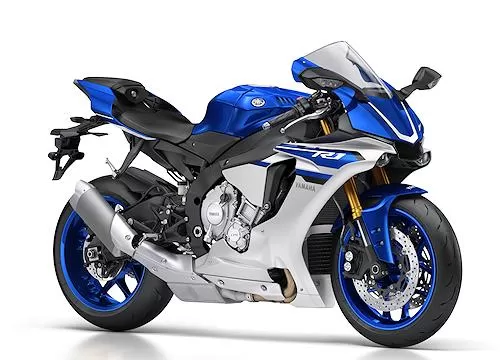
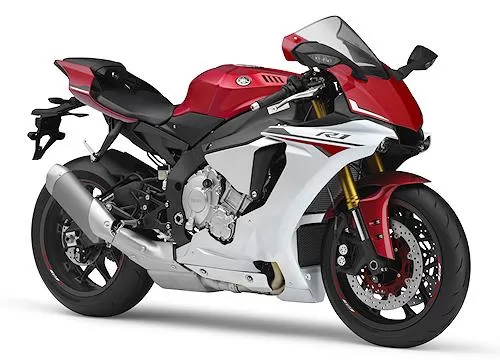
2015
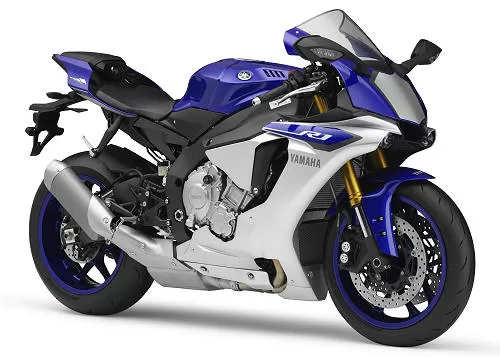
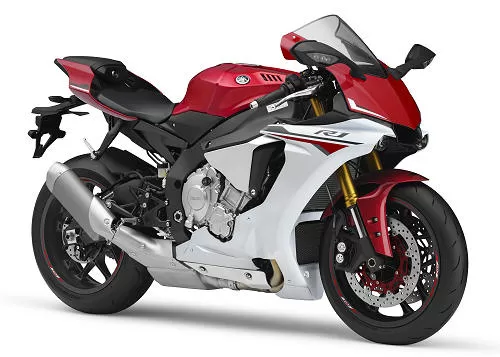
Used


Compare the YZF-R1 1000 to its competitors
Acceleration
Fuel consumption
Range
Torque
Power
Power-to-Weight ratio
Torque-to-Weight ratio
Speed
CO² emissions
FAQ Your frequently asked questions about the YZF-R1 1000 2019
- What is the power of the YZF-R1 1000 2019?
-
The YZF-R1 1000 2019 develops a power of 200 ch (197.20 hp)
- What is the torque of the YZF-R1 1000 2019?
-
The maximum torque of the YZF-R1 1000 2019 is 11.50 mkg to 11,500 rpm.
- What is the maximum speed of the YZF-R1 1000 2019?
-
The YZF-R1 1000 2019 is capable of reaching a top speed of approximately 300 km/h (186.40 mph) on the track.
- What is the weight of the YZF-R1 1000 2019?
-
The YZF-R1 1000 2019 has a a dry weight of 179 kg (395 lb), a weight when fully loaded of 199 kg (439 lb).
- QWhat is the seat height of the YZF-R1 1000 2019?
-
To ensure good accessibility, the YZF-R1 1000 2019 offers a minimum seat height of 855 mm (33.66 in).
- What is the price of the YZF-R1 1000 2019?
-
The price of the YZF-R1 1000 2019 is 18,999€ in France
News
-
New motorcycle products for 2026

-
Bridgestone announces the RS12, its new road-race weapon.
-
Yamaha Race Like A Girl: Natalia Rivera in episode 5.
-
Bridgestone presents the Battlax V03, its new slick tire.
-
With Sartoria Meccanica, MV-Agusta aims to go beyond premium.
-
Upgrading the entire Bonneville family for 2026.
-
Metzeler unveils three new tires at EICMA.
-
World Superbike celebrates 70 years of Yamaha.
-
Exceptional: some thirty new Triumphs in 2026.
-
40.000 bikers for the Royal-Enfield "One Ride" 2025.



Bikers' reviews Leave a review - 16 reviews
wen de l'ile de la reunion Rating : 5/5 Respond to wen
Sportively
Thanks Rating : 5/5 Respond to Baby69
.... Rating : 4/5 Participate in the conversation
Rating : 5/5 Respond to mario