
Motorcycle specifications KawasakiNinja 1000 ZX-10R KRT Replica 2020 The quest for hundredths of a second


presentation of the Ninja 1000 ZX-10R KRT Replica 2020
the ZX-10R is always on the lookout for power. Last year, its mechanics were given the proper care to gain watts. It passed a new stage with a revised cylinder head and a number of optimizations.
its 'Kawasaki Racing Team' paintwork has been retouched to exude aggressiveness. And there's plenty of it. Wringing out the handle followed by an approach to the red zone will be rewarded with a 203hp charge. That's three more units that you'll have to go and get 500 rpm higher, at 13,500 rpm. It's not so much the increase in power that's intriguing, but the technical changes. The 4-cylinder has opted for louvered valve timing, as on the BMW S 1000 RR and the latest version of the Suzuki GSX-R 1000 / R. This valve actuation method reduces weight by 20%, increases revs and allows the introduction of meaner camshafts. To prevent wear, a DLC treatment has been applied.
No jealousy in the range: all ZX-10R models feature the new cylinder head(first introduced on the RR). To celebrate, the cylinder head cover is painted red. What's more, to keep up with the competition, the 'basic' Ninja 10R steals the Up&Down shifter from the RR and SE siblings; on the old model, it only worked when upshifting.

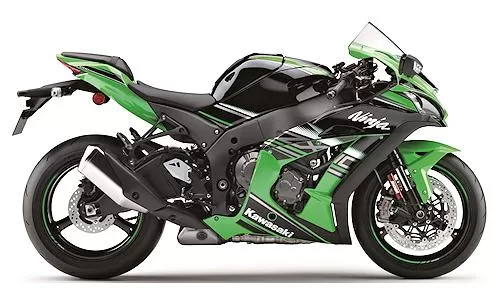
a touch of make-up and technical optimization to follow on from the previous 2016 update. The big Ninja hadn't really changed visually since its previous incarnation; it had been delicately styled. With its more chiselled headlights, more receding rear and tapered exhaust, the machine gained in elegance, almost in smoothness. With subtle hints of the 636, it was more accommodating than disturbing. The old"bio-medicalized" rear light unit gave way to a much more successful design. Since then, it has given off that imperceptible touch of class. The bow blades of the fairing are retained, as are the generous tank covers. The design above the fork head has been revised. Gone is the exception of having a bubble without edges; the cockpit accompanies it on its edges, thus reducing vibrations. Miss Ninja seems to care about the rider, accompanying the effort and giving a little respite on long straights swallowed at full speed. This is evidenced by slightly increased protection and small ears cut almost at the top of the fork head. This would reduce the depression behind the bubble and limit helmet shake.
However, the pencil has not been forced onto the drawing board. You'll have to keep your eyes peeled to distinguish the two generations of ZX-10R; we've seen more marked evolutions.

in competition, it's not really the evocative design that will be at the center of discussions. Instead, we'll be talking about...
Wait, what are those tubes in front of the brake calipers?! Gosh, that looks an awful lot like an Öhlins pressurized fork. You know, the kind of front end you only find on MotoGP, WSBK, EWC and Greek shipowners. Let's come down to earth and appreciate Showa's technology. The technical approach is much the same as that of the Swedish manufacturer's FGR. Damping is no longer managed in the bushes, but in these small external chambers, filled with nitrogen. As a result, the damping is more stable, the fork works better and lets you appreciate even more what's going on under the wheel. Until now, this type of fork has only been seen in top-level competition. Showa has democratized it with this BFFF (Balance Free Front Fork), just as inverted forks and radial calipers are gradually appearing.
And here's the second bonus. This front drivetrain has not ceased to amaze us. Forget the Tokico and the petal wafers. Smell the delicate, acrid scent of molten metal under Brembo's assault. This time, it's more than serious. The brake discs are 330 mm in diameter (+20 mm), and the brake shoes are M50 monobloc. All under the control of aviation hoses and a radial-pump master cylinder. Enough to make a Ducati 1299 Panigale or an MV-Agusta F4 jealous; and you know how an Italian brakes. But will the graft take as well on a Japanese bike?!
ABS? Always present, and now impossible to do without. The KIBS goes so far as to detect a rear-wheel lock-up caused by a hard downshift, and therefore doesn't kick in. It can be deactivated with the electronic key supplied in the racing kit (more on this later). The Öhlins steering damper is retained, to calm the steering.

before tackling the chapter on the ever-increasing number of impressive electronic aids, let's let the engine have its say. It's a supercharged muscle with the performance of a madman. Don't get hung up on the maximum power of this 4-cylinder. Kawasaki gave it 200 horsepower back in the day (210 with forced air intake), and that was enough to dislodge 99% of anything on the road. With 203 horsepower in 2019, the situation has moved up a notch. The work of the engine manufacturers, largely influenced by the work of KRT, is moving in the direction of a fuller, more breathable engine, with less inertia when revving (was there?). I'll spare you all the technical modifications... But if you really want to know, you'll find all the details at the bottom of the page. Highlights include a larger airbox and a much more aerated filter, a lightened crankshaft, thicker cylinder walls, optimized camshafts, new exhaust valves and a new, more compact engine.larger exhaust valves, improved gas evacuation, lighter, stronger pistons, a refined intake and a more compact gearbox. Gears 2 and 6 have been shortened, making it easier to get out of corners and hit top gear. Oh, by the way, the gearbox is located higher up, so you can open it without having to drain the mill. How convenient.
The power is there, with a desire to be more exploitable. The choice of cartography supports this approach. 3 modes are available, delivering 60% (low), 80% (middle) or 100% (full) of the 998 cm3's watts.
With all these evolutions, it's enough to make you wonder if the Kawasaki Racing Team doesn't want to invite itself into your garage. The electronic arsenal too?
for the most part, yes. Theold ZX-10R already had its answer in this respect. Now it's time to move on to the next stage, between power-assisted driving and a manned mission to Mars. KIBS, as we've already seen above. But the ZX-10R"phase 6" has even more underneath. The big change on this Ninja is the adoption of Bosch's UMI, 5-axis inertial control (longitudinal, transverse and vertical acceleration, roll rate and pitch rate). And there aren't many bikes on the market with this intelligent control module. The latest 1299 Panigale and R1 do their thing brilliantly, and the 10R is now up to speed. The Akashi-based manufacturer adds a personal touch with the calculation of yaw angle, provided by the ECU. This allows the on-board electronics to "see" in 3D where the bike is in space and how it reacts, enabling them to act with great efficiency.
Traction control takes full advantage. The S-KTRC no longer relies solely on the difference in wheel speeds to intervene. With the help of UMI measurements, it can act according to track conditions, tires, machine glide and wheeling. Amazing! It can now be set to five levels instead of three.
The ZX-10R is also equipped with Launch Control, even more effective than that of the H2 and H2R, and KEBC for engine braking.

s-KTRC, KEBC, UMI, KLCM, KIBS, KQS... Haven't we forgotten someone? Well, doesn't this Kawa have a structure? Arf, electronics are so much in the forefront on these cars that you'd almost forget about the chassis. But the bugger does most of the work. Even better from this point on. We've seen that the front drivetrain takes its standards up a notch. To transform, it relies on the double-beam aluminum perimeter frame, modified only in the thickness of the walls, which are thinner but just as solid. The main changes concern geometry. The steering column has been moved back 7.5 mm, while the swingarm has been lengthened by 15.8 mm. The increased wheelbase should provide a little more stability, although no one has complained about this. As for the chassis modifications, they result in more weight on the front wheel, favoring corner entry feel.
That's right, the weight. One wonders where Kawa slipped a brick onto its sporty 1000. The specification sheet announces an extra 5 kgs, or 206 units. Probably the catalytic converter and other crap.
The rear monoshock and its quasi-horizontal kinematics are retained; the Showa BFRC Lite is lighter, with a separate damping function (as for the fork) and easier adjustments. The ZX-10R is a weapon! Finely honed to cut through the competition.
the bar graph on the dashboard, not always appreciated, has also been retained. The instrument panel gets a few more lights, the digital window changes its layout a little, and a brightness sensor automatically dims the instrument panel.

the Kawasaki ZX-10R is more about evolution than real redesign. It does, however, significantly improve an already high level of efficiency. Perhaps we would have appreciated the option of semi-active suspension... The most hardcore riders will focus more on the racing kit. The steering column can be adjusted by 4 mm using a set of spacers. Another set of parts can be used to modify the swingarm axis. There are also a whole host of engine parts, as well as the electronic key mentioned in the ABS chapter. This allows you to deactivate the anti-lock braking system, fine-tune the riding aids, reprogram the ECU to gain 10 horsepower and smooth the power curves.
Now, turn the key in the ignition, close the visor, let it express itself, drive... You're in racing mode, while the stopwatch sweats.
M.B - Manufacturer's photos
a little more technique:
all the evolutionary work Kawasaki has done on its ZX-10R fits on 29 pages. Let's concentrate on the engine and its main technical modifications:
- The intake ducts are machined using a cutting-edge technique borrowed from Kawasaki's WSBK team: their outlet ports are machined in two stages, first with the valve seats and then at an angle. In this way, the air follows a straighter path as it enters the combustion chamber. While smoothing the flow, this wider, straighter duct geometry enables a greater volume of air/fuel mixture to be drawn in, to the benefit of power. As before, the intake ducts are polished.
- In the same spirit of increased power, the exhaust ducts are also wider, straighter and now polished.
- The larger diameter of the exhaust valves (Ø 24.5 mm -> Ø 25.5 mm) also increases power, particularly at high revs. Inlet valve diameter remains unchanged at 31 mm.
/ Both intake and exhaust valves are made of titanium, a material with high thermal resistance and reduced moving mass.
The reworked cam profile lengthens the crossover period, for greater power (especially at high revs).
/ Chromoly camshafts contribute to the overall weight reduction.
- The shape of the combustion chamber evolves to improve intake and exhaust efficiency
- To handle the increased engine load, the pistons have been shortened (39.2 mm -> 37.7 mm) and their crowns redesigned. Each piston is 5 grams lighter, for improved engine response. In addition, they are made from a new material that is both more robust and extremely heat-resistant. Finally, the addition of a dry lubricating film on the skirt reduces low-speed friction and facilitates piston running-in.
- The crankshaft's moment of inertia is reduced by 20%, one of the most important results of the lessons learned by the Kawasaki WSBK Team. The performance gain is noticeable at all levels: acceleration, deceleration and cornering.
- The new material of the connecting rod bearings enhances their endurance at high revs, while their new coating improves resistance to seizure.
- At cylinder level, the bore walls are thicker (5 mm -> 6 mm) to match rigidity to power gains, which also benefits reliability.
- The use of electronic throttle control justifies the adoption of a new 32-bit electronic control unit (ECU). The resin-free aluminum casing promotes heat dissipation, and hence reliability.
by Greg

 Share
Share
Key facts Kawasaki Ninja 1000 ZX-10R KRT Replica (2020) : What you need to know before you buy
 France

Specifications Kawasaki Ninja 1000 ZX-10R KRT Replica 2020
- Chassis
- Frame : double alu perimeter beam
- Fuel capacity : 17 liters (4.49 US gallons)
- Seat height : 835 mm (32.87 in)
- Length : 2,085 mm (82.09 in)
- Width : 740 mm (29.13 in)
- Min height : 1,145 mm (45.08 in)
- Wheelbase : 1,440 mm (56.69 in)
- Weight when fully loaded : 206 kg (454 lb)
- Front axle
- BPF reverse telehydraulic fork Ø 43 mm, Wheel travel : 120 mm (4.72 in)
- Braking 2 discs Ø 330 mm (12.99 in), radial mounting, 4-piston caliper
- Front tire : 120 / 70 - 17 → Order this type of tire
- Transmission
- 6 stage gearbox
- Secondary by chain
- Rear axle
- Mono-damper, Wheel travel : 114 mm (4.49 in)
- Braking 1 disc Ø 220 mm (8.66 in), single-piston caliper
- Rear tire : 190 / 55 - 17 → Order this type of tire
- Motor
- 4 cylinders online , 4 strokes
- Injection Ø 47 mm
- Cooling system : liquid
- 2 ACT
- 4 valves per cylinder
- 998 cc
- 203 ch (200.20 hp) to 13,500 rpm
- 213 hp with ram air
- 11.70 mkg to 11,200 rpm
- Power-to-weight ratio : approximately 0.95 kg/ch
- Weight / torque ratio : approximately 16.34 kg/mkg
- Compression : 13 : 1
- Standard equipment
- Brake assist : Sport ABS
- Practical information





Models
2020

2019

2018

2017
2016

Used


Compare the Ninja 1000 ZX-10R KRT Replica to its competitors
Acceleration
Fuel consumption
Range
Torque
Power
Power-to-Weight ratio
Torque-to-Weight ratio
Speed
CO² emissions
FAQ Your frequently asked questions about the Ninja 1000 ZX-10R KRT Replica 2020
- What is the power of the Ninja 1000 ZX-10R KRT Replica 2020?
-
The Ninja 1000 ZX-10R KRT Replica 2020 develops a power of 203 ch (200.20 hp)
- What is the torque of the Ninja 1000 ZX-10R KRT Replica 2020?
-
The maximum torque of the Ninja 1000 ZX-10R KRT Replica 2020 is 11.70 mkg to 11,200 rpm.
- What is the maximum speed of the Ninja 1000 ZX-10R KRT Replica 2020?
-
The Ninja 1000 ZX-10R KRT Replica 2020 is capable of reaching a top speed of approximately 300 km/h (186.40 mph) on the track.
- What is the weight of the Ninja 1000 ZX-10R KRT Replica 2020?
-
The Ninja 1000 ZX-10R KRT Replica 2020 has a a weight when fully loaded of 206 kg (454 lb).
- QWhat is the seat height of the Ninja 1000 ZX-10R KRT Replica 2020?
-
To ensure good accessibility, the Ninja 1000 ZX-10R KRT Replica 2020 offers a minimum seat height of 835 mm (32.87 in).
- What is the price of the Ninja 1000 ZX-10R KRT Replica 2020?
-
The price of the Ninja 1000 ZX-10R KRT Replica 2020 is 18,099€ in France
News
-
New motorcycle products for 2026

-
Bridgestone announces the RS12, its new road-race weapon.
-
Yamaha Race Like A Girl: Natalia Rivera in episode 5.
-
Bridgestone presents the Battlax V03, its new slick tire.
-
With Sartoria Meccanica, MV-Agusta aims to go beyond premium.
-
Upgrading the entire Bonneville family for 2026.
-
Metzeler unveils three new tires at EICMA.
-
World Superbike celebrates 70 years of Yamaha.
-
Exceptional: some thirty new Triumphs in 2026.
-
40.000 bikers for the Royal-Enfield "One Ride" 2025.



Bikers' reviews Leave a review - 6 reviews
i am the owner of a zx10 R 2020 krt. it has 400 KM, bought in ocase new so still in break-in. can you inform me about the break-in of this vehicle? Rating : 5/5 Respond to OUNZ
I already had the 2016 model, which I found top-notch, despite a not-very-pleasant engine noise (mechanical rattling).
The engine difference is obvious. To cut a long story short, I'm more responsive to the running-in engine on the 2018 than I was with the 2016, which was already well broken in. This bodes well for terrific performance once the engine is unleashed.
It's a bike on which you feel at ease. On the road, it knows how to be gentle (you have to stay under 7000 rpm!).
On the track, it'll take on just about anything.
V
Christophe Rating : 5/5 Respond to LHORTO95
headlight call ! Rating : 5/5 Respond to kawa