
Motorcycle specifications YamahaTracer 9 GT 2025 Looking further ahead


presentation of the Tracer 9 GT 2025
The Tracer9 is taking its GT role in the Yamaha range more and more seriously. Long gone are the days when the 900 Tracer blended trail, roadster and Sport-GT in a wild, hybrid machine. Today, its distant descendant wants to be a road-going machine, and makes a strong technological case for it.
When this crossover became Tracer9 (in 2021), its physiognomy changed course. At that point, the road profile really took over. The 2025 model confirms this trend, while its design may come as a surprise. The mutinous little forehead becomes more slender, while the jowls take on chronic importance. The polygamy of headlights is assembled like little bricks installed by Jacky Tuning.
Although the overall look is very similar to the old model, the entire line has evolved as a result of numerous improvements. The shoulders are stricter, the tank cladding reworked and the rear frame stretched. But once back in front of the big Tracer, it's impossible not to wrinkle your nose at its face.
And then, what's all this? Yam has installed adaptive cornering lights on all Tracer9 models, and more specifically matrix headlights on the GT and GT+. Dac, but what does it do? To adapt lighting to the environment.
But how? Right in the middle of its face, the Tracer9 GT has slipped in a camera to view light sources, the weather, and car headlights. With the help of the inertial unit to compensate for the motorcycle's movements, the system adapts the light beam, its level and its distribution to provide optimum illumination without disturbing oncoming traffic.
Matrix lights are a further step in adaptive lighting. Not only for cornering, but also for distribution. They are fully automatic, but the driver can choose 3 levels of sensitivity at any time.

big changes inside. The Tracer9 abandons its dual screen (sometimes controversial and regularly misunderstood) to install a single, practical, simpler, functional..... and much larger screen. A 7-inch TFT color screen, which is much more comfortable to read. The layout stands out for its appreciable simplicity, 3 display themes, impeccable presentation of driving mode settings and integration of Garmin's Motorize GPS navigation system. Smartphone connectivity is via USB, Wi-Fi or Bluetooth. The MyRide app allows you to control music, calls, messages and settings for the bike's riding aids.
The new Tracer is less confusing thanks to this new interface, and more welcoming from the seat. The rear buckle has been lengthened and lightened to offer more space for the passenger. The rider also benefits from a new seat, flatter between the legs and more generous for the buttocks... but also higher. The seat reaches 845 mm at its lowest point. Or 860 mm in its highest position. Values close to those of a KTM Adventure. But Yamaha (re)assures us that the design of the front part of the seat should make life easier for all riders.
Comfort is one of the priorities of this new generation of Tracer. The handlebars and footrests (adjustable in height) have been redesigned with this in mind, as has the installation of an electric bubble offering 100 mm of travel, the arrival of a storage compartment with USB socket on the right-hand side of the fuel tank, and the possibility of backing up the engine with the Y-AMT* automated gearbox.
If you take these elements and add them to theex-Tracer9's renewed package, you get a (somewhat trail) tourer with 30-liter panniers each, heated grips, hand guards, a center stand, and electronics galore.
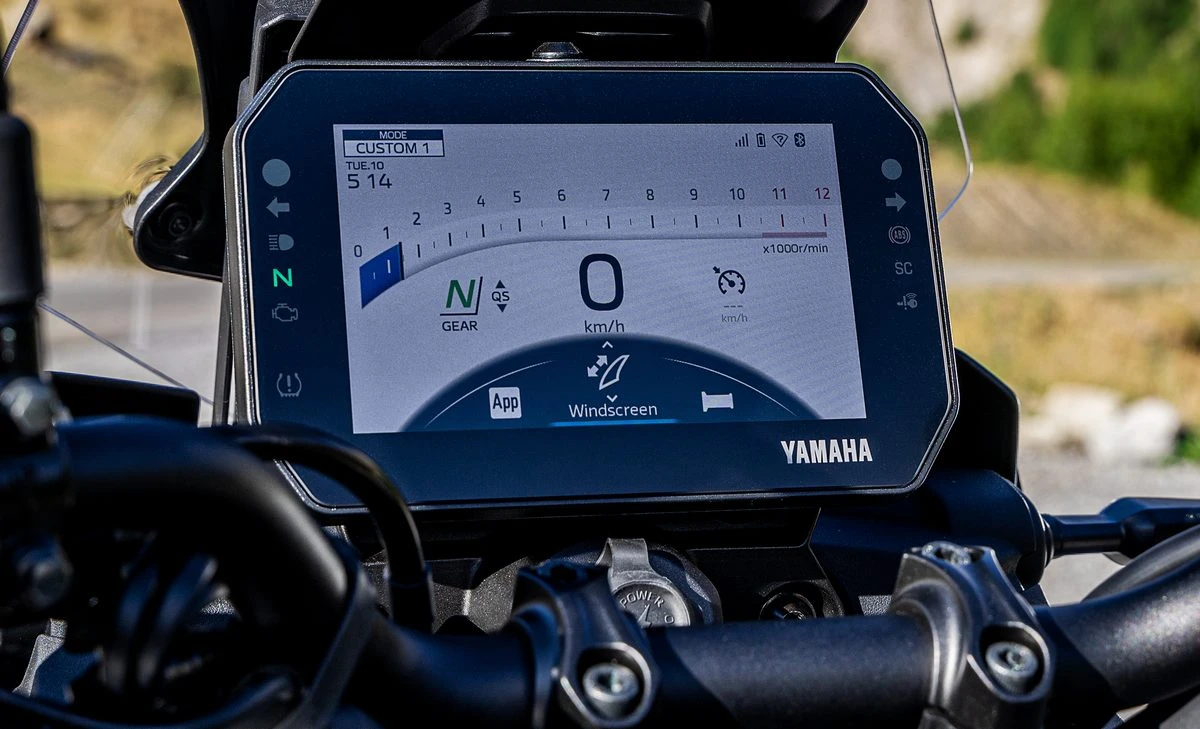
With a new 17.8 cm speedometer, all-new gauges, keyless entry, speed limiter, multi-function indicators, hill-start assist and matrix headlights... These are the additions to the new Tracer. In addition, there's Kayaba KADS semi-active suspension, shifter, cruise control, traction, glide, braking and wheeling controls, cornering ABS and 5 riding modes.
Didn't it used to have 4? Hardly. Yamaha has added one more and revised their names. The D-Mode system no longer identifies them from 1 to 4, but obeys a more universal process: 3 with common names, Sport / Street / Rain, to which are added 2 customizable modes 1 / 2.
On the other hand, does upgrading to Euro5+ change anything for the engine? Not a thing. The spirited 890 cm3 CP3 retains its 119 hp and a healthy dose of 9.5 mkg of torque. Whatever the machine it's fitted to, and whatever the application, this three-cylinder is a delight to use.
To channel its energy, the chassis is ad hoc as much as identical to previous vintages. A Deltabox frame in die-cast aluminum, surrounded by a 41 mm inverted fork, monoshock and 17-inch Spinforged lightweight wheels. Yamaha asked Bridgestone to design T32 tires specifically for the Tracer, to boost its handling. In fact, this new Tracer9 steers a little better. Not thanks to the new tires or a reworked chassis, but to the redesigned fork support. Braking is still of a high caliber, with 4-piston radial calipers biting 298 mm tracks. The rear disc has grown from 245 mm to 267 mm.
Like so many other brands, Yamaha no longer has a big GT in its range, but it's pulling out all the stops on its Tracer models to offer a high level of comfort and equipment. The new Tracer9 GT is even more loaded, as a worthy representative of the road. A step up, the GT+ comes with radar, adaptive cruise control, standard Y-AMT, tire pressure monitoring, a tougher chain, blind spot detection and backlit controls.

M.B- manufacturer's photos
kADS: This semi-active system is integrated into the bike's electronics and automatically adjusts damping using real-time data detected by the six-axis IMU, such as lean angle, load, acceleration, amplitude and speed of suspension travel, offering sporty riding without compromising comfort.
The rider can choose between different modes at the touch of a button, and dynamics are determined by the selected YRC riding mode, offering a firmer, sportier setting in Sport mode, while the emphasis is on comfort in Street and Rain modes.
.
by Greg

 Share
Share
Key facts Yamaha Tracer 9 GT (2025) : What you need to know before you buy
Prices
| Basic version | |
|---|---|
 France France |
15,699€
|
 Austria Austria |
17,699€
|
 Belgium Belgium |
16,299€
|
 Germany Germany |
16,049€
|
 Italy Italy |
15,399€
|
 Luxembour Luxembour |
15,849€
|
 Spain Spain |
16,399€
|
 Switzerland Switzerland |
15,690CH
|
 United Kingdom United Kingdom |
£14,350
|
Model sold in 2025

Performance
- Max speed : 225 km/h (139.80 mph) on the odometer
- Average fuel consumption : 5 liters/100km (0.47 mpg)
-
Estimated range
: 380 km (236 miles)
Calculated range until tank is empty, not verified.

Specifications Yamaha Tracer 9 GT 2025
- Chassis
- Two-seater saddle
- Frame : diamond aluminum perimeter
- Fuel capacity : 19 liters (5.02 US gallons)
- seat height adjustable between 845 mm and 860 mm
- Length : 2,175 mm (85.63 in)
- Width : 900 mm (35.43 in)
- Height between 1,440 mm (56.69 in) and 1,530 mm (60.24 in)
- Wheelbase : 1,500 mm (59.06 in)
- Weight when fully loaded : 227 kg (500 lb)
- Front axle
- Reverse telehydraulic fork Ø 41 mm, Wheel travel : 130 mm (5.12 in)
- Braking 2 Sumitomo discs Ø 298 mm (11.73 in), radial mounting, 4-piston caliper
- Front tire (Tubeless) : 120 / 70 - 17 → Order this type of tire
- Transmission
- 6 stage gearbox , manual - shifter standard - robotized optional
- Secondary by chain
- Rear axle
- Mono-damper, Wheel travel : 131 mm (5.16 in)
- Braking 1 Sumitomo disc Ø 267 mm (10.51 in), single-piston caliper
- Rear tire (Tubeless) : 180 / 55 - 17 → Order this type of tire
- Motor
- 3 cylinders online , 4 strokes
- Injection
- Cooling system : liquid
- 2 ACT
- 4 valves per cylinder
- 890 cc
- 119 ch (117.40 hp) to 10,000 rpm
- 9.50 mkg to 7,000 rpm
- Power-to-weight ratio : approximately 1.79 kg/ch
- Weight / torque ratio : approximately 22.17 kg/mkg
- Compression : 11.5 : 1
- CO² emissions: 116 g/km
- Standard equipment
- Brake assist : ABS
- Number of riding modes : 5
- Storage volume : 60 liters
- TFT Full-Colour screen size: 17.78 cm (7 inches)
- ABS Cornering
- Aluminium rims
- Shifter
- Center stand
- Gear indicator
- Cruise control
- Bluetooth
- USB plug
- Keyless ignition
- Traction control
- Heated grips
- Electric adjustable windscreen
- Electronically adjustable suspension
- Anti-wheeling control
- Saddlebags
- Forged rims
- Traction control
- Anti-slip clutch
- Adjustable seat
- Adaptive headlights
- Engine-brake control
- Practical information





Models
2025


Used


Compare the Tracer 9 GT to its competitors
Price
Acceleration
Fuel consumption
Range
Torque
Power
Power-to-Weight ratio
Torque-to-Weight ratio
Speed
CO² emissions
FAQ Your frequently asked questions about the Tracer 9 GT 2025
- What is the power of the Tracer 9 GT 2025?
-
The Tracer 9 GT 2025 develops a power of 119 ch (117.40 hp)
- What is the torque of the Tracer 9 GT 2025?
-
The maximum torque of the Tracer 9 GT 2025 is 9.50 mkg to 7,000 rpm.
- What is the maximum speed of the Tracer 9 GT 2025?
-
The Tracer 9 GT 2025 is capable of reaching a top speed of 225 km/h (139.80 mph) on the odometer on the track.
- What is the weight of the Tracer 9 GT 2025?
-
The Tracer 9 GT 2025 has a a weight when fully loaded of 227 kg (500 lb).
- What is the fuel consumption of the Tracer 9 GT 2025?
-
Average fuel consumption is estimated at 5 l/100km (0.47 mpg) according to the WMTC cycle.
- QWhat is the seat height of the Tracer 9 GT 2025?
-
To ensure good accessibility, the Tracer 9 GT 2025 offers a minimum seat height of 845 mm (33.27 in). The integrated adjustment allows you to adjust the riding position to suit your needs.
- What is the price of the Tracer 9 GT 2025?
-
The price of the Tracer 9 GT 2025 is £14,350 in United Kingdom. It is displayed at 15,399€ in Italy, at 15,690CH in Switzerland, at 15,699€ in France, at 15,849€ in Luxembour, at 16,049€ in Germany, at 16,299€ in Belgium, at 16,399€ in Spain and at 17,699€ in Austria.
- What colors are available for the Tracer 9 GT 2025?
-
For the 2025 model year, the Tracer 9 GT is available in several colors: black and grey.
News
-
New motorcycle products for 2026

-
Bridgestone announces the RS12, its new road-race weapon.
-
Yamaha Race Like A Girl: Natalia Rivera in episode 5.
-
Bridgestone presents the Battlax V03, its new slick tire.
-
With Sartoria Meccanica, MV-Agusta aims to go beyond premium.
-
Upgrading the entire Bonneville family for 2026.
-
Metzeler unveils three new tires at EICMA.
-
World Superbike celebrates 70 years of Yamaha.
-
Exceptional: some thirty new Triumphs in 2026.
-
40.000 bikers for the Royal-Enfield "One Ride" 2025.



Bikers' reviews Leave a review - 10 reviews
It's a far cry from the comfort of a FJR 1300! Beware, however, of the fairing, as it made the FJR's engine run hot, and that was its downfall. Rating : 5/5 Participate in the conversation
I couldn't find a single fault with it, except that it's very difficult to drive calmly with this engine, and the points on your license could soon be deducted!
The aesthetics of the front end are also questionable. I won't talk about the electronics, as they're not my thing; I prefer simplicity. Rating : 5/5 Respond to Alain81