Field testOur tester's opinion on the Ninja ZX-4RR 400 from 2025
The world of sports cars was merciless!!! Performance, horsepower galore for the hypersports; millimetre trajectories with the SuperSports; increasingly suffocating budgets... Enough to call into question certain passions.
Then came the gentle sports bikes, derived from highly successful roadsters. The Ninja 650, GSX-8-R, R7, CBR 650, Daytona 660, SR-R 675 offer the container with a less boiling content than the pure pistardes.
Alongside these shores, there's another world, where adrenalin dilutes in the veins more slowly but with just as much effect. A frontier of hysteria that sporty smoothies can't cross, where power is not the law. The passport to this frontier is the Kawasaki 400 ZX-4RR.
Small but proud
Style (5/5)
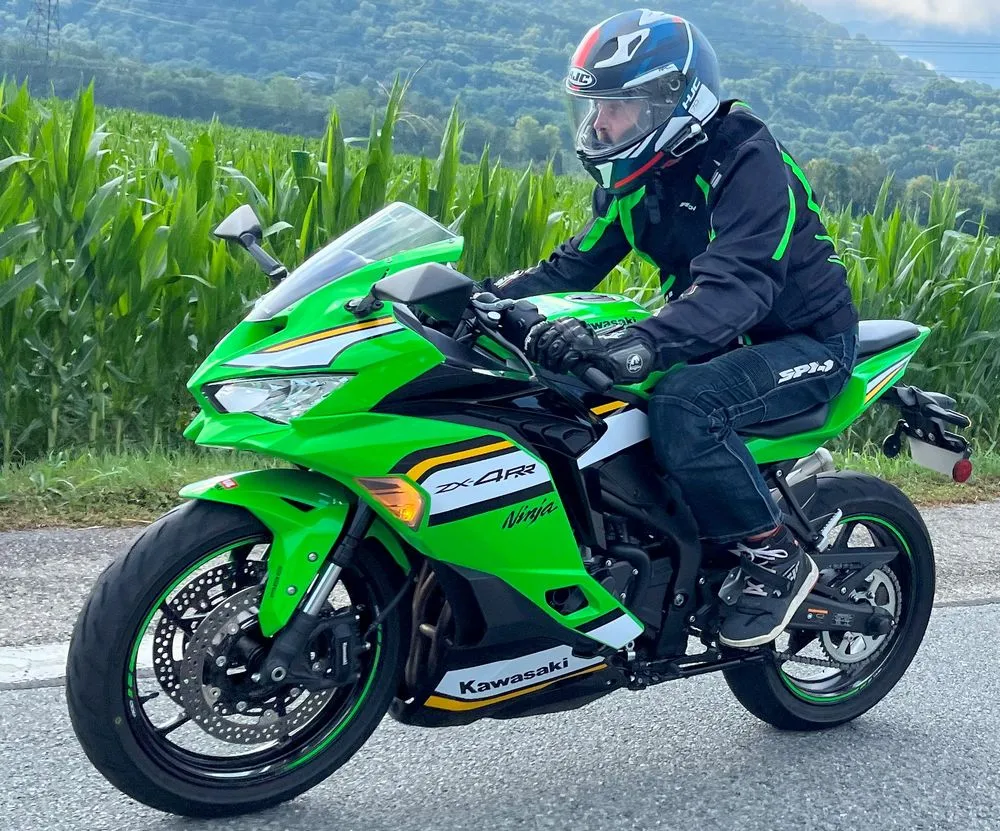
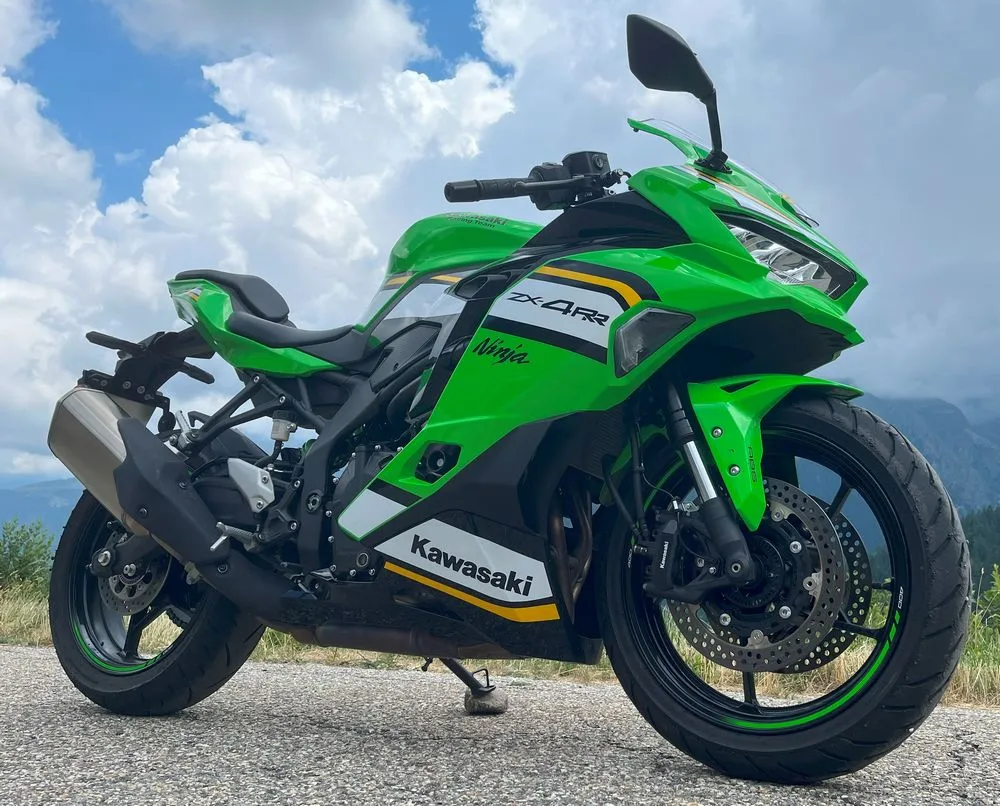
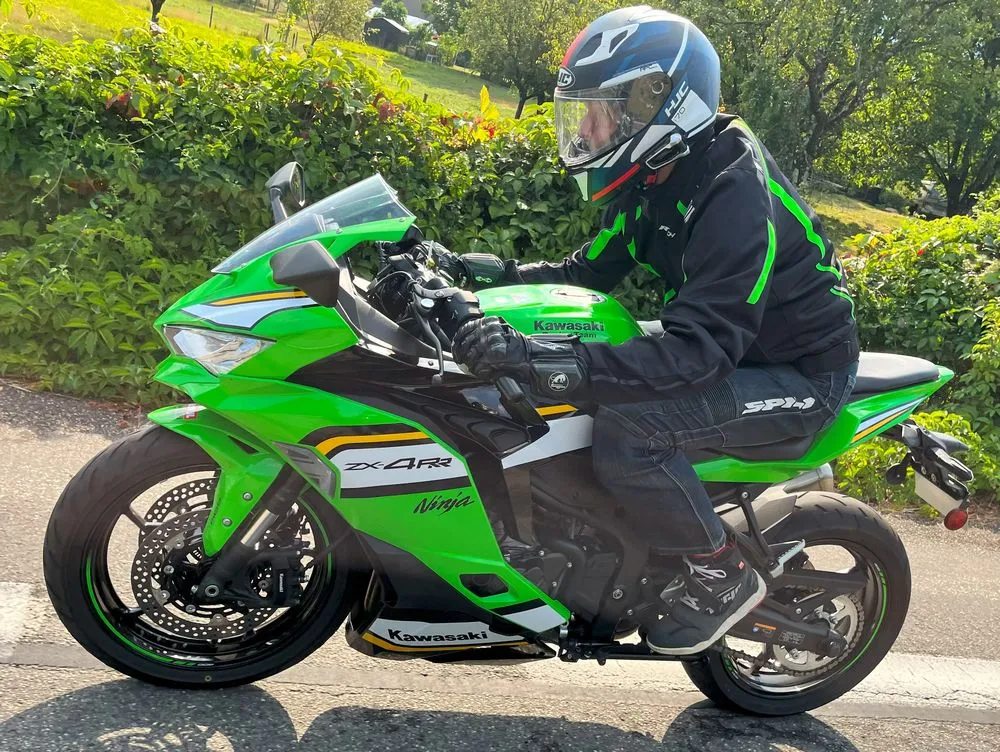
Let Kawasaki take you into a world where 16,000 rpm isn't synonymous with drooling and orbiting. Trust this green viper from which Kawasaki has removed the venom, leaving only an exhilarating bite. Which begins with a silhouette in the fine tradition of the ZXR. From the outset, the ZX-4RR's aggressive lines make it look like a ZX-6R. The KRT replica color scheme is a must, accentuating its racing pedigree.
No surprises when it comes to build quality. The workmanship, the assembly, the finish - it's all top-notch, with the feeling that everyone has worked hard at every stage. Under the saddles, the positioning of the electrical equipment is proof of the care taken to ensure well-thought-out procedures.
Without being in any way prohibitive, the choice of certain elements shows the user that he is not in the category of high-class machines. The smallest of the ZX-Rs (but not the Ninja, mind you) has a steel frame with a non-removable rear frame, a somewhat flimsy swingarm (also in steel), a banal brake control (a sport jar would have more cachet)... annoyances that you soon forget once you're on the bike.
Not much aluminum on the 4R. But aside from that, there are some features you'll appreciate. Like, for example, the standard Up&Down shifter, the 4.3-inch color TFT screen, Kawasaki's 4-piston brake calipers (Tokico ones), the small tank giving a remarkably compact impression, the adjustable Showa upside-down fork, the all-round adjustable monoshock (with a beautifully crafted shock absorber body) and the half-handlebars revealing the philosophy of this machine. Anchored below the fork crown but raised enough to be positioned above it, they provide sporty but moderate support for the front end. As a result, the rider doesn't feel at all broken or constrained on the machine. So you can expect to ride a lot of kilometers before getting sore. This bobinette promises to be very accommodating in everyday use, with a little spice in your breakfast.
The paddock in the background
Comfort (4/5)
As the morning freshness fades from its taut green skin, the ZX-4RR's eyes urge you to start quickly to warm up the range and the small cylinders, each with 99.75 cm3. Start-up takes longer than usual, surely to circulate more oil in the engine before the dance begins. The engine's already lively, alert rustle immediately sets the tone: it's a little moth that lives in there. For the moment, the Kawa doesn't deceive. It looks and sounds like a true sports car. But does it have the taste and flavor?
It continues its seduction with a surprising welcome. Once on board, its small size is immediately apparent. Better not be too tall! The half-handlebars don't break your handgrips, the clutch is incredibly smooth and the riding position is almost comfortable, albeit compact. Add to this the fairly compliant suspension, and you'd almost think you could spend a morning or an afternoon on the 4RR without getting worn out. Except that the idea of taking it for a ride doesn't last more than 400 meters. The idea of a decoction of a ride only lasts as long as it takes to warm up the engine and tires. The desire for an adrenaline infusion sets in as quickly as that of coffee in the morning. A few bends, a series of chicane, a wisp of horizon... the scenery changes in the mind, vibrators sprout in the corner of the eye, Jonathan Rea, Scott Russell, Ian Hutchinson and Akira Yanagawa raise their arms - I'm a teenager again in pursuit of emotions!!!!
A bomb without a blast
Engine (5/5)
That's it, everything's hot (including the driver). I'm stopped by traffic lights, with an unbearable countdown. The seconds tick away, my left hand ready to release the clutch while my right hand grows impatient.... 10 seconds to go.... The 4-cylinder grumbles..... I'm at the start of a Grand Prix..... 3 seconds.... The crowd can't take it anymore.... Hedgehogs tremble..... Red lights go out !!!!! Gooooooo go go go !!!!!!!!!! You'd think you were there! That's the magic of this over-excited little 400. It quietly and slyly distills its zest for life. Once you've got used to the 16,000 rpm, the traj' and the turbine noise inlaid with delicious scraping noises, the chequered flag takes the place of the horizon.
It all begins with an almost tranquil take-off. The engine's small displacement, low torque and "all up in the revs" nature mean that it doesn't demonstrate much in the first two-thirds of the rev counter. It's barely better than a 250, until the second phase of acceleration at around 9,500 rpm. The block starts to gain consistency, encouraging you to seek out the next stage at around 12,000 rpm. It gets stronger, really starts to howl, calls for more revs and sets off to conquer its reason for living.
I find the same kind of sensations as with a Yamaha R6, with this thrust and hysteria terribly enjoyable once in the (very) high revs. Except that with the ZX-4RR, it's slower, less explosive, and takes longer to reach the edge of the red zone. But it's just as exhilarating! The main difference, apart from speed of course, is that corners and revs don't jump out at you. The Kawa gives you time to appreciate its visceral howl, to prepare turns and trajectories, to feel everything it's got in its belly. So you brake later - but not too much, as you need to keep your speed to avoid getting stuck in the bends - you concentrate on staying in the right power range as much as possible, and you weld until the sensation of speed has taken hold. Want to have some fun? Always stay above 10,000 rpm! You really want to play with it? Never go below 12,500 rpm; a must! Want to slam a clock? Forget the 4R - it's not made for that, and pays little heed to it.
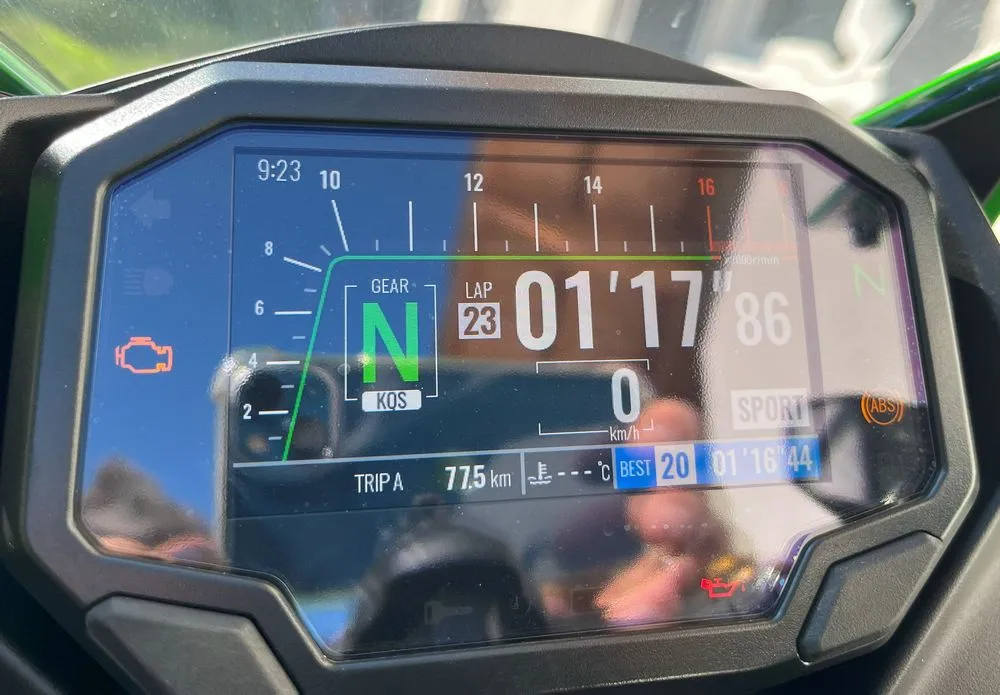
The ZX-4RR is a GP in miniature. With less speed, as if you were experiencing it in slow motion, but with just as much pleasure. Its top speed in no way reflects the sensations felt on board. On the track, the speedometer was able to read 215 km/h. But you have to be patient to get the hang of it.
Pocketable co-pilots
(3/5)
Like its more muscular sisters, this Ninja comes with several riding modes. Let's forget about Rain mode, which has no chance of justifying its presence. In this mode, the engine plays a game of belote before picking up a modicum of power, the KTRC is triggered on almost every corner exit, and in the end, it's only used once: to see what happens. The Road is a little more convincing. It allows you to make the most of the thruster's energy, while moderating your impatience to tease out a sporty drive.
Overall, however, it's the Sport and Rider modes that we'll be using the most. They are the most in tune with the ZX-4RR's use and image.
5 min to remove the road fittings; a little longer to put them back on, due to the electrical plugs being too deeply embedded in the inside of the rear frame. 5 cm more would have been enough to make things easier.
Like a fish in the current
Agility (5/5)
We set off on the Bresse circuit for a day's riding in the blazing sun. Conditions are perfect, and the Kawette is able to take to the track amidst the stars of the paddocks, with bikes of a different calibre. And this is where the ZX-4RR really comes into its own.
With its 399 cm³ in-line 4-cylinder engine and tiny 57 mm-bore pistons, there's no need to expect your arms to be ripped off by the torque. This is not its home turf. But the track is its kingdom. Here, you can keep this engine in its zone of ecstasy - above 10,000 rpm - and suddenly, the 400 wakes up. It climbs rapidly up the rev range, the airbox sucking in its lungs. The exhaust starts to sing, and before you know it, you're flirting with 12,000 rpm. A flick of the shifter, the two slams, the three flies, it pulls, it screams, and this raging little block pushes you to seek out 15,000 rpm in an exhilarating, raging, totally addictive crescendo. The noise invades the helmet, screaming and clawing at the eardrums... and you want more.
Of course, in a straight line, the V4s and big twin-cylinders catapult you over the horizon. But it doesn't matter: at the next chord point, you're grinning from ear to ear. Because this bike, which lives up high, combined with almost non-existent engine braking, offers a simple and exhilarating ride: you delay braking as long as possible, maintain speed in corners, play with inertia, and put the handle back in the corner with an exhilarating soundtrack to the next bend.
Kawasaki claims a fully loaded weight of 189 kg. On the track, it feels like twenty less. The lightness is amazing. You can throw the bike from corner to corner like a 125 with a boost, and tighten up trajectories with a simple push on the footrest. Nothing to do with a 1000 cm³ that heats up your thighs and tortures your arms: here, you just need to concentrate on pure riding. Whether you want to learn, improve or simply have fun, this Kawa is a riding school on wheels.
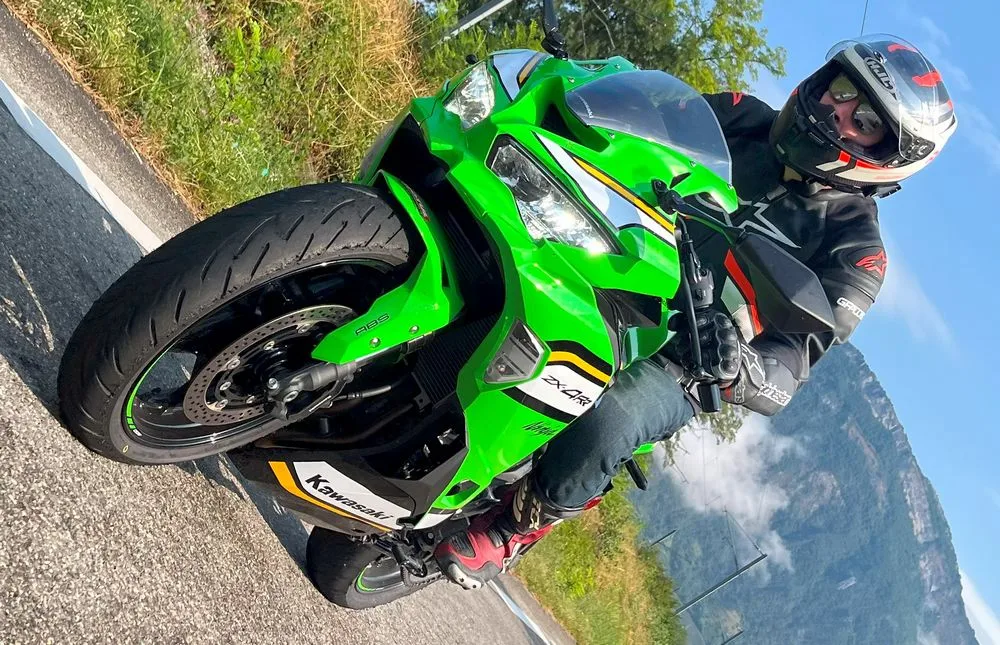
Despite an unflattering tubular steel frame architecture on paper, Kawasaki has taken care of its copy: the ZX-4RR takes braking on an angle without flinching or straightening, remains docile when manhandled, and proves reassuringly stable, even in a straight line. We only regret the absence of a steering damper, which would have completed the picture for those who want to play the competitive game. As for braking, it's up to the task: the Tokico radial calipers, though "old-fashioned", bite with enough power and progressiveness to ensure that you never feel out of your depth.
However, not everything is perfect. The fuel injection can be a little dry on short throttle applications (nothing dramatic, really, it's just for titillation). As for the shifter, it tends to give a little jerk when shifting from 2 to 3 if you're in the 10,000 - 12,000 rpm zone (but this is quite common on sports bikes). On the other hand, it works perfectly well when pulling on the gears in a straight line. In short: to attack, shift on full throttle. For city driving, use the clutch lever (which is surprisingly flexible).
Suspension-wise, the picture is pretty good. The shock absorber (fully adjustable) is rigorous and maintains traction. The fork also does a good job, but we'd have liked to see it adjustable for more than just preload: more seasoned riders may find it a little too 'soft', and become frustrated by the limits of adjustment. But is this really the bike's audience?
Let's get down to size. This 'mini-Ninja' is an illusion, with its premium finish and long swingarm. However, for anyone over 1.75 m tall, it's a little cramped: to be able to lie behind the bubble in a straight line, it lacks a few precious centimetres of rearward clearance. Nevertheless, the sporty yet versatile driving position contributes to a "sportiness/comfort" balance to its advantage!
But in the end, the essential is elsewhere. With its playful character, never-failing efficiency, and above all an engine that screams its life out at up to 16,000 rpm, the ZX-4RR turns every session into a recreation. You don't go for the clock, you don't fight the bike, you don't scare yourself. You just enjoy yourself. And that, on a racetrack, is certainly the most important thing.
The Kawasaki ZX-4RR is definitely a sports bike worth discovering. Playful, lively and a lot of fun, it can be used both for tracking without having to reach reprehensible speeds, and as an introduction to track riding. We particularly applaud Kawasaki's efforts in bringing this machine to our market. While in the past it was possible to discover over-accelerated 400s with machines like the Honda 400 VFR or the Kawasaki ZXR 400 (not to mention the GSX-R400, Honda CBR 400 RR and Yamaha FZR 400 R, which hardly made it out of Japan), the current offering for this kind of sports bike boils down to.... this Kawa. Let's not mention the R7, Daytona 660 and others, which are more akin to the roadster-caréné-sport-gt.
Problem is, it's not cheap. Almost 10,000 euros for a 400! And yet, the price isn't too shabby, and is even justified for the features on offer. Except that the financial effort and almost exclusive use won't help it make a place for itself on the market. But give it a try and you'll be tempted to fall for it. The only thing holding you back is your wallet.
Greg Rattin / Sébastien de Malfin
Published on 7/29/25 by Greg
Highlights
Fun and exhilarating
Sporty sensations without going 200
Racing but not radical
Weak points
Painful 4-cylinder howl over time
Un tariff rebutant
No aluminum frame
Galleryof our Ninja ZX-4RR 400 test drive
Essentials
The safety of your rider and the performance of your motorcycle are paramount. At our partner 'Revzilla', you'll find everything you need, from equipment to spare parts, to maintain your machine to perfection.
Externally easy motorcycle. Very nice on the road thanks to a not too sporty riding position. I put it on the track. Need better quality cartridges for the fork and controls set back. Otherwise, it's all good fun.Rating : 5/5
Respond to Jm
It's an extraordinary bike! It's fabulous to ride, an adrenalin rush at the highest revs, but beware of under-revs where the bike has no grip, but not all small 4-cylinder bikes can handle under-revs, so it's best to keep it in the hands of experienced riders.Rating : 5/5
Respond to Cacaille
Expensive and heavy (for a 400), power and torque at very high revs, I don't really see the point on the road every day. For a Kawa 400 coupe on the racetrack, maybe?Rating : 4/5
Respond to Alain81





 helmet
 Gloves
 jacket
 braking
 Chain kit
 Oils
Oils Find an intercom
 Parts
Parts Luggage
 Tires
Tires
 France
Bikers' reviews Leave a review - 4 reviews