
Motorcycle specifications Triumph660 Daytona 2025 The incisor bay


presentation of the 660 Daytona 2025
Ever since Triumph's involvement in Moto2, everyone has been hoping for the return of the Daytona. Especially with the 765 cm3 engine and chassis efficiency of the Street Triple RS - a fairing, a few tweaks, a dose of extra sportiness and it would be done. A short follow-up offered some hope, with the 765 Daytona limited series in 2020. Then nothing happened, and the public's desire for the model never disappeared.
Had Triumph heard? Had the planets finally aligned so that the Dayto' could return to carve out trajectories?
Break out the champagne, but only fill the glasses halfway! Yes, the Daytona is back! Yes, it's back to sport. But a more restrained sport, far removed from the fury of its predecessor. The new Dayto' is based on the 660 Trident roadster. But as we shall see, Hinckley has really worked to make it a much more tasteful machine.
In terms of styling alone, this British machine looks great. You can vaguely guess the spirit of the 675, but you can't really make the connection. Less tense, less angry, the new Daytona wants to claim a certain affiliation without being able to achieve the aggressiveness of an authentic circuit machine. Between the eyes is a triangular air intake and a strange little parabolic recess under the nose. Compared to the Trident, the Dayto' changes the fuel tank, installs a double-decker seat, modifies the riding position with new footrest plates and a one-piece fork crown + half-guidon assembly, installs the rear road kit under the seat and gives the frame a false look. Cosmetic parts give it the appearance of an aluminum spar structure, but it's really steel tubing underneath.
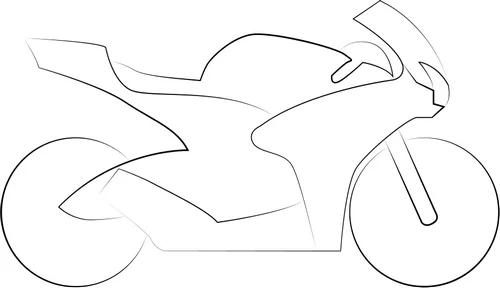
The result is a true identity. It's not shy about taking on the machines of the "nice" mid-size sports car segment. A semi-militarized zone where the recipe for creating a model is pretty much the same everywhere. Whether it's the GSX-8R, CBR 650 or Ninja 650, they're all based on a roadster to which a fairing has been added and a few components tweaked. Basically, the outfit is changed for the same performance, but with a more racy look.
Triumph goes much further. For a start, the Daytona 660 is not going to join the same sports club. The little three-cylinder no longer has the same desires. A visit to the engine-makers gives it 17% more power and 9% more torque. Wow! That's a lot!
For a little perspective, let's take a look at the MT-07 and the R7. Whether you ride one or the other, it's 73 horsepower.
Let's switch to England, where the Trident offers 81 horsepower. Switch riders and you're off to a 95hp start. This healthy dose of watts is completely unleashed at 11,250 rpm. Surprisingly, the red zone is still a long way off, at 12,650 rpm. There's no doubt that the 3-cylinder could still send a few more nags our way. But by keeping to 95 horsepower, the Daytona preserves its A2 compatibility.
With 69 Nm instead of 64 Nm, maximum torque marks a less spectacular but also highly appreciable improvement, with 80% of its power available after 3,125 rpm.
To achieve this very significant increase in power, Triumph modified the crankshaft, camshafts, cylinder head and pistons, and then took the opportunity to touch up the gearbox a little. A new exhaust system also makes a difference to the voice of this revitalized 3-cylinder. The Torque Assist clutch is back, to ease lever effort and calm rear-end slippage on hard deceleration.

In the Daytona, the engine doesn't show its grunt right away. It follows the mood of the Trident's block until the beginning of the mid-range, and then starts to emancipate itself at around 6,500 rpm. But it's really after 7,500 rpm that it shows its difference and takes off.
Aware that riders are going to be asking for more effort and a faster pace, the Daytona also revamps its front end. The 41 mm Showa inverted fork has been upgraded from the SFF model to the large-piston SFF-BP, while the brake calipers are now radial, doubling the number of pistons in action. Look how Triumph has "cleaned up" these 4-piston shoes, leaving only its logo in evidence. The front brake discs are the same diameter (310 mm), while the rear is reduced from 255 mm to 220 mm.
The tubular steel perimeter frame remains unchanged, as does the steel swingarm. This is where the Daytona loses points of nobility compared to a pure sports bike, and cannot proudly raise its chin to the 675 dynasty. There are no beautiful aluminum parts, no suspension adjustments at all levels (only preload at the rear), no top-excluded dashboard. With such an iconic name, were you expecting a TFT display like the Street Triple Moto2?

instead, you get the 660 Tiger trail handset. A little LCD at the top, a dose of TFT at the bottom... The info's there, but not the distinction. Disregarding it will be tricky, given that the rider will regularly have this vision right under his nose. Between the plastic and the data, the thumb will have the choice of the machine's character. The 660 Daytona comes with three Driving Modes, affecting throttle response and traction control levels. The "Rain" and "Road" Modes are taken from the Trident, with the addition of "Sport", a fitting choice for a bike with such an ambiguous name. Traction control can be switched off as required.
The shifter has not been invited to the resurrection. You'll have to go through the options to get it. A casino zone where you'll also find Triumph's connectivity system for controlling your smartphone (and accessing music, turn-by-turn guidance, etc.), heated grips, a USB socket, a tracker, tire pressure, a seat cover..
It's clear, and all the better for it: there's a world of difference between the Trident and the Daytona. Anyone worried about getting a roadster in a new outfit will be reassured to discover a bike that's far sharper than the roadster. Enough to whet the appetite for a battle where the imagination sows vibrators on the road.
On the other hand, it's essential to remember certain facts, such as weight. The Daytona 2024 comes in at just over 200 kg, with just one extra unit..... Whereas the last-generation 675 cm3 model weighed in at just 184 kg, with 128 horsepower. So, yes, it's important to show that there's also a gap between two Daytona chapters. It has changed because the world is changing, not as purists would have it.

the new Daytona, unlike its 675 predecessor, is not a Supersport but a sports bike. Are these just words? Much more, and well weighed. The former was all about pure performance, and didn't hesitate to take on the R6 and 600 CBR; today's Daytona isn't about time, but about sport. Targets: Suzuki GSX-8 R, Yamaha R7 and Aprilia RS 660. Or even the Honda CBR 650 R and Kawasaki 650 Ninja. The contours of this new world are shaped not by the stopwatch, but by market figures.
M.B - Manufacturer's photos
by Greg

 Share
Share
Key facts Triumph 660 Daytona (2025) : What you need to know before you buy
Highlights
- power-enhanced 3-cylinder
- Sporty face
- Better front axle
Weak points
- Far from being as sharp as the old Daytonas
Prices
| Basic version | |
|---|---|
 France France |
9,795€
|
 Luxembour Luxembour |
9,995€
|
 Belgium Belgium |
9,995€
|
 Germany Germany |
9,795€
|
 Italy Italy |
9,795€
|
 Spain Spain |
9,995€
|
 United Kingdom United Kingdom |
£8,595
|
 Switzerland Switzerland |
10,295CH
|
 United States United States |
$9,195
|
 Portugal Portugal |
9,895€
|
Performance
- Max speed : over 230 km/h (142.90 mph)
- Average fuel consumption : 4.90 liters/100km (0.48 mpg)
-
Estimated range
: 286 km (178 miles)
Calculated range until tank is empty, not verified.
Specifications Triumph 660 Daytona 2025
- Chassis
- Frame : Tubular steel structure
- Fuel capacity : 14 liters (3.70 US gallons)
- Seat height : 810 mm (31.89 in)
- Length : 2,084 mm (82.05 in)
- Width : 736 mm (28.98 in)
- Min height : 1,145 mm (45.08 in)
- Wheelbase : 1,425 mm (56.10 in)
- Weight when fully loaded : 201 kg (443 lb)
- Front axle
- Reverse telehydraulic fork Ø 41 mm, Wheel travel : 110 mm (4.33 in)
- Braking 2 J.Juan discs Ø 310 mm (12.2 in), radial mounting, 4-piston caliper
- Front tire : 120 / 70 - 17 → Order this type of tire
- Transmission
- 6 stage gearbox , manual - optional shifter
- Secondary by chain
- Rear axle
- Mono-damper, Wheel travel : 130 mm (5.12 in)
- Preload adjustment
- Braking 1 J.Juan disc Ø 220 mm (8.66 in), single-piston caliper
- Rear tire : 180 / 55 - 17 → Order this type of tire
- Motor
- 3 cylinders online , 4 strokes, set at 120°
- Injection
- Cooling system : liquid
- 2 ACT
- 4 valves per cylinder
- 660 cc
- 95 ch (93.70 hp) to 11,250 rpm
- 7.10 mkg to 8,250 rpm
- Power-to-weight ratio : approximately 2.01 kg/ch
- Weight / torque ratio : approximately 26.54 kg/mkg
- Compression : 12.05 : 1
- CO² emissions: 113 g/km
- Standard equipment
- Brake assist : ABS
- Number of riding modes : 3
- Aluminium rims
- Gear indicator
- Traction control
- Anti-slip clutch
- Practical information





Maintenance
The engine may fail due to internal damage from a disruption of oil flow, which could increase the risk of an accident.
Information source du rappelModels
2025


2024


Used


Compare the 660 Daytona to its competitors
Price
Acceleration
Fuel consumption
Range
Torque
Power
Power-to-Weight ratio
Torque-to-Weight ratio
Speed
CO² emissions
FAQ Your frequently asked questions about the 660 Daytona 2025
- What is the power of the 660 Daytona 2025?
-
The 660 Daytona 2025 develops a power of 95 ch (93.70 hp)
- What is the torque of the 660 Daytona 2025?
-
The maximum torque of the 660 Daytona 2025 is 7.10 mkg to 8,250 rpm.
- What is the maximum speed of the 660 Daytona 2025?
-
The 660 Daytona 2025 is capable of reaching a top speed of over 230 km/h (142.90 mph) on the track.
- What is the weight of the 660 Daytona 2025?
-
The 660 Daytona 2025 has a a weight when fully loaded of 201 kg (443 lb).
- What is the fuel consumption of the 660 Daytona 2025?
-
Average fuel consumption is estimated at 4.90 l/100km (0.48 mpg) according to the WMTC cycle.
- QWhat is the seat height of the 660 Daytona 2025?
-
To ensure good accessibility, the 660 Daytona 2025 offers a minimum seat height of 810 mm (31.89 in).
- What is the price of the 660 Daytona 2025?
-
The price of the 660 Daytona 2025 is £8,595 in United Kingdom. It is displayed at $9,195 in the United States, at 9,795€ in France, in Germany, in Italy, at 9,895€ in Portugal, at 9,995€ in Luxembour, in Belgium, in Spain and at 10,295CH in Switzerland.
- What colors are available for the 660 Daytona 2025?
-
For the 2025 model year, the 660 Daytona is available in several colors: red, white and grey.
News
-
New motorcycle products for 2026

-
Bridgestone announces the RS12, its new road-race weapon.
-
Yamaha Race Like A Girl: Natalia Rivera in episode 5.
-
Bridgestone presents the Battlax V03, its new slick tire.
-
With Sartoria Meccanica, MV-Agusta aims to go beyond premium.
-
Upgrading the entire Bonneville family for 2026.
-
Metzeler unveils three new tires at EICMA.
-
World Superbike celebrates 70 years of Yamaha.
-
Exceptional: some thirty new Triumphs in 2026.
-
40.000 bikers for the Royal-Enfield "One Ride" 2025.



Bikers' reviews Leave a review - 3 reviews
A little disappointed by the new Dayto, but of course we're leaning towards modesty and a global vision of a changing world. But at least the mid-size "sport" segment isn't dying. Rating : 4/5 Respond to khwaja